I’m starting a new idea for the blog called Weekend Writing.
Weekend Writing is an experiment for me to try to write more often. Some posts may be about things that I don’t think merit a full article, or may be me talking about games I’ve recently played in an attempt to play more games than I usually do.
There’s no guarantee every weekend will have a Weekend Writing post, but I hope I can stick with this idea for a while.
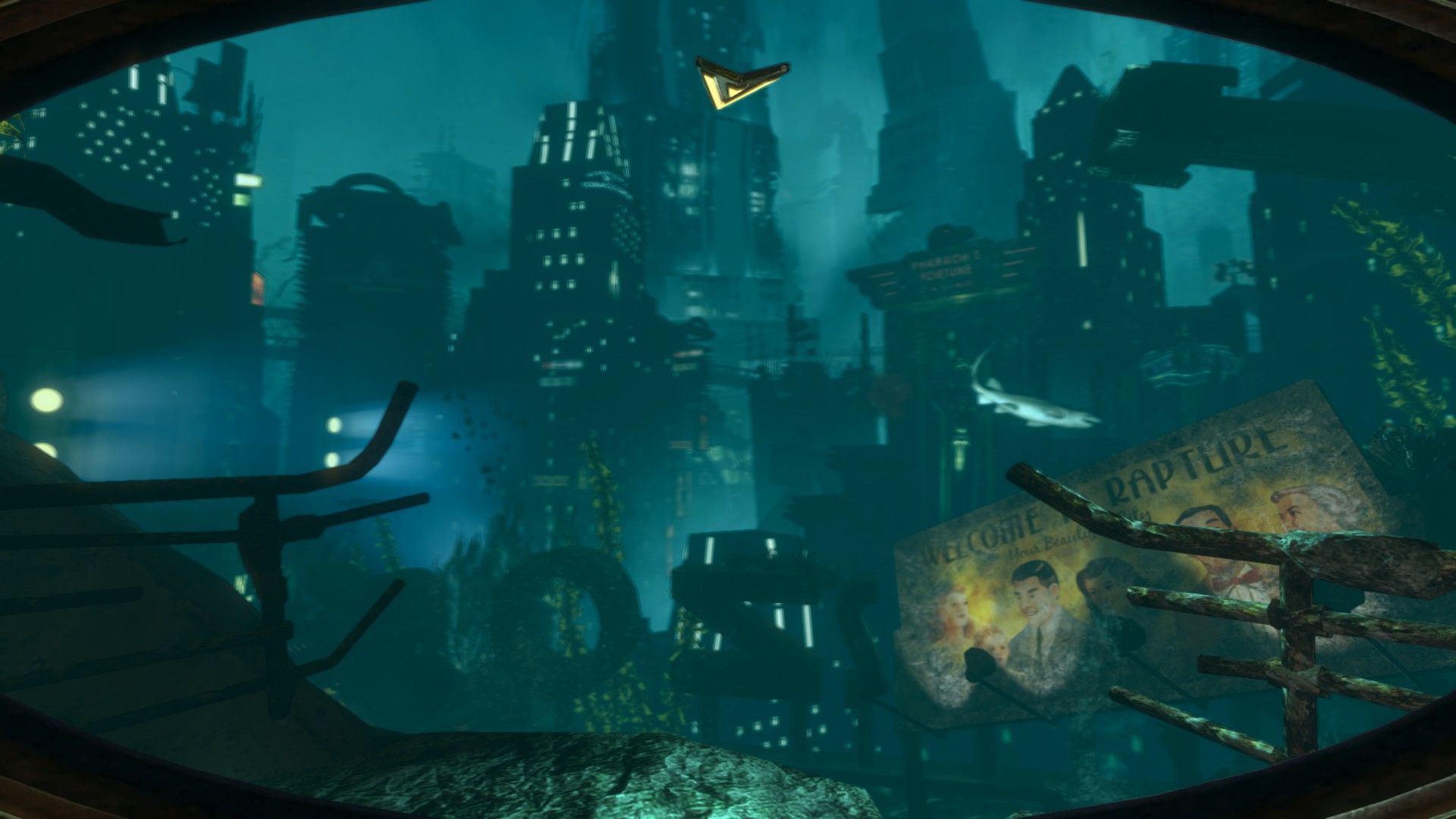
This still looks pretty good years later.
As of this writing, I finished BioShock 2 Remastered. Part of BioShock: The Collection, it’s one of those fancy HD Remasters that was released for the current generation of platforms and PC. I had finished BioShock Remastered back in 2016, not long after beating BioShock 2 for the first time. Since it had been a few years, I figured it was time to go back to it, just to have something to play in the meantime, and to see if my opinion has changed on the first two games.
Something I didn’t know until looking through my screenshots for this and the original: This credits sequence is different in the remaster. Looks nicer than the original.
I say first two because despite buying it way back in 2014, I still haven’t played BioShock Infinite. Maybe some day.
BioShock is a pretty cool series. A stylistic art deco first-person shooter with skills, hacking and magical abilities; the game came out in 2007 to universal acclaim, some putting it on their “best of all time” list. I’m not one of those people, though I do consider it to be a solid game.
Shout out to the artists at Irrational and 2K Marin for making a cool world to look at *and* roam around in.
BioShock shares several elements with System Shock 2, considered a spiritual predecessor to BioShock. Fitting considering both were developed by Irrational Games. Stripping away the futuristic space motif for Rapture’s 1950s look was a wide decision as it gave them a fresh, unique environment to work with. BioShock’s look and feel is something I haven’t seen in a big budget game before or since, the closest is maybe Fallout. I’m surprised this style didn’t get ripped off more.
About three years ago, I had won a free year of Loot Crate through reasons I don’t really remember these days. For the first couple of months, I started writing about them as part of “The Crate Chronicles,” documenting these goofy little things. They stopped in early 2016 because I lost interest. Among other things.
The biggest problem I had – and this is not the fault of Loot Crate – is that these were often for things I had no interest in. The Avengers. Star Wars. The Walking Dead. All those TV shows and movies that are “the in-thing” at the moment. I’m so out of touch when it comes to that stuff that I can’t even feign interest. When it had something video game related, however, I was a bit more hyped.
I ended up getting the full year and let it lapse, because the monthly costs for junk I don’t really need wasn’t worth it, for the reasons mentioned above. By then, I think they expanded to other crate types, including one that was specifically about video games. But again, cost. On the bright side, at least I didn’t get a loot crate with an inflatable crown in it.
(Kanye West’s “POWER” starts blaring in the background)
All the Loot Crates eventually got stored away, along with a bunch of other things. But one thing made the rounds on social media lately that made me think “Hey, wait, didn’t I get that item in a Loot Crate once?” And sure enough, I did. We’re gonna talk about it, as well as the other things in there. Strap in, as I cover May 2016’s Loot Crate. Three years (and a month) to the day.
Hulk SMASH… this thing, whatever it is
The Incredible Hulk Qfig
Oh hey, a figurine based on that big green dude who punches things. Made to advertise Avengers: Age of Ultron, it’s a nice, stylized figurine of The Incredible Hulk doing his patented Hulk Smash on some poor building. The style is a bit more cartoonish than the film it’s based on, which is a good choice.
I don’t have much else to say about this one. It’s a neat figurine, but I have no space in my house for something like this. At least it’s not a Funko Pop.
I wonder why hes wrapped around that thing…
Dragon Ball Z Shenron plush keychain
You can add Dragon Ball Z to the list of “things I haven’t watched.” Well, maybe I watched it when I was a teenager on Toonami or something, my memory’s foggy on that front. Was that the version that had the “Rock the Dragon” theme song? I forget.
Anyway, it’s Shenron, that dragon dude wrapped around a dragon ball. Like in the intro and a handful of episodes. It’s nice and squishy. It even has a hook to place on your bag or on an actual keychain. It looks pretty neat, and I’m not even a fan of the series.
Now that I think about it, maybe I should’ve listened to All Systems Goku. That could’ve gotten me interested in this silly Dragon Ball stuff. It’s certainly better than what I watch these days.
(CONTENT WARNING: This post will go briefly into serious subjects, such as cancer and death.)
My mom was into video games for a really long time. Played the Atari 2600 before I was born, played stuff like Super Mario Bros. 3, Monopoly, and Sonic the Hedgehog 2 when I was young; we were both also hardcore You Don’t Know Jack fans, owning practically every edition that came out. She was really into fairly casual games, such as when DirecTV had a channel specifically for playing casual puzzle games. FarmVille 2 was something she was really into in the past few years.
By the time the Nintendo 64 came around in the mid ‘90s, the complexity of Super Mario 64 alongside the bizarre three-prong controller pushed her away from most console video games until we got a Wii in 2009. She still played Jack and the aforementioned casual games, but nothing particularly complex.
Yet out of the many games she played, there was one game, a 16-bit classic, that she was really into, one that you wouldn’t expect considering the other games I mentioned. That game was the wonderfully Jammin’ ToeJam and Earl.
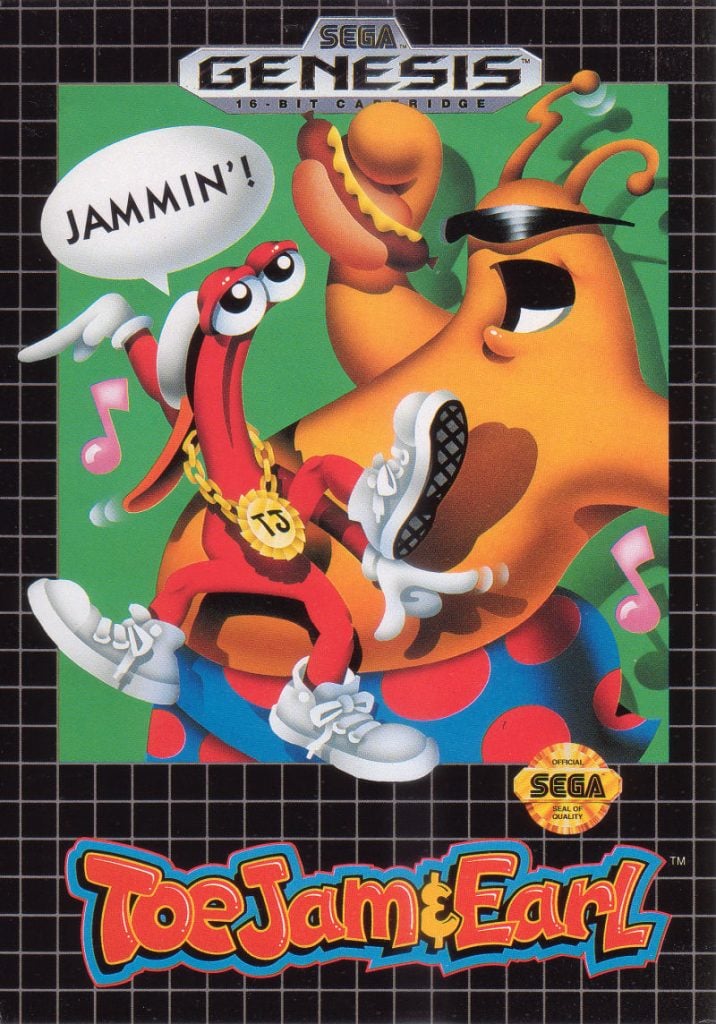
This was a pretty dope cover for a Genesis game like this.
An exploration-based game where the titular ToeJam and Earl travel through various areas on planet earth to recover the pieces of their destroyed ship, ultimately to get back to Planet Funkotron. This was developed by Johnson-Voorsanger Productions, a couple of guys who had previously worked at Toys for Bob on the Star Control series of games.
A typical journey through the game.
ToeJam and Earl on the surface is a fairly simple game: Find ship pieces in specific levels without running out of lives from various hazards. Yet there’s also a bit of complexity: one could play with a fixed world of 25 stages, or a random set of levels that could be a cakewalk or a punishing challenge. Along the way, our heroes must avoid the aforementioned hazards such as bees, crazy dentists and hula girls while finding the elevator to the next floor. The two also have presents they can open to give items that could help or hinder progress, from defensive weapons like tomatoes and rose bushes to hazards like school books, rain clouds, and present randomizers.
Since the elements of presents and ship pieces could change from game to game, ToeJam and Earl is practically a rogue-like, where not every game plays the same. Pretty damn impressive for 1991.
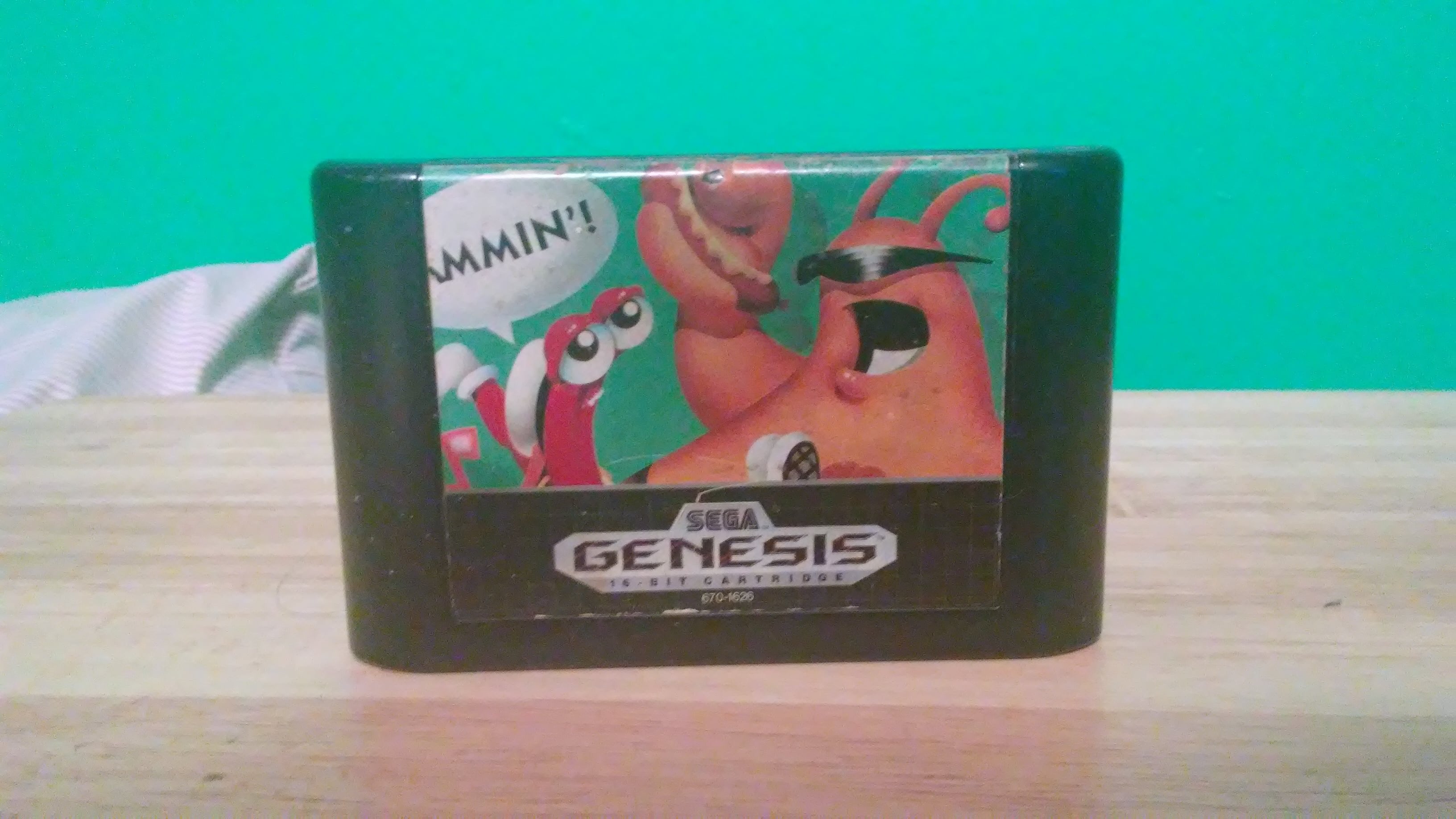
This battle-worn copy we have came from a Blockbuster Video. They even imprinted the store name on the back of the cartridge. It’s a nice memento considering the fading relevance of Blockbuster Video.(more…)
I’m probably gonna show my age with this one. While I don’t think I’m one of those “30 year old boomer” types that people meme about these days, I certainly have been playing multiplayer games for a long, long time. I’ve been playing them for literally decades at this point. I’ve played most of the notable ones, like Quake, Unreal Tournament, Counter-Strike, Call of Duty 4, you name it, I’ve probably dabbled in it at some point.
But sometimes I wanted more than Just Deathmatch. Stuff like Capture the Flag or Domination helped, but it just wasn’t enough. There was one mode popularized in a game that really caught my interest and was a fun mode that I wished more games did: Unreal Tournament’s Assault mode. Seriously, why isn’t this in every game???
Kidding aside, the other game mode that I’ve learned to love over the years is Gun Game. A simple deathmatch variant, the goal is mainly to kill enemies with a specific weapon, leveling up to the next weapon, and repeating this process until a player got a kill with every weapon. It’s been around for a while, and any game that features it will certainly pique my interest.
My earliest experience with the gun game concept is Soldier of Fortune. While mostly known for its excess gore and goofy Hollywood story, SOF did have its own version of Gun Game. The mode was simply called “Arsenal.” This was before the “gun game” parlance became commonplace.
Getting a kill in Soldier of Fortune was satisfying. Not because of the gore, but because of a really goofy fanfare that played each and every time. That needs to come back.
Despite the different name, it’s similar to the gun game most of us know now: A set of weapons are given to every player, with the goal of getting one kill with each weapon to win. The big differences that there was no fixed pattern of weapons, and when someone got the final kill with their last remaining weapon, instead of ending the game, they got a “big winner bonus” score and the game started anew with new weapons until the score or time limit was reached. Good for those who end up with a bad layout of weapons and can hope to rebound on the next set.
Though while I remember playing Arsenal in the mid-2000s, when the original Soldier of Fortune was mostly a skeleton crew of hardcore players by that point, the one I remembered more fondly was Counter-Strike: Source’s gun game mod.
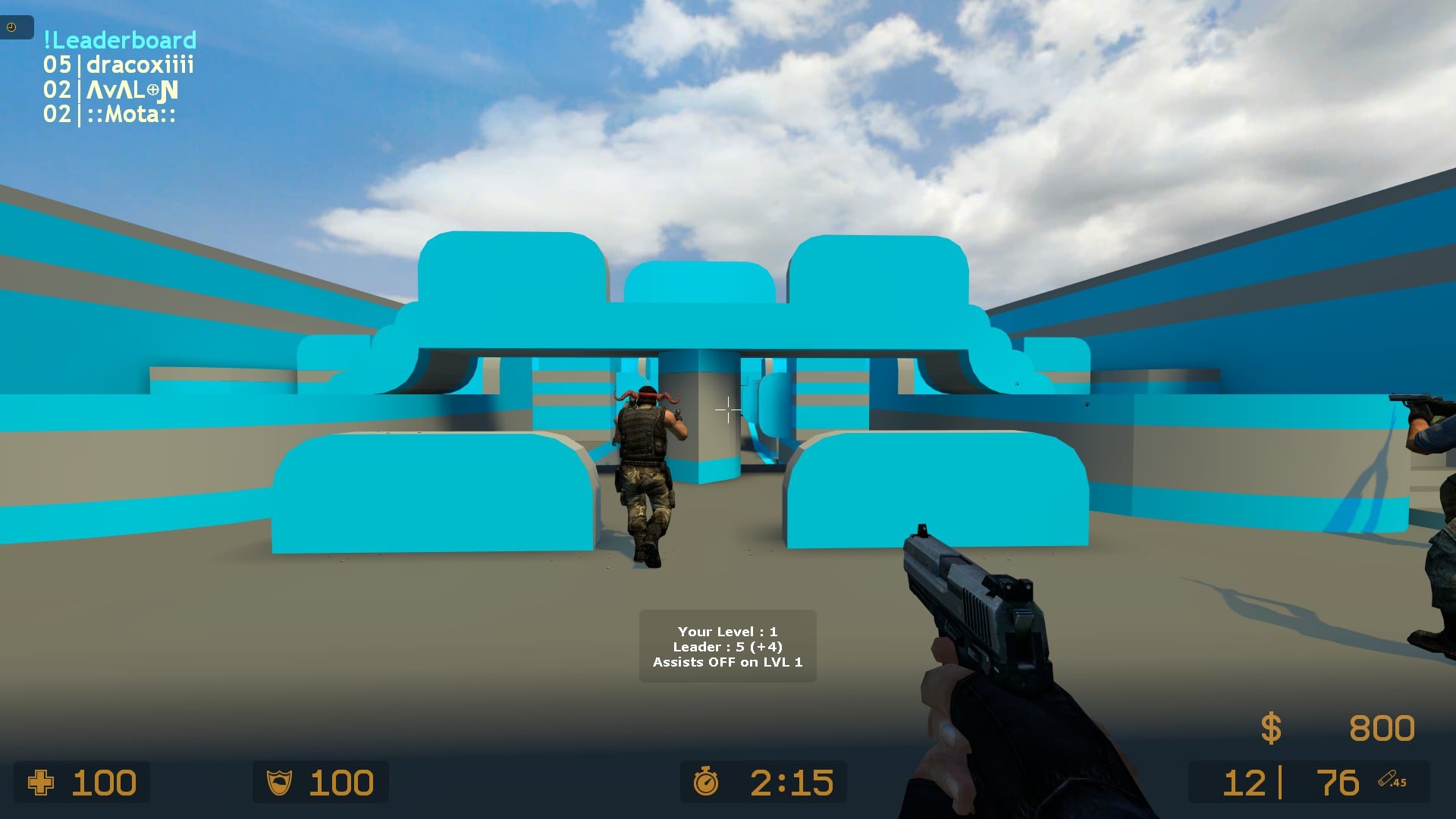
Man, cs_deagle is a map I’ve seen constantly used in these kind of modes. Surprised no one’s copied it.
In the gun game mod for CS:S, the goal is to take out enemies of the opposing team with one of each weapon, with the famous knife often being the final level. Regardless of whatever side you were on – Counter-Terrorists or Terrorists – you needed to get a kill with every weapon. So in addition to the weapons that are available to a specific faction in the regular game, CTs still had to get kills with Terrorist-exclusive weapons like the Galil, MAC-10 and AK-47, and Ts needed to get kills with the CT’s USP, M4A1 and the AUG, just to name a few.
When it comes to video games based on existing TV shows, game show video games rarely ever get talked about. If they do, they’re often relegated to brief blurbs with ridiculous arguments like “why play this when I could watch the show?”, missing the whole point.
There’s been several dozen versions of Jeopardy! and Wheel of Fortune – most recently for the Switch, Xbox One and PlayStation 4 – with Family Feud not too far behind. There’s been a handful of games based on The Price is Right, Deal or No Deal and Who Wants to be a Millionaire?
But then there’s shows that somehow got 1-2 games, despite not being that well-known. Now You See It, Win Lose or Draw, Fun House… Even 1 vs. 100 got a few games, which as time went on has been remembered more for being an interactive Xbox Live experience more than being an Actual Game Show.
One of these lesser-known game shows that got the video game treatment is High Rollers.
I’m more a fan of Hair Rollers, myself…
High Rollers had a few runs over the years: Fairly popular runs from 1974-76 and 1978-80 with a pre-Jeopardy! Alex Trebek, and a short-lived revival from 1987-88 with Wink Martindale. Created by Merrill Heatter and Bob Quigley, who had done similar gambling-like game shows such as Gambit. Oh, and a little-known show called Hollywood Squares.
While there are more comprehensive places on the internet that’ll cover all the rules, the game basically goes like this: Two players compete to answer questions to roll a pair of dice, and knock numbers off – one each of 1 through 9 – to win prizes while avoid getting a bad roll. Winner of the match plays the Big Numbers – where there’s no questions, only dice rolls – for a chance at $10,000 big ones. It’s basically the classic board game Shut the Box but with gambling and quiz show elements.
For being called “Box Office,” they weren’t a big success.
Box Office, a budget publisher of computer games, developed and released this game. They didn’t do very many computer games, the only other standout games are A Personal Nightmare, a horror game featuring Elvira; and games based on ALF, The $100,000 Pyramid and, surprisingly, Psycho. Lord knows how making one of Alfred Hitchcock’s iconic films into a video game even works, but that’s not the weirdest “movie into a video game” I’ve ever seen.
Wink looks a bit… concerned here.
There are multiple versions of the game, but for the sake of this article I’m covering the DOS version. You’ll see why in a moment.
After being flooded with a litany of PC Speaker sound effects at the main menu, the visage of host Wink Martindale appears, in all his CGA glory. His smiling mug is on the box and in all versions of the game, but the DOS version here has the best one because of the CGA color scheme. This is the only time you’ll see Wink, as you only see his back during actual gameplay. After seeing a very plaintext menu option, you’re whisked away to start buzzing in and rolling dice.
If there’s one thing I need to improve on in my life, it’s to write something in the moment. I’ve bought plenty of games, played a bevy of mods, grabbed other assorted things for potential blog fodder…
Then I do nothing with it. This has happened more often than not, but only because I get the problem of being an ideas person and rarely act upon them. I’ve been slowly improving on this front, at least more than I was years ago.
Which brings me to this post about a game mod. I played this on a whim back in 2018, and thought it was pretty neat. While I’m currently wrapped in a few other things right now, I thought I’d write something quick for this month.
A few years back, I wrote an article praising the wonders of Red Book CD audio. CD audio tracks that would play in certain games, fromPC classics like Half-Life, to even Sega CD games like Sonic CD. Unfortunately, modern technology is not too kind to the concept, as it often struggles to work properly on modern devices. In some cases, digital re-releases of games like Starsiege: Tribes didn’t even come with the CD music, removing part of the ambience.
There have been solutions thanks to source ports and game updates. For instance, playing Half-Life on Steam has all its music files as MP3s, so if the game (or a related mod) calls for that CD track, it’ll play it without needing the CD.
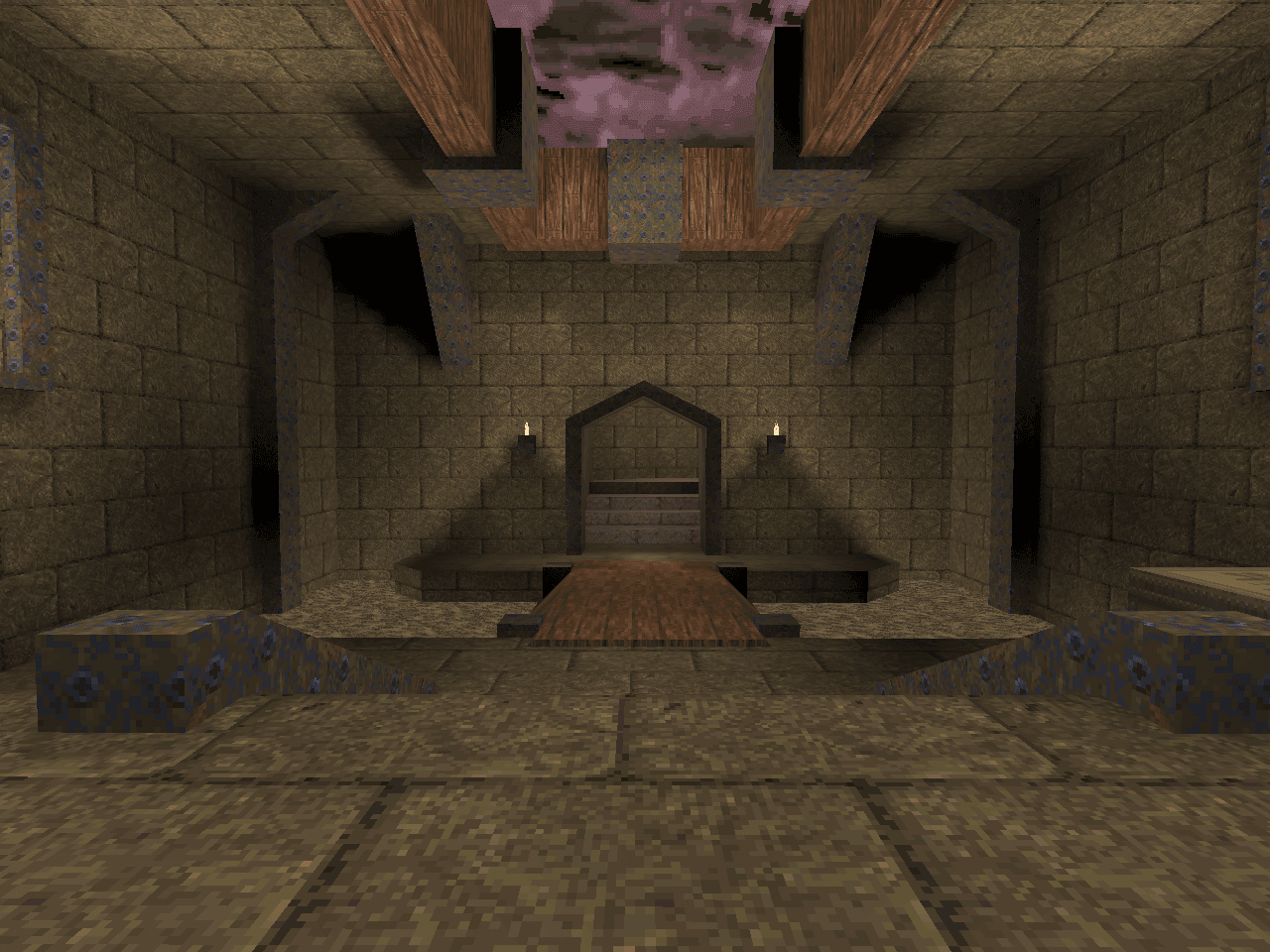
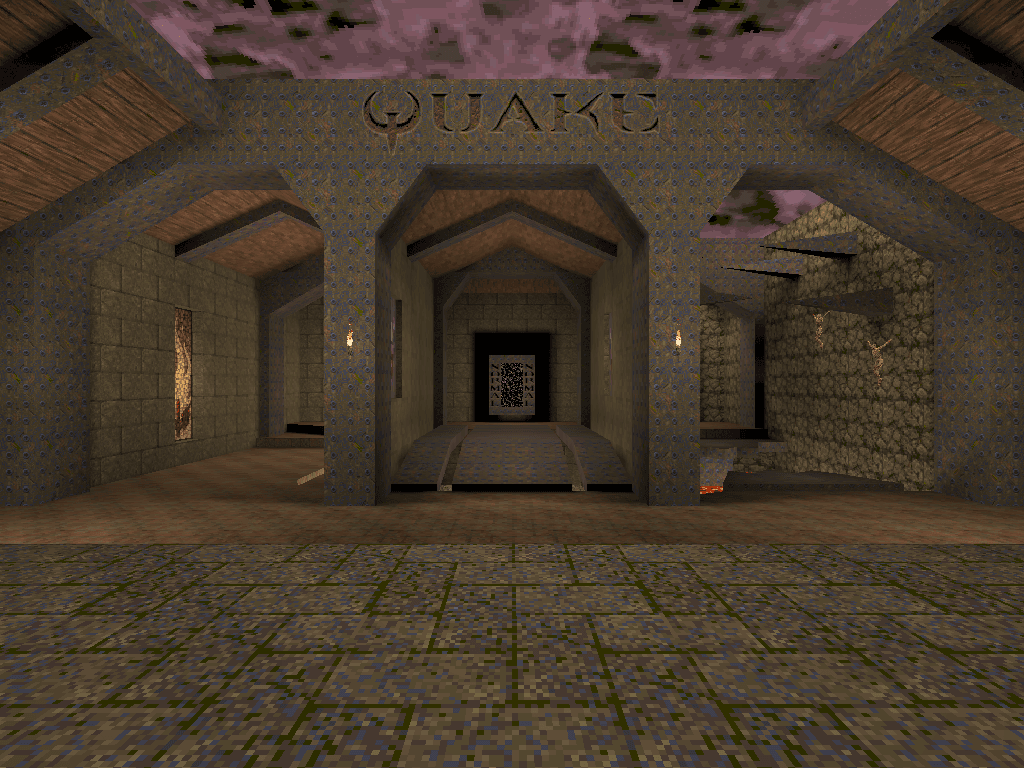
Looks just as good as it did in ’96.
Which brings me to a classic in Red Book audio: Quake. One of the earliest PC games to use it, popping in the CD would fill your ears with weird ambient music by Trent Reznor and his band Nine Inch Nails. Modern source ports such as Quakespasm actually support playable CD tracks in MP3/OGG formats, which means one can rip the soundtrack from their copy of Quake – or just find it on the internet, I doubt id and Zenimax care these days – and play it easily, proper looping and all.
There’s a handful of Quake map packs that come with custom soundtracks tailor-made for the level pack, such as Travail. Others outright replace the Nine Inch Nails soundtrack with different ambient tracks, like EpiQuake or Quake Epsilon. But what if I told you someone replaced Nine Inch Nails music with Nine Inch Nails music?
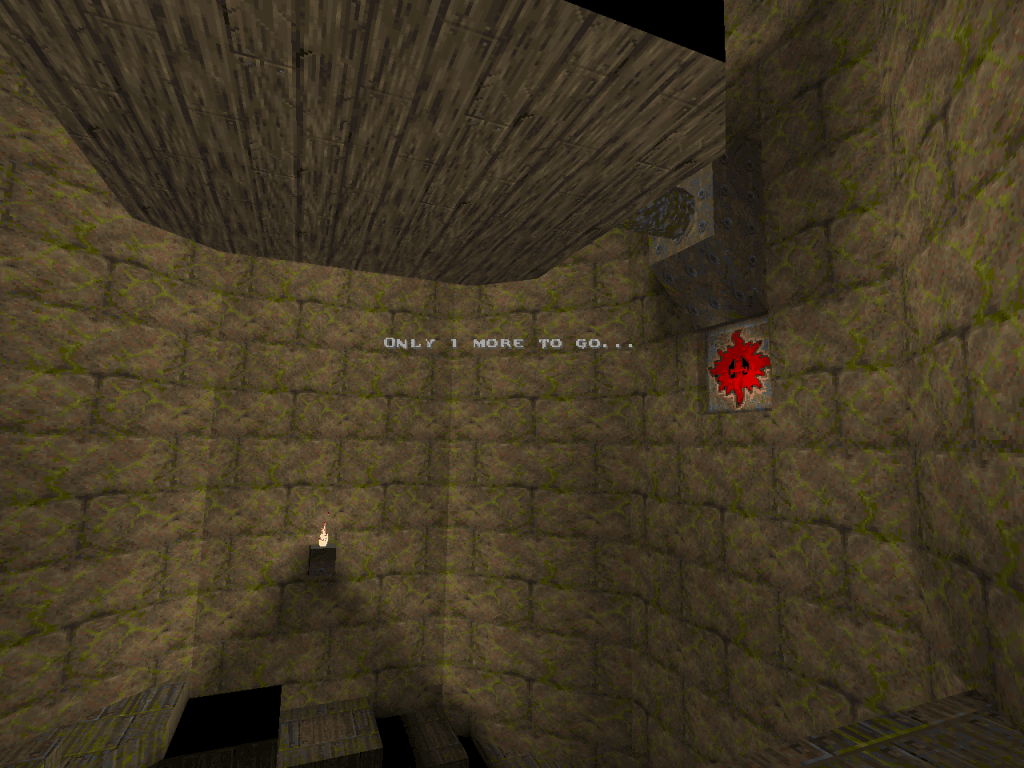
Ha! Now I won’t be burned by hot slag. Take that! (Oh wait, now I can’t get out…)
“Ghosts I-IV for Quake” is an interesting mod. Replacing the original 1996 soundtrack with the entirety of Ghosts I-IV, an album by Nine Inch Nails with nothing but ambient instrumentals seems like a good fit. In a sense, Ghosts I-IV is a spiritual successor to the original Quake soundtrack, even if there’s little similarities in style.
The album itself is interesting: Frustrated by their record label, Trent Reznor severs his contract with Interscope Records and decides to go independent – for a while anyway – and released this under a Creative Commons license. This license is how the mod exists without lawyers getting involved, as it’s a free mod for a commercial video game.
Shooting switches with the power of magic pellets!
There is one other feature of this mod: There’s no monsters or weapons. Now there’s mostly empty levels with switches, lifts and other assorted things, but nothing to shoot. With god mode turned on. In a sense, this changes the perspective of the game entirely. No longer a straight explosive romp, it’s strictly an exploration-based affair.
Welcome to the first Secret Area post of 2019. Here’s something that was several months in the making. This was mostly due to procrastination. Naturally, I’m writing about a game I finished last year, two days short of a year after I had beaten it. And it’s a callback to a post I made last June. Let’s do this.
Last year, I had written a somewhat scathing review of the 2010 Medal of Honor reboot, which took the legacy of a long-standing WWII FPS franchise and basically ruined it by being a Call of Duty 4: Modern Warfare copycat. You can check that post out here. At the end of that post, I had hinted towards a game that I had said was just as close to the original Medal of Honor games.
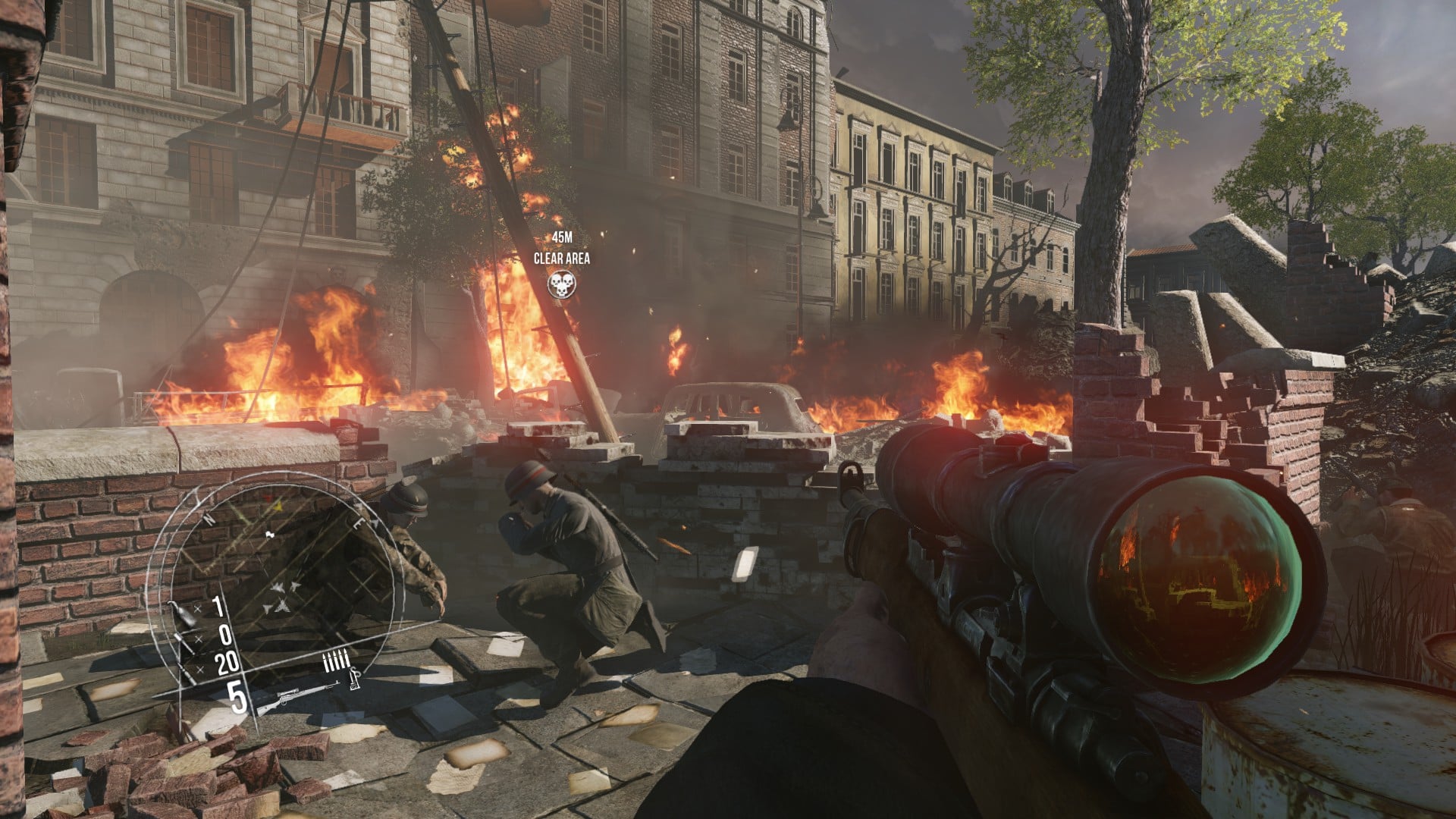
Okay, it’s a bit of a stretch, but it is a World War II FPS, and surprisingly a decent one at that.
Enemy Front was a shooter released in 2014 for various platforms, including PC. Released by CI Games, it was a fairly unknown budget shooter in an era where those kind of shooters were slowly disappearing due to the drought of retail games as well as the prevalence of Steam making it a newer (and cheaper!) haven for the cheap schlock of the past.
I had heard of it thanks to a certain YouTube personality. Ahoy – later a maker of wonderful flashy documentaries about Doom, Half-Life, the Amiga, and many others – had done a video chronicling the arsenal of Enemy Front. He had done similar videos before for Call of Duty and other franchises, and would later be revised to an all-purpose format with his Iconic Arms series of videos. I’m still waiting for the new season of Iconic Arms, just to see what games he uses as an example for the weapon he’s talking about.
Though, it wasn’t just a British YouTube personality talking about a budget polish-developed FPS’s weaponry that got me to snag Enemy Front. It was also dirt cheap on a Steam sale. All it takes is something to be under $5 and you’ve caught my interest almost immediately.
Broadcasting your war diaries doesn’t sound like a good idea to me.
Enough preamble. Let’s get to the meat and actually talk about Enemy Front proper. You play as American journalist Robert Hawkins as he reports the stories of a resistance front all around Europe. Hawkins’s voice sounds familiar to me. There’s no voice cast in the game itself, and IMDB only gives a brief unconfirmed list. I swear I heard him in that infamous Duty Calls game I also wrote about long ago, but there’s no proper credits for that one (or for Enemy Front).
Later meeting up with resistance fighters, Hawkins must stop the Nazi menace in various locales around Europe, including during the Warsaw Uprising. A fair share of the game takes place around that Polish conflict. It’s fitting, considering developer/publisher CI Games is based in Warsaw, Poland.
Human shields are a good way to be threatening. Until they realize you just grabbed some expendable low-ranking goon.(more…)
Over the years I’ve written about games, I end up writing about games from a certain genre, and that’s first-person shooters. It’s my genre of choice, with enjoyable action romps like Doom and Quake to more cinematic experiences like Call of Duty 4: Modern Warfare. Though for every Call of Duty, there’s a clunker of a single player experience, such as Homefront, which I replayed recently.
I tried to play this earlier this year, but then the US-Korean conflict was fresh in my mind, thus it felt like playing it would be in bad taste. Christ, 2018 feels like it’s been ten years long.
Homefront is a game developed by Kaos Studios, a development team consisting of people who made the popular Desert Combat mod for Battlefield 1942 way back when, were the ones who worked on this infamous game. Backed by THQ’s ambitious marketing campaign, the game had the chance to be something really, really interesting. Except it wasn’t.
Prior to Homefront, Kaos Studios only made one game: the middling Battlefield clone Frontlines: Fuel of War. After the lukewarm reception that game got, they soon were hard to work on a spiritual successor in Homefront. According to a retrospective over at Polygon, the game was meant to be strictly a multiplayer-only experience – which makes sense, considering the developer’s pedigree – but executive meddling caused a shift in marketing to add a traditional single player campaign, causing it to drown out the carefully crafted multiplayer they had made.
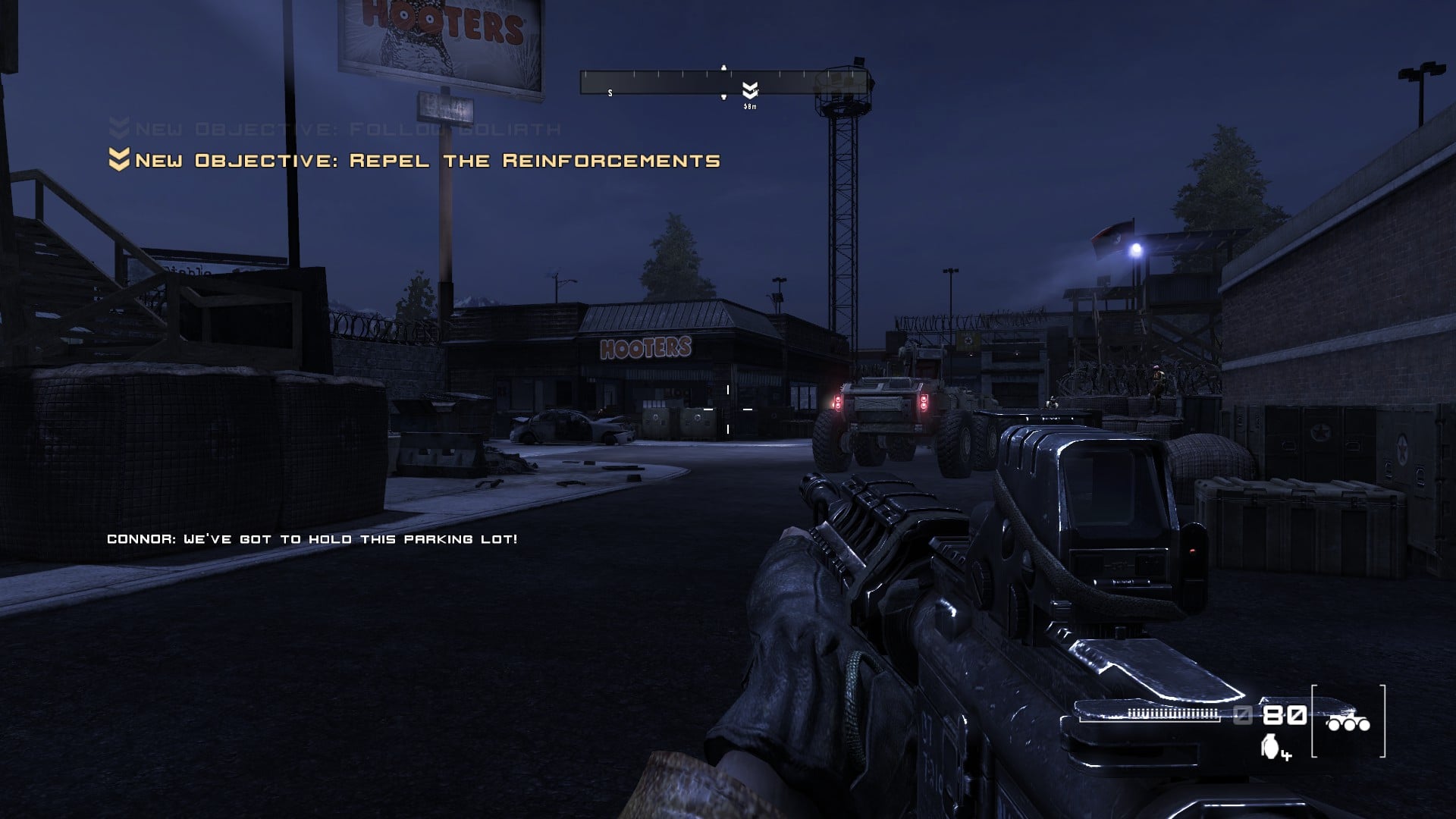
It’s hard to tell in this screenshot, but Connor here kept running in place, stuck on a rock. I had to restart the checkpoint to fix it.
I decided to replay this, on PC this time – my previous experience was through the streaming OnLive service around 2012 or so – and it hasn’t gotten any better. If anything, it’s much worse than I remember.
All Ghillied Up this ain’t.
Homefront’s single player campaign checks off every single thing Call of Duty did, but somewhat worse: there’s a section where you kick open a door and shoot everybody in slow motion like in Modern Warfare 2, a portion of a stage where you’re picking off enemies as a sniper as you infiltrate an enemy camp ala “All Ghillied Up” from Call of Duty 4, even a section at the very end has you using a CUAV drone to pick off targets on the Golden Gate Bridge much like a section in Modern Warfare 2.
It feels like someone up top at THQ said to Kaos, “Hey! Remember that thing that Call of Duty did? Do that!” and did so without having a say in the matter. A shame, really.
But that’s not what I’m here to write about. I’m here to write about the game’s product placement.
This screenshot, from Remedy’s Alan Wake, features product placement from Energizer, slightly breaking the immersion.
Product placement in video games is a sticky kind of subject matter. I can’t think of any recent game that used it effectively short of sports games, and even there it can get pretty bad at times. Homefront is littered with advertisements for so many brands that taints the atmosphere of the game, taking place in a modest town in the middle of the United States. For being part of “the resistance,” you sure see a lot of product placement.
Kaos Studios’ lead level designer once talked about using brands in their game, and how they were allegedly rejected by several companies in doing so. Though it sounded like there’s only a brand or two in the entire game, there are many, many more brands than what they say here. It also looks pretty ironic considering in this interview they condemn Infinity Ward for making Burger Town, a fictitious brand in Modern Warfare 2.
As I played through Homefront’s campaign, I started documenting all the brands I saw. Now I don’t think I got every single bit of product placement here, there’s likely a few I missed because there’s shockingly so many of them. I’m ranking them from the least offensive to the most egregious in the entire game. It gets pretty ugly in spots, so strap in.
Homefront starts with a section where protagonist Robert Jacobs – a successful graduate of the Gordon Freeman School of Character Development – is shoved onto a bus ostensibly to be retrained as an enemy fighter pilot. That gets stopped short by the supporting allies of the resistance, Connor and Rianna. Though it does give a glimpse of a few Pabst Blue Ribbon banners strewn throughout the city before the bus is flipped over.
Not long after Jacobs escapes, they slip through a certain restaurant chain – more on that later – and walk past a Full Throttle vending machine. An energy drink brand by Monster, it’s one of two brands they own that are featured in this game, the other being NOS, which shows up a little later into Chapter 3. Oddly enough, Monster itself is a no-show here. Guess they save the main brand for the real prestigious games like Call of Duty.
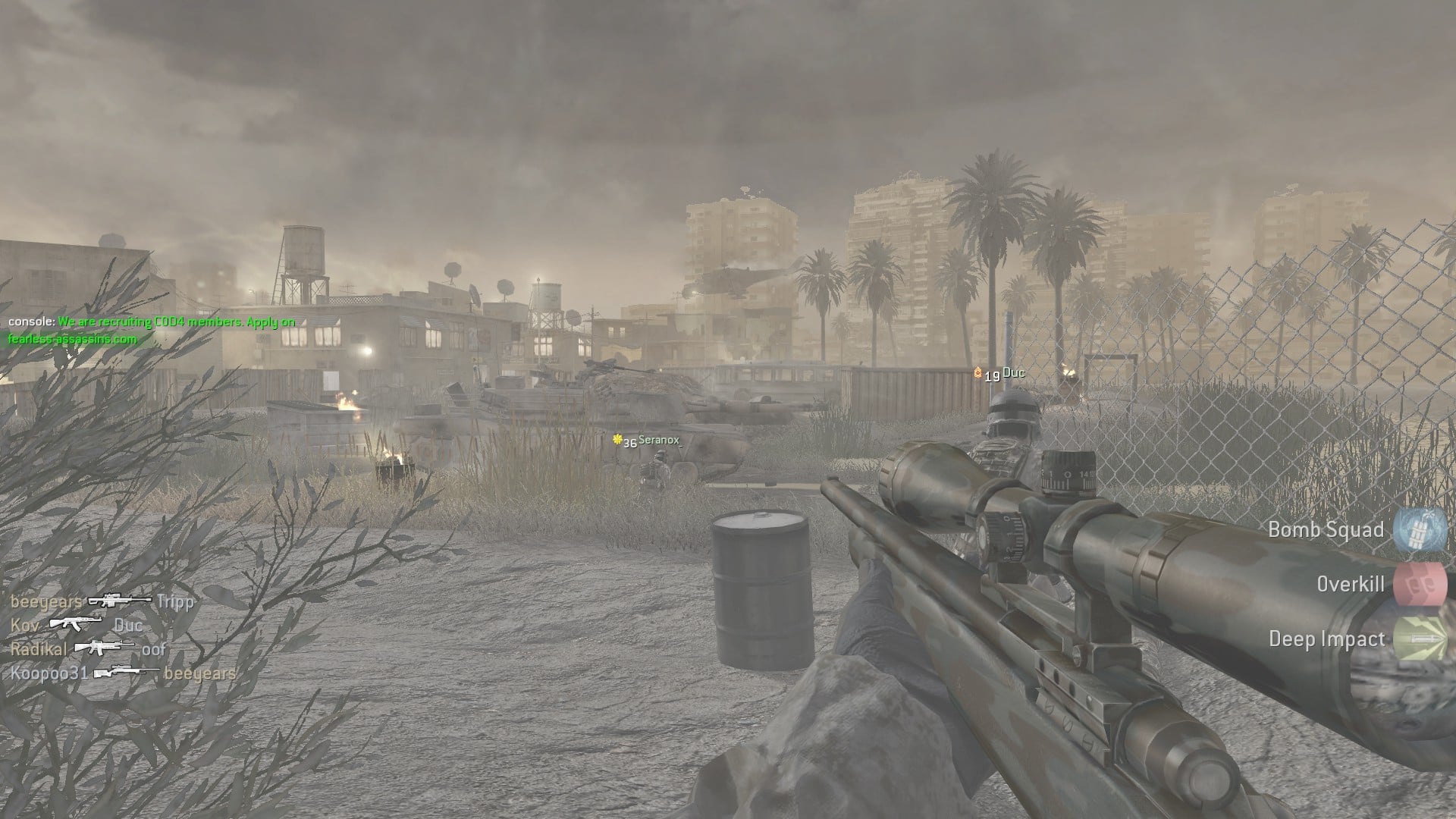
While playing on Bog, a dark, wide map filled with small gaps of cover and two small buildings ripe for camping, I noticed an enemy player’s been using the infamous “noob tube” – an M203 grenade launcher – to get easy kills. I decide to switch over to my sniper rifle build, with an R700 equipped, ready to pick off the offending noob tuber.
I then started sweeping around the map looking for enemies. I spotted enemies on the other side of the map and starting aiming down the scope and taking shots, occasionally moving to avoid being easily killed. I then spotted an enemy with a rifle and his grenade launcher prepped, and I nailed him in one shot. However, he had just shot a grenade before he died. A grenade that landed right on me. I couldn’t resist to type “good trade” in the chat.
The aftermath.
It’s 2018, and there’s people still playing Call of Duty 4: Modern Warfare online 11 years later. I had picked up the PC version of COD4 as well as World at War on Steam for $10 each. I had hoped they would hit the $4.99 sweet spot, but Activision doesn’t believe in the concept of making their games that cheap.
Surprisingly holds up even graphically.
Honestly, I didn’t need to buy these versions again. I already had both of those games on a console – hell, Call of Duty 4 was the first game I ever got for my PlayStation 3 in 2008 – but the PC version had a fair share of advantages that I wanted to check out. Plus I couldn’t resist replaying the campaigns to one of the best games in the entire series. (Black Ops would probably be a close second.)
First, I also wanted to look into the mod scene. There was a Star Wars-themed mod for COD4 calledGalactic Warfare that was making the rounds around 2009-2011, and it was kind of the reason I wanted to look into the PC version. Sadly, it seems the overall mod scene has died out, leaving me with just vanilla COD4 to play with. With Hardcore settings on, no less.
Hardcore makes it so there’s little HUD, and everybody’s a glass cannon. At least some of the weaker weapons prevail in this mode…(more…)
Alright, finally got to this. A few weeks late, but I was never known to be prompt on things like these.
So a while back, the Portland Retro Gaming Expo happened. On its twelfth year, it’s a convention that has retro arcade games, pinball machines, loads of booths to buy merchandise of various kinds, and panels about retro video games in some fashion.
Regrettably the past few years I’ve missed out on a handful of panels, but I’m grateful for at least checking out the Nintendo History Museum by the cool peeps at the Video Game History Foundation. I also bumped into my friends Weasel and Cass while during my roaming of the show floor, while also spotting a fair share of notable personalities here and there. (Weasel told me I was “right next to The Gaming Historian” at one point and I didn’t even notice.)
I’m at that point where I don’t really need many video games at this point, considering my burgeoning backlog. Yet against my better judgment, I did buy games for super cheap, trying to fill up my original Xbox collection and snagging a few cheap deals. But I also grabbed a few tech-based things during and after the expo, so let’s get to recapping.
$15:
A component video cable for an original Xbox ($10)
Xbox: Medal of Honor: European Assault ($5)
Okay, these were after the expo. On Sunday I had put a goal to find some video cables for some of my consoles because I felt they needed an upgrade. I didn’t find one of them, so I had eventually went to Video Game Wizards (the closest mom’n’pop game shop to me) and snagged some cables, as well as an Xbox game for good measure.
At this point, now I am able to play all of the early-to-mid 2000s game consoles in component video quality. I have component cables for the PS2 and Xbox, and I have a Wii with Gamecube backwards compatibility, which I also run through component.
I know there’s solutions now to get those systems to output in HDMI, but I feel that’s a bit excessive. Though, EON had a booth for an HDMI adapter for the Gamecube, which might be cheaper than trying to get the very expensive component cables for the system. If you’re going that route, check them out here, perhaps that’s a better option for those who have more recent TVs where it’s HDMI only with no other video inputs.
As for Medal of Honor: European Assault? Well, we’ll get back to that one in a bit.
UPDATE 11/8/2018: The cables in question refused to show any video on my television regardless of resolution, so I exchanged them for different cables. While those actually showed video in component, the signal occasionally flickers out and doesn’t work in 720p. Sadly, I think my TV is slowly dying, which I’m not surprise, considering it’s a Toshiba TV I got about several years ago. I should probably get a new TV at some point.
$10: Xbox: Tony Hawk’s Pro Skater 2x
Now to cover stuff I actually got at the expo, starting with probably the most expensive thing I bought.
The Tony Hawk games were a franchise that passed me by. I played the first two, but tapped out not long after. I snagged Pro Skater 3 on disc for PS2 a long while back, and I thought now’s the time to start getting into the series proper while they’re still easy to get.
A launch title for the original Xbox, this was a spit-shine “HD” version of Pro Skater 2 by Treyarch, before they became 1/3rd of the Call of Duty Cerberus. In addition to prettifying the original game’s levels, there’s a few levels exclusive to this port as well as the original Pro Skater stuff in there.
In my head, this is probably a better way to start playing the franchise in order than hunting down fairly pricey copies of Pro Skater and Pro Skater 2 for older systems. Though, I wouldn’t mind finding any of the Pro Skater games for the Nintendo 64, as those are interesting technical marvels. Well, that and the N64 version of Pro Skater is how I got introduced to the franchise back in the day.
Surprisingly, I enjoyed the chopped up music loops they used because of cartridge space limitations, and Pro Skater 3‘s soundtrack pretty much makes them outright remixes.