The Rambo series of films are an interesting timepiece. The first film, aptly titled First Blood, features Sylvester Stallone as Vietnam war veteran John Rambo being chased from some irate cops in a small Washington town, and is more of an action-driven thriller. However, Rambo: First Blood Part II and Rambo III are definitely action movies in the simplest sense, something that could really only be made in the Reagan-dominated 1980s.
They’re cheesy as all hell, and a little bit unsettling these days – especially the more recent entries, John Rambo and Rambo: Last Blood – but I can appreciate their relevance in pop culture all the same.
Over the years there’s been a handful of Rambo video games, mostly of average quality. One of the more well-known ones was Pack-in-Video’s Rambo game on the NES that was a knockoff of Zelda II: The Adventure of Link, and many of Sega’s games throughout the ’80s. After Rambo III, there weren’t any games featuring that M60-wielding muscle man, unlike similar action films like Robocop that got games years after the films were relevant. Cut to 2014, several years after the fourth film, and at a time when the franchise couldn’t be any less relevant, and somehow we got… this.
“I’m sorry they sent you to such a hellhole, John.” “I’ve seen worse.”
Rambo: The Video Game is the most recent attempt to make the action movie series into a video game. With so many years between the last major Rambo game, you’d think we get a really solid adaptation of the film series, right? Wrong. Developer Teyon and publisher Reef Entertainment brought this out to critically negative reviews, from gamers and fans of the films alike.
So, what’s the genre they opted to go for? First-person shooter, right? Perhaps a third-person cover shooter? The answer to that is neither: It’s a light gun game. Considering Teyon’s pedigree – they made a majority of the Heavy Fire series of light gun games – it seems fitting, but also very limiting.
“Let’s commemorate this man by being glad the bastard’s gone, that’ll show him.”
So how does the game piece the story together? Well, our game begins with a cutscene of a military colonel talking about John Rambo at his funeral, retelling his stories of war, while satisfied the man’s dead.
This is amazingly inaccurate it hurts. Not only does Rambo live after the events of these films, it just comes off as incredibly comical and not at all powerful or emotional. I honestly thought this was a reference to a small scene in one of the films, but nope, this was made specifically for the game. I don’t know why they opted to tell the story this way, but it’s really really dumb.
For a game released in 2014, this looks… pretty bad.
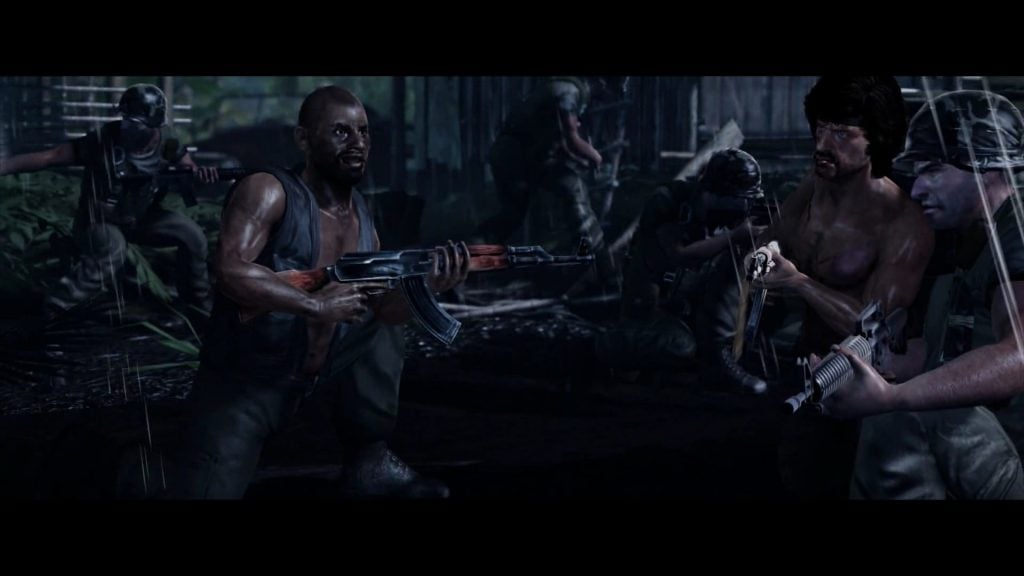
After that, we’re thrown into a cutscene that takes place before the events of First Blood, featuring Rambo (with digital Stallone sporting a mustache just as ugly as he did in that movie) escaping from a camp. Then the game begins, in all its light gun glory.
As I’ve been writing about random games for years at this point, I’ve started to look back at the various cheapo bargain bin games I’ve written about. Most of them were made here in the United States and published by ValuSoft, the most infamous of bargain bin game publishers. Other times I’ve written about stuff a little lesser known, like City Interactive’s Enemy Front. But sometimes, despite owning many different bargain bin games over the years, there’s a few that made me wonder “Why the hell did I buy this?” Alpha Prime fits that bill perfectly.
A shame I have no idea who Ondrej Neff is. They should’ve done what they did with Metro 2033 and make a novelization of the game that’s somewhat difficult to read in English.
I honestly can’t remember why I bought Alpha Prime. Maybe it was $1 in a Steam sale. Maybe I saw someone show me a dumb video about it, and it looked so bad I couldn’t resist giving it a try. Regardless, I had the game in my backlog, and I felt like I needed something drastically different from BioShock 2, which I had just finished and written about recently.
Alpha Prime is made by Black Element, a development studio based in the Czech Republic. They were part of a collective called the Independent Developers Association (IDEA), founded by Bohemia Interactive. Suddenly it makes sense why the makers of ARMA and DayZ published this mid-2000s budget FPS. At least, according to the Steam store page.
Since I have a penchant for rough, janky games made in Europe, I decided to give this a try just out of morbid curiosity. Let’s just say the experience was rather… unpolished.
It looks like Arnold isn’t even interested in Livia’s advances. Wonder if that’s a side effect of the Hubbardium.
The plot goes like this: Arnold Weiss (or Arnie as some call him) is a former soldier who was stationed at Alpha Prime, an asteroid full of Hubbardium, a fictitious space rock that is said to give people special powers. After being egged on at a bar by an old fling named Livia, he goes back to Alpha Prime to help his buddy Warren, and stop his group from mining more Hubbardium. But then disaster strikes.
Those are words that *can* be used to make a sentence, but I can’t make heads or tails of it.
At least, I think that’s how the story goes. Naturally, since this was made by Czech people, English is not their first language. There is lots of stilted, awkward dialogue in this game, combined with a bunch of spelling and grammar mistakes that made it very hard to comprehend the game’s story, and I ended up ignoring it after a while.
Leaning? shooting behind cover? Yeah, this is definitely a 2000s era FPS.
Alpha Prime is a by-the-numbers FPS. Shoot dudes, try not to get shot too much, that sort of thing. The weapons are standard FPS fare for the time: pistol, shotgun, assault rifle, grenades, the works. There’s some interesting ideas, like the assault rifle being a mini gatling gun, but it acts no different than your standard FPS assault rifle.
These uses of the ReCon could’ve been useful, but most of the time it’s used to look into cameras, which isn’t really as useful.
The game does throw a couple interesting ideas, however. At one point you acquire a ReCon, a device that lets you hack into cameras and activate platforms and traps. It’s kinda neat in spots, but in most cases seeing into the next area won’t help you that much unless there’s a trap inside to make combat easier.
I’m starting a new idea for the blog called Weekend Writing.
Weekend Writing is an experiment for me to try to write more often. Some posts may be about things that I don’t think merit a full article, or may be me talking about games I’ve recently played in an attempt to play more games than I usually do.
There’s no guarantee every weekend will have a Weekend Writing post, but I hope I can stick with this idea for a while.
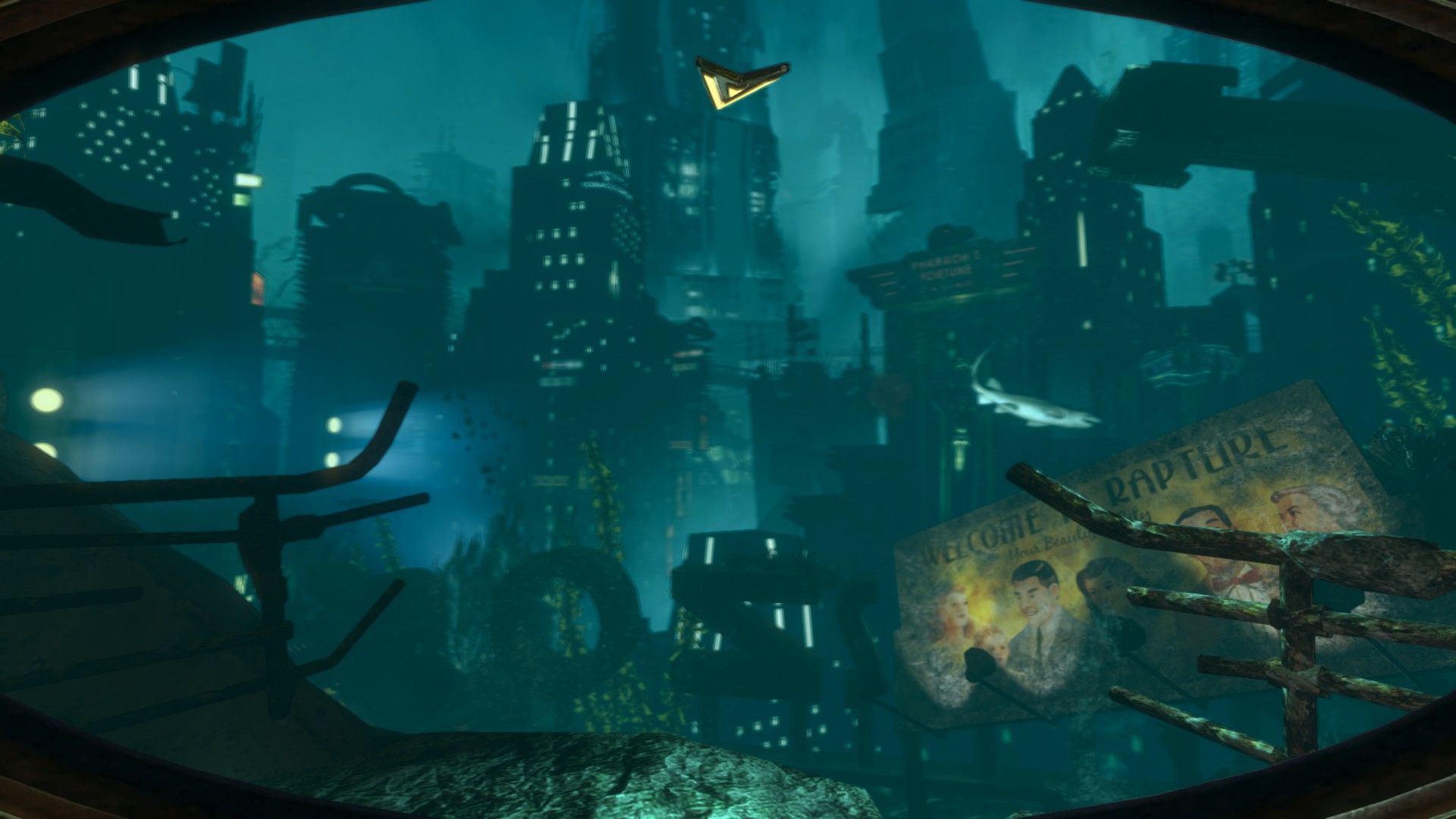
This still looks pretty good years later.
As of this writing, I finished BioShock 2 Remastered. Part of BioShock: The Collection, it’s one of those fancy HD Remasters that was released for the current generation of platforms and PC. I had finished BioShock Remastered back in 2016, not long after beating BioShock 2 for the first time. Since it had been a few years, I figured it was time to go back to it, just to have something to play in the meantime, and to see if my opinion has changed on the first two games.
Something I didn’t know until looking through my screenshots for this and the original: This credits sequence is different in the remaster. Looks nicer than the original.
I say first two because despite buying it way back in 2014, I still haven’t played BioShock Infinite. Maybe some day.
BioShock is a pretty cool series. A stylistic art deco first-person shooter with skills, hacking and magical abilities; the game came out in 2007 to universal acclaim, some putting it on their “best of all time” list. I’m not one of those people, though I do consider it to be a solid game.
Shout out to the artists at Irrational and 2K Marin for making a cool world to look at *and* roam around in.
BioShock shares several elements with System Shock 2, considered a spiritual predecessor to BioShock. Fitting considering both were developed by Irrational Games. Stripping away the futuristic space motif for Rapture’s 1950s look was a wide decision as it gave them a fresh, unique environment to work with. BioShock’s look and feel is something I haven’t seen in a big budget game before or since, the closest is maybe Fallout. I’m surprised this style didn’t get ripped off more.
Welcome to the first Secret Area post of 2019. Here’s something that was several months in the making. This was mostly due to procrastination. Naturally, I’m writing about a game I finished last year, two days short of a year after I had beaten it. And it’s a callback to a post I made last June. Let’s do this.
Last year, I had written a somewhat scathing review of the 2010 Medal of Honor reboot, which took the legacy of a long-standing WWII FPS franchise and basically ruined it by being a Call of Duty 4: Modern Warfare copycat. You can check that post out here. At the end of that post, I had hinted towards a game that I had said was just as close to the original Medal of Honor games.
Okay, it’s a bit of a stretch, but it is a World War II FPS, and surprisingly a decent one at that.
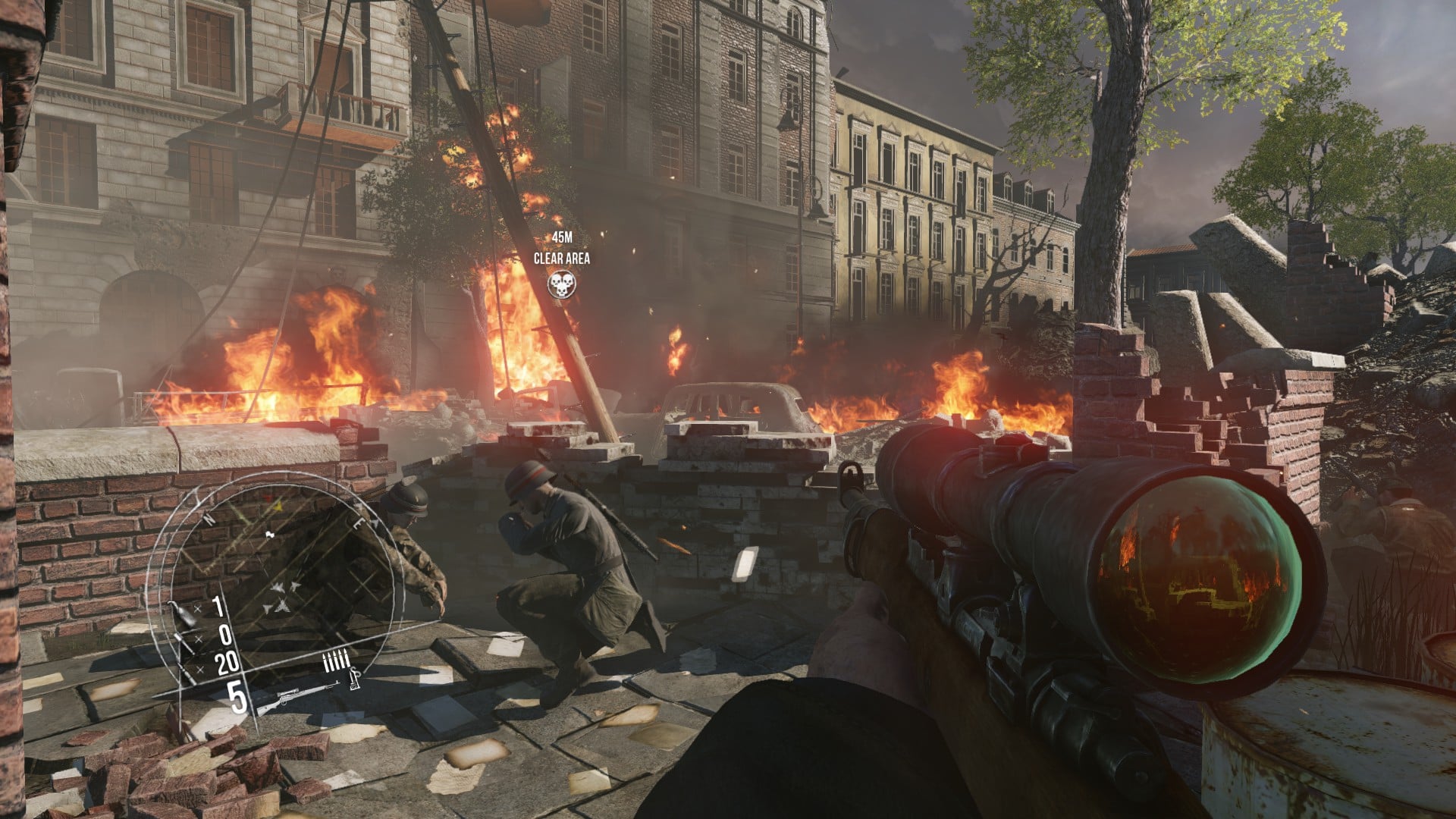
Enemy Front was a shooter released in 2014 for various platforms, including PC. Released by CI Games, it was a fairly unknown budget shooter in an era where those kind of shooters were slowly disappearing due to the drought of retail games as well as the prevalence of Steam making it a newer (and cheaper!) haven for the cheap schlock of the past.
I had heard of it thanks to a certain YouTube personality. Ahoy – later a maker of wonderful flashy documentaries about Doom, Half-Life, the Amiga, and many others – had done a video chronicling the arsenal of Enemy Front. He had done similar videos before for Call of Duty and other franchises, and would later be revised to an all-purpose format with his Iconic Arms series of videos. I’m still waiting for the new season of Iconic Arms, just to see what games he uses as an example for the weapon he’s talking about.
Though, it wasn’t just a British YouTube personality talking about a budget polish-developed FPS’s weaponry that got me to snag Enemy Front. It was also dirt cheap on a Steam sale. All it takes is something to be under $5 and you’ve caught my interest almost immediately.
Broadcasting your war diaries doesn’t sound like a good idea to me.
Enough preamble. Let’s get to the meat and actually talk about Enemy Front proper. You play as American journalist Robert Hawkins as he reports the stories of a resistance front all around Europe. Hawkins’s voice sounds familiar to me. There’s no voice cast in the game itself, and IMDB only gives a brief unconfirmed list. I swear I heard him in that infamous Duty Calls game I also wrote about long ago, but there’s no proper credits for that one (or for Enemy Front).
Later meeting up with resistance fighters, Hawkins must stop the Nazi menace in various locales around Europe, including during the Warsaw Uprising. A fair share of the game takes place around that Polish conflict. It’s fitting, considering developer/publisher CI Games is based in Warsaw, Poland.
Human shields are a good way to be threatening. Until they realize you just grabbed some expendable low-ranking goon.(more…)
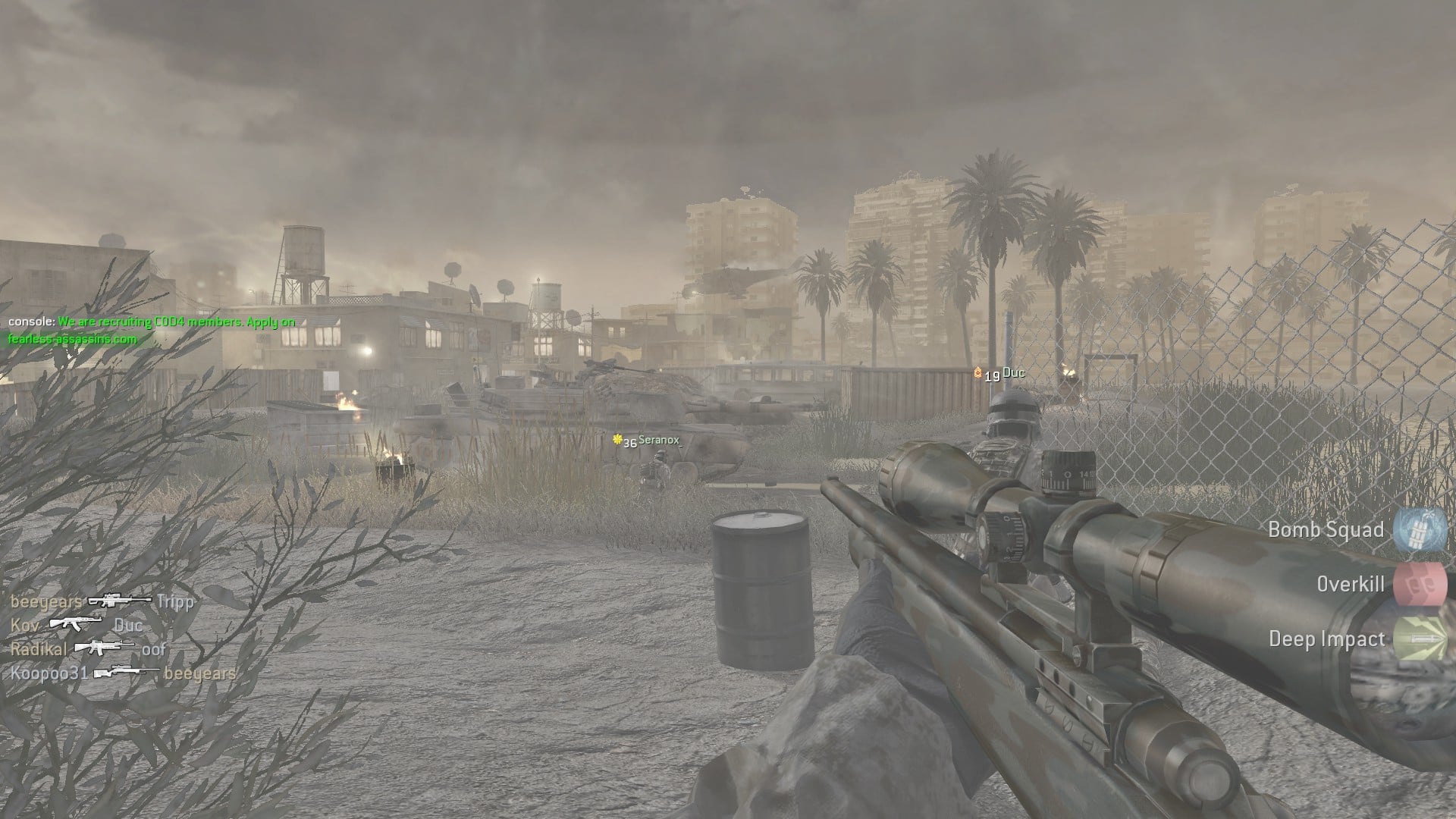
While playing on Bog, a dark, wide map filled with small gaps of cover and two small buildings ripe for camping, I noticed an enemy player’s been using the infamous “noob tube” – an M203 grenade launcher – to get easy kills. I decide to switch over to my sniper rifle build, with an R700 equipped, ready to pick off the offending noob tuber.
I then started sweeping around the map looking for enemies. I spotted enemies on the other side of the map and starting aiming down the scope and taking shots, occasionally moving to avoid being easily killed. I then spotted an enemy with a rifle and his grenade launcher prepped, and I nailed him in one shot. However, he had just shot a grenade before he died. A grenade that landed right on me. I couldn’t resist to type “good trade” in the chat.
The aftermath.
It’s 2018, and there’s people still playing Call of Duty 4: Modern Warfare online 11 years later. I had picked up the PC version of COD4 as well as World at War on Steam for $10 each. I had hoped they would hit the $4.99 sweet spot, but Activision doesn’t believe in the concept of making their games that cheap.
Surprisingly holds up even graphically.
Honestly, I didn’t need to buy these versions again. I already had both of those games on a console – hell, Call of Duty 4 was the first game I ever got for my PlayStation 3 in 2008 – but the PC version had a fair share of advantages that I wanted to check out. Plus I couldn’t resist replaying the campaigns to one of the best games in the entire series. (Black Ops would probably be a close second.)
First, I also wanted to look into the mod scene. There was a Star Wars-themed mod for COD4 calledGalactic Warfare that was making the rounds around 2009-2011, and it was kind of the reason I wanted to look into the PC version. Sadly, it seems the overall mod scene has died out, leaving me with just vanilla COD4 to play with. With Hardcore settings on, no less.
Hardcore makes it so there’s little HUD, and everybody’s a glass cannon. At least some of the weaker weapons prevail in this mode…(more…)
It feels weird these days that there’s no James Bond video games being released. The last major James Bond game was 007: Legends in late 2012, made to advertise the then-new Skyfall film. Activision revoked the James Bond licence the following year, and unfortunately killed off the wonderful Eurocom in the process. Since then, nobody has come up to the plate to bring the titular spy back in a big-budget licensed game. A shame, really.
While most people probably remember the heyday when Nightfire was the in-thing, or even tried to give stuff like 007 Blood Stone a try, James Bond games have been around much, much longer. There’s so many of them, more than you’d expect. Most of these are fairly quick to talk about, except for one that came out in the early ‘90s.
But before Activision, before EA, even before Goldeneye 007 was having people go Slappers Only in The Basement, there was those really awkward years throughout the 80s and 90s.
Before Nintendo published James Bond 007 and the famous Goldeneye, there wasn’t really a definitive publisher of James Bond games. Parker Brothers put out a passable action game on the Atari 2600 where you play as one of Bond’s fancy cars rather than the character. Mindscape published a few Angelsoft text adventures – written by James Bond historian and later Bond book author Raymond Benson – at one point even Interplay got in on the Bond thing, taking Delphine Software’s Operation Stealth and slapping the James Bond license on it, changing only a few names here and there. But the primary publisher for a lot of Bond games during this period was British publisher Domark.
When Domark had the license throughout the late 80s to early 90s, they released many different kinds of games. Often times these were action games inspired by existing games, like the game based on The Spy Who Loved Me being a passable Spy Hunter clone. There were also games based on Licence to Kill, Live and Let Die, and The Living Daylights.
I do not recommend actively seeking out these games. If you’re morbidly curious, find a cracked copy where you can turn on cheats. A lot of these games are stupidly hard, probably to cover up how little there was in overall game content. For example, Licence to Kill can be beaten in less than 15 minutes if you’re skilled enough. Probably wasn’t worth the $50 price tag with that little gameplay value.
While most of these games were on home computers, there was a James Bond game on home console and it was quite an interesting little piece, and I’m not talking about that busted THQ game based off the short-lived James Bond Jr. TV series. No, I’m talking about what ended up being Domark’s final James Bond game: James Bond 007: The Duel.
Domark really loved using this publicity photo from Licence to Kill, didn’t they?
Released in 1993 for the Sega Genesis/Mega Drive and Game Gear, this is an action-based platformer. Developed by “The Kremlin” – in reality Domark’s in-house development team – this is the only James Bond game to appear on Sega platforms. Surprisingly this is not based on an existing film, but rather an amalgamation of various elements of Bond films up to that point.
This also got a Master System and Game Gear release, mostly identical to the Genesis game gameplay wise, but for the sake of this article I’m covering only the Genesis version.
It even features Timothy Dalton as Bond. At least, a video game rendition of him. This is interesting because he hadn’t done a Bond film since 1989’s Licence to Kill, and this was around the time where the James Bond franchise was in limbo because of legal problems between MGM and United Artists. Dalton would leave the role in early 1994, with Pierce Brosnan being the next James Bond later that year. Had this game come out just a little bit later, we probably would’ve gotten Pierce Brosnan making his James Bond game debut here. Oh, what could’ve been.
Hey folks. Sorry that my posting is still somewhat erratic at the moment. Things have been going on in my life, and for a good while I didn’t have anything interesting to write about. I’ve amassed so many junk items over the years that they’re all strewn about in my room, hoping one day they’ll be played and/or written about.
So instead of struggling to think about something, I’m gonna do some posts about some of the games I’ve beaten throughout 2018. Surprisingly it is a small list, as I had fallen into the trap of playing the same quick pick up and play games instead: Killing Floor 2, Payday 2, Asphalt 8: Airborne, and more recently, Quake Champions.
Despite having a massive backlog, I still did finish a few games throughout the year. This was originally gonna be a post with two reviews, but this particular review got so lengthy that I had to split it up.
So let’s talk about a failed reboot of an iconic franchise, shall we?
Mr. DudeMcLargebeard getting ready to shoot the evil people.
(Warning: Spoilers for the story of Medal of Honor 2010 and Call of Duty: Modern Warfare 2 lie within.)
Back around 2014, I had written (but oddly didn’t publish) a thing about Medal of Honor: Airborne, which I had replayed because a friend was streaming the game. It’s one of his personal favorites, and while I liked some elements of it like being able to drop anywhere on the in-game map, or even the creative weapon upgrade system, it just felt like a tired shooter going through the motions, and was going beyond the more historical angle of Medal of Honor, even having Nazi super soldiers wielding MG42s like it was nothing.
At the end I had written something to the effect “It’s not as amazing as Frontline or Allied Assault, but it’s probably better than Medal of Honor: Warfighter.” At the time, I hadn’t played the most recent Medal of Honor games, and 2018 felt like the time to tackle Medal of Honor 2010 – as I’m gonna call it from here on in, to distinguish it from the 1999 original – and I felt disappointed all the way through.
I finished this back in January, as the very first game I beat in 2018. This was not a good start to the year.
Realizing World War II games were on their way out after a near ten-year period of them constantly coming out, EA was in a bind. Medal of Honor was considered this prestigious franchise, and they didn’t know where to take it. Their solution was to see what their competition already did three years prior and follow suit: Go modern, and see if it stuck.
The problem was that this came out right after the extremely successful Modern Warfare 2, and was out the same year as Call of Duty: Black Ops – probably in my top three favorite Call of Duty games for various reasons – so already EA was climbing a very, very steep hill. With Medal of Honor 2010, EA didn’t get to the top, but instead slipped and started rolling down the hill, giving themselves bruises and broken bones along the way.
Gameplay wise, it’s a boilerplate roller coaster of a modern military shooter. Shoot the bad guys, reload, occasionally use a grenade launcher or call in airstrikes. Right click aims, Left click shoots. Occasionally you get medals for headshots or multikills, a holdover from Medal of Honor: Airborne that doesn’t make sense here. There’s even a level where you’re in a helicopter. Occasionally soldiers go “hooah” and speaking military lingo so frequently that it’s almost self-parody.
Even something like this has been done, and done better elsewhere.
It’s clear Danger Close was glancing at what Call of Duty 4 did years prior, and tried to copy it, but didn’t understand what made Call of Duty 4 such the blockbuster success.
Over the many years I’ve been collecting games, I’ve always found particularly unusual game show games. Besides the common Jellyvision/Jackbox collective, I’ve found stuff like Outburst, a board game that decided to become a poor man’s You Don’t Know Jack; Another Jack clone that was endorsed by MTV’s TRL, the list goes on. I even have Pat Sajak’s Lucky Letters, which makes me one of the 34 people who bought a physical copy, and that’s also worth talking about. But this one’s a bit different. It comes from across the pond, and features one of the most notable fads of the mid-2000s…
I wonder if us Americans thought Carol Vorderman was like Mavis Beacon.
It’s Carol Vorderman’s Sudoku. A somewhat obscure Sudoku game, this came out courtesy of Secret Stash Games, a weird Eidos Interactive imprint. Though Empire Interactive is also credited on the box and in the game itself, which mostly published games in the UK (and were the original distributor there, presumably).
So you’re probably asking: Who the heck is Carol Vorderman, and why is she endorsing a Sudoku game? I’m going to assume the people reading this post are not from Britain and/or game show nuts, so I’ll give the skinny on who she is: Carol Vorderman is a long-standing television host, being the co-host for a British game show called Countdown.
Countdown is a fairly simple game show where players either try to come up with the longest word from a semi-random pick of letters, or solve a mathematics puzzle by hitting a target number with six randomly chosen set of numbers.
Carol solving a particularly devious numbers round.
Vorderman was well known especially for the latter, sometimes getting solutions to the math problems that even the players couldn’t figure out. She was on the show for a very long time, from the show’s early beginnings until 2012. She’s almost like Britain’s Vanna White, but does more than touch screens and clap all day.
As for Sudoku, it’s a little more complex. A long standing game that got an unusual resurgence around the mid 2000s, the game involves placing the numbers 1 through 9 on a 9×9 grid split into 3×3 subgrids. The goal is to make it so each row, column, and subgrid have one of each number without any duplicates. It’s a nice mental puzzle that gained traction in unusual ways, and it’s one of the mini-games in Nintendo’s then-popular Brain Age games. It’s certainly more enjoyable than Jumble or Crossword puzzles, anyway.
Presumably this was made for a pittance, since this was around the time Phoenix Games were churning out sub-par budget games in the UK, so this likely got tossed in that same pile. Though in my case I only paid a few bucks for it at a gaming convention, so it’s no big loss.
So here’s the first problem I have with this game. Carol Vorderman doesn’t have the name recognition that someone like Gordon Ramsay or James Corden has outside their native England. Had I not told you who Carol Vorderman was, you would probably assume she was a fictitious entity like Mavis Beacon.
But I assure you, she’s a real person who endorsed a Sudoku game, and for some reason somebody thought it was fitting to bring it here without any context of who she is or where she’s from.
This looks like this was made in like five minutes while the Ui designer was taking a bathroom break.
But enough about what person gets to endorse the sudoku game, let’s get back to the game itself. The version of Carol Vorderman’s Sudoku I’m playing on is the PS2 version. Though it did get a PC release, I couldn’t get it to work on Windows 10. I assume both versions are identical in terms of content, but when it comes to something like Sudoku, you can really only change so much.
About a year or so back, I wrote about Modern Combat 5. I did so because I had jumped from Windows 7 to Windows 10, and never got to experience the Microsoft Store ecosystem.
One of the games I had downloaded, Sniper Fury, weren’t really worth talking about all that much. Just felt like Modern Combat 5 but more like a rail shooter.
I was going to do a series based on Windows 8-10 apps, but I got sidetracked by other things. The other games I had installed had either gotten super grindy to make progress unless I paid, or in the case of Asphalt 8: Airborne, that they are such a daily ritual for me that I’m still grinding to get that last achievement to this day. The only other games that could be interesting to write about are too well-known like the Killer Instinct reboot.
But there was one more game I had installed, and until recently, never tried. Then I tried it, and thoroughly regretted playing it.
STERN MILITARY FACE RETURNS
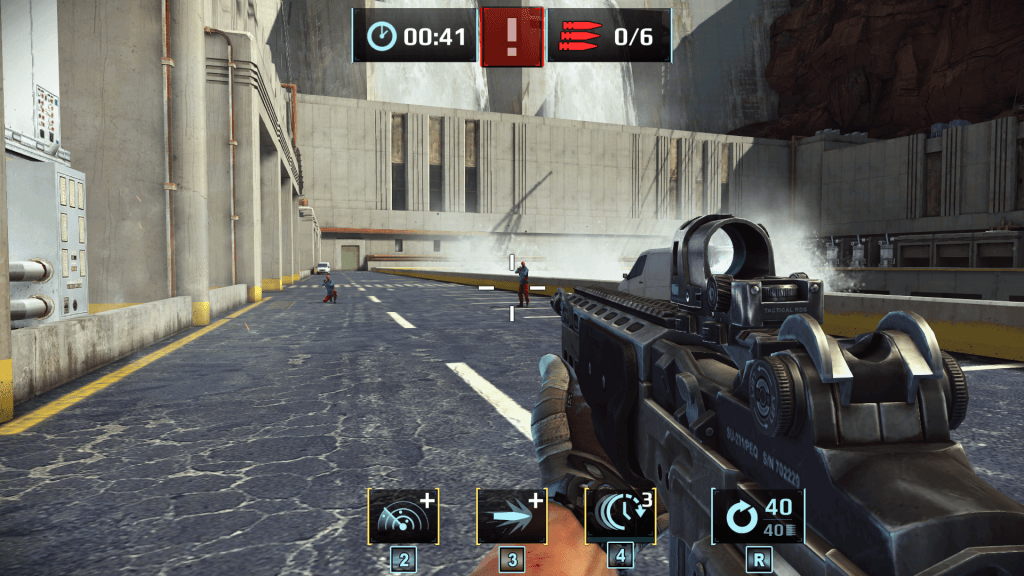
Overkill 3 is the third installment in a modestly popular franchise originally released on mobile platforms. Co-developed by Spanish developer Game Troopers and Czech developer Craneballs – props for the goofiest developer names I’ve seen yet, this is the first game available on the Windows platform.
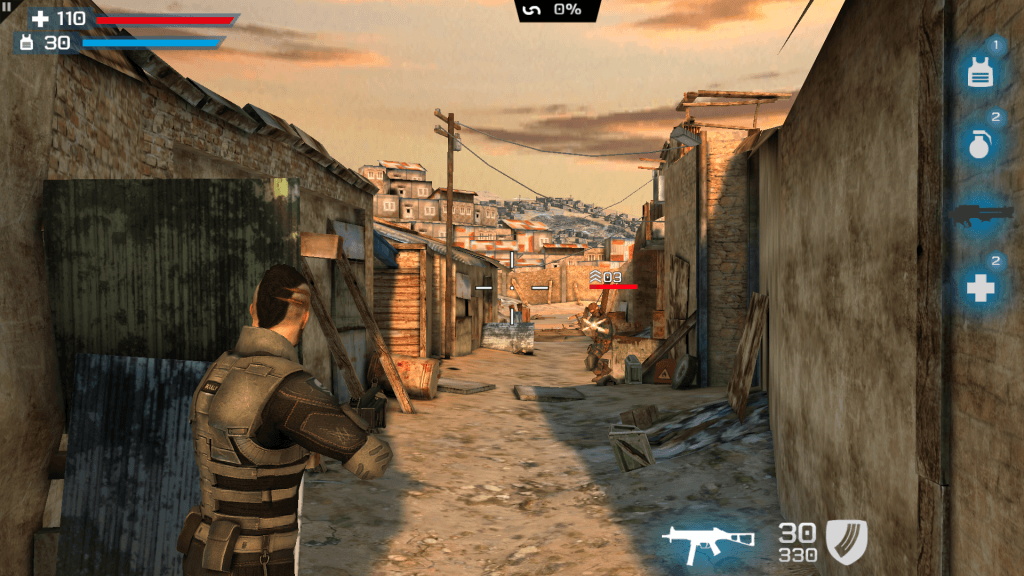
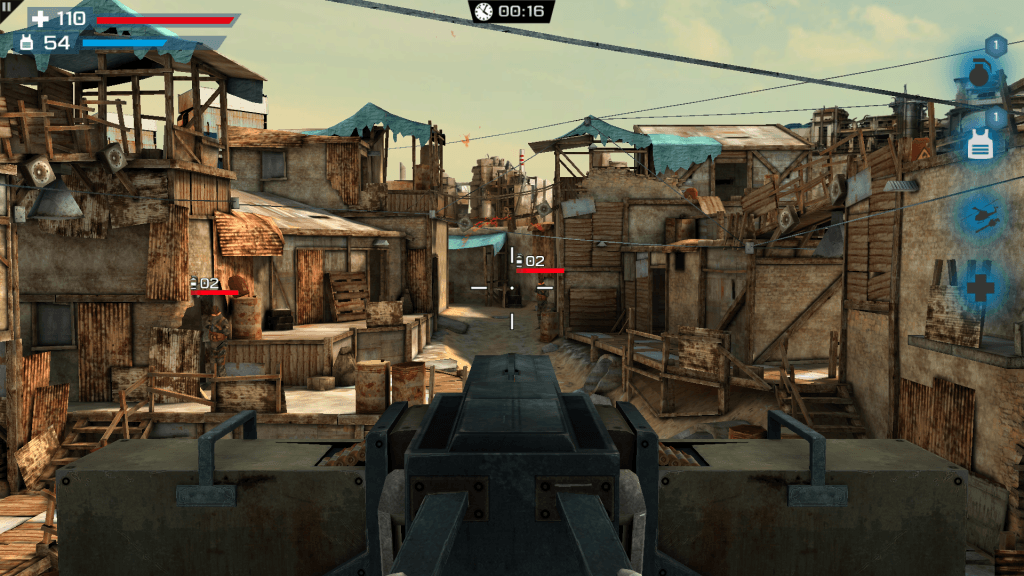
From what I’ve seen of screenshots from the previous titles, Overkill 3 takes a mild curveball in terms of how it plays. The previous titles were first person rail shooters, and while Overkill 3 still plays like one, we actually get to move to third person, over-the-shoulder rail shooting. So it’s a bit of both a rail shooter like its predecessors and a cover shooter like other games out there. At least they’re spicing things up.
Here’s our resident shootyguy who must kill the evil big bads from… doing the bad things. Honestly I couldn’t tell you much else.
There is a plot to the gmae, but it’s so razor-thin that there’s no reason to pay attention to it. You play as John Scully, a military soldier who goes from various places around the world fighting off big bads that vary from generic soldiers to outright mechs. There is no principal villain, just Scully going from place to place, hiding behind cover, and shooting dudes repeatedly. Scully also wins the award for the most ridiculous protagonist hairdo I’ve seen this side of Soap MacTavish, which is something.
Each mission has Scully shooting enemies, and completing certain tasks. Some are simple: Finish the mission, complete the “slide the screen” quick time events, don’t die. Others are fairly grindy, like killing x number of enemies, or staying in a stage for a period of time. Completing challenges gets a star and some cash or medals that can be used to upgrade or buy new things.
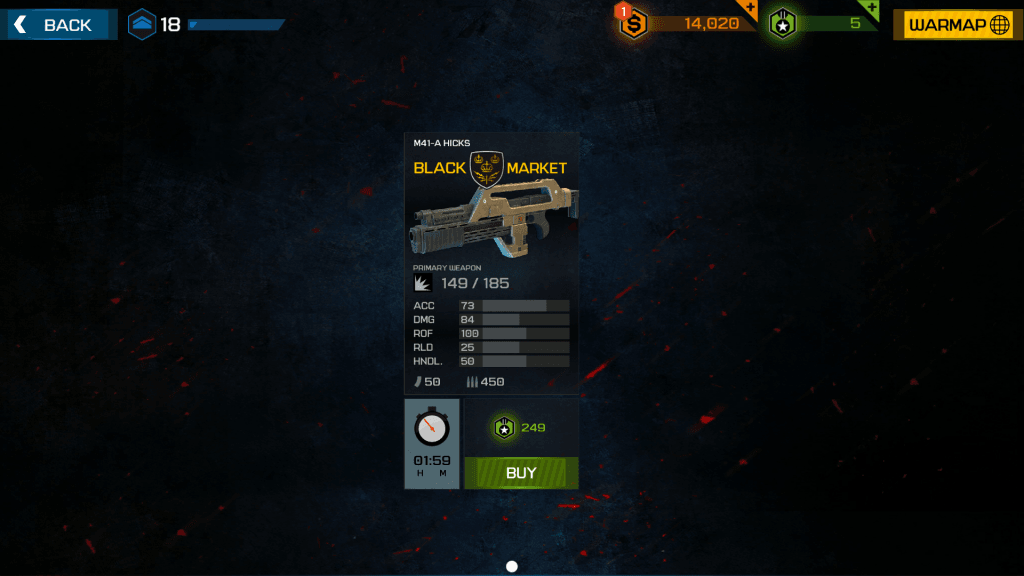
How cute, I could get the Aliens pulse rifle if I get some more premium currency. Bet it doesn’t have the sound effects.
Overkill 3 hits this weird territory of being tonally inconsistent with the world and its plot at times. While there are human soldiers who wield real guns like an AK-47, a Desert Eagle, and a Barrett .50 cal, there’s also futuristic space guns, even ones like the pulse rifle from Aliens, and… stuff like a giant mech robot with a minigun.
Johnny 5 is alive! …and he’s fuckin’ PISSED!
It’s like the team wasn’t sure if they wanted to stick to being a modern military game, or saw what Call of Duty was doing at the time and thought future warfare was The In Thing; so they decided to go with both. I assume the previous games were mostly grounded in reality, but since they were on iOS I can’t really confirm.
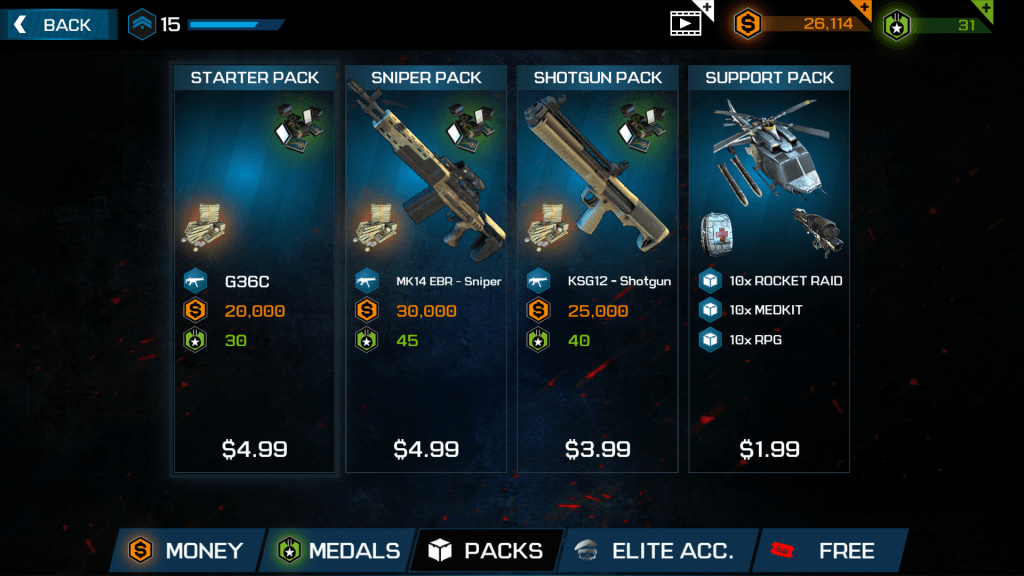
Since this is a freemium mobile app, they’re gonna barrage you with packs for real money to get you to invest in their ecosystem. Thankfully I didn’t spend any money.
So you probably read “buy new things” and asked, “This is a freemium game, isn’t it?” You’d be right. To get certain weapons and armor, you need to have the right amount of credits and medals. Credits can be acquired by just doing missions, but medals require either leveling up, completing specific challenges, etc. Of course, you could just buy your way to victory, but I do not encourage this because this game really doesn’t deserve any money.
There was a point where every time I started playing Overkill 3, that there was a glimmer of hope, that there might be something good. As I progressed, there were missions that became so annoying and remotely unfair in spots that I must’ve tried and retried a dozen times, and that’s even when given the opportunity to revive just by watching an ad. I basically was grinding myself down in a vague attempt to make some progress, and it certainly wasn’t fun.
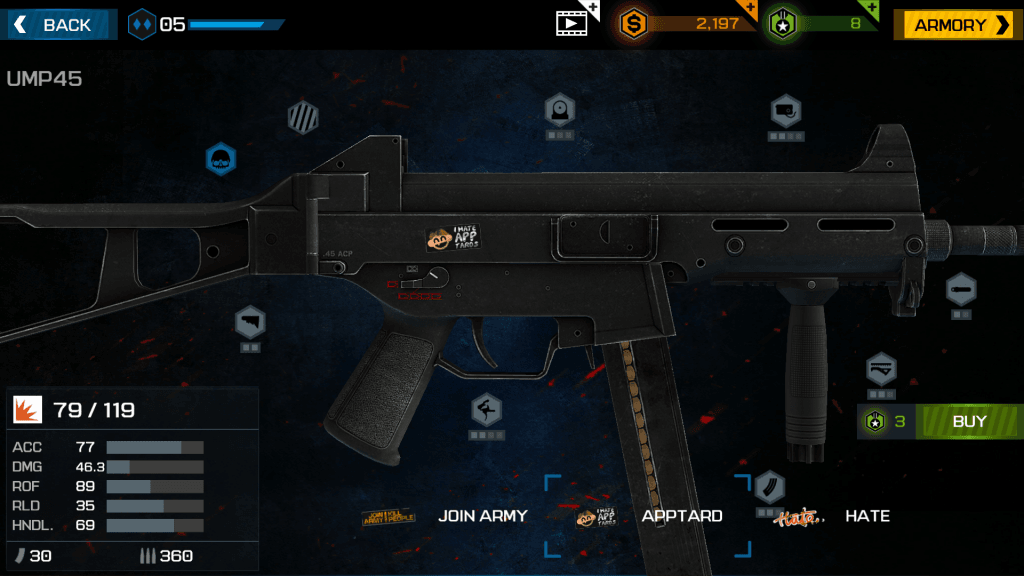
I can’t tell which of these is worse, the sticker with the ableist language or the “JOIN ARMY | KILL PEOPLE” sticker…
It doesn’t help that even while in cover, Scully was still taking damage. Sitting there, not firing, having him nag at me for not doing anything, and he would still take chip damage. At one point, I had just finished off the last enemy – a mech robot shooting rockets at cover – and took just enough damage to die, thus denying me the reward for finishing the level, having to start over.
This seems more in line with the other games in the series, just being a gun that shoots everything in front of them.
I could upgrade my armor, but I also hit that wall where I needed medals, and I didn’t have enough of those. I could get a better, more powerful gun, but those cost a lot of credits and require lots of grinding. I could upgrade my weapons or buy grenades or rocket raids, but eventually those cost medals as well. And if I use medals, I then can’t get certain weapons or armor unless I grind or spend money to get them. Lather, rinse, repeat.
There is a reason there’s a fair share of disdain among people who play these kind of free-to-play games and hit the brick wall of being stuck unless they’re willing to do the grind or give up and pay their way to make progress. For Overkill 3, the gameplay loop is so rote that it just wasn’t fun.
I was willing to put up with the paper-thin story, the wonky controls that were made more for a tablet touchscreen and not a common mouse and keyboard PC, hell, I was even willing to play the endless mode to get some extra cash. But I just got sick of it, and realized there were many other, better games I could be playing instead.
This mission in and of itself took a dozen tries, mostly because I went from full health and armor to zero in a matter of seconds. This game ramps up the difficulty unfairly.
I hate leaving games unfinished, but if the goal to completion is “grind or pay up,” I tend to abandon it without much of a second thought. Unless it’s a game I really find enjoyment in, like Asphalt 8, I can’t stick with it. I gave up roughly around the halfway mark, and feel no urge to come back to it, because I know even if I returned to it, all the elements of the grind would rear its ugly head once more, and I’d get sick of it again. So I abandoned it, and moved on to something else.
Even though this is a mobile game ported over to Windows, this is not where the legacy of Overkill 3 ends. Game Troopers moved on from the crowded mobile game market to the not-nearly-as-crowded virtual reality market. For the low low price of $20 — VR headset sold separately — you can play Overkill VR, which is this exact same game in Virtual Reality! At least it probably doesn’t have scummy microtransactions to slow down progress.
Let’s make tap to high-five the new “Press F to pay respects.”
There is one thing I do appreciate about Overkill 3, though: Sometimes Scully will ask you to do a high-five upon completing a mission. I’m not even bothered by the fourth-wall breaking moment, it’s just so goofy that I’m always amused when it happened, no matter what.
I will always appreciate games from countries you won’t expect to have a burgeoning games industry. Hell, I wrote fair praise about Chaser a few years ago, a game by a Slovakian game development studio. It’s just not a good game. If they were to release an Overkill 4, I’ll be okay with skipping that, if this game is any indication. At best, Game Troopers and Craneballs deserve a gold star for trying and not much else.
id software’s amazing run of first-person shooters in the ‘90s are in some of my top games of all time: Doom, Quake, even Quake III Arena was pretty good in spite of Unreal Tournament’s more fun, absurd nature. But one game I had a fondness for was Wolfenstein 3D.
For a long time, I tended to look at the more community side of these games, looking towards the mods and user-created levels people made. Even for something like Wolfenstein 3D, which is nothing but 90 degree angled floors, there was some charm and enjoyment from them. Hell, I even found some amount of enjoyment in the third-party Spear of Destiny mission packs that FormGen put out.
Wolfenstein 3D is a fairly simplistic shooter by modern standards, but it started laying the groundwork for what made their games tick: Exploring areas, defeating enemies quickly, and strafing around arenas in a quick pace. It’s operatic ballet but with guns and nazis. What happens when you try to make it work in an actual 3D engine and try to shoehorn in awkward mechanics that just don’t fit? You get Wolfram.
Already we’re off to a great start with this menu…
I have to give a shout out to the Video Game Music Preservation Foundation, which for some reason has an article dedicated to this game. Being a fan of the Wolfenstein games, I had to see if this was the remake of Wolf3D that would be better than the original, like how Black Mesa to Half-Life. Sadly, I was in for a world of disappointment.