Category: Reviews

The various opinions I have of many different video games.

  • Sega Swirl: The puzzle game time forgot.

    Sega Swirl: The puzzle game time forgot.

    Sega in the late 1990s to early 2000s was a weird time, at least here in the United States. After bungling the Sega Saturn, there seemed to be some hope for the company with the blue hedgehog as they released the Sega Dreamcast in 1999, being a modestly successful system. But then Sony’s PlayStation 2 came out the following years and steamrolled over all competition, forcing Sega to abandon games console production and go into full-time game publishing instead. As time rolls on, the Dreamcast era seems to be more fondly remembered, alongside many of the games that came with it. But there’s one game Sega heavily pushed during this era, one that has been slowly forgotten to time.

    While Sega was mostly known in the console space, they did have a middling PC division during those years. Most of them ports of legacy games like Sonic & Knuckles Collection, but there was one game they released around 2000 that was a unique, interesting idea. It was a game that would absolutely dominate my middle school years in terms of its simplicity and fun factor.

    What the heck kind of company is
    What the heck kind of company is “Sega of America Dreamcast” anyway?

    Introducing Sega Swirl, a fairly simple puzzle game released by Sega, loosely inspired by the Dreamcast logo swirl. This came out as a freeware game from around 1999-2000, and while the title screen is incredibly basic, there’s a lot more to it than you think.

    The swirls almost look like colored cinnamon rolls. Damn, now I’m hungry.

    The gameplay is fairly simple: You’re given a grid of swirl colors, and your goal is to find groups of colored swirls for points. Removing them shrinks the playfield down, making it easy to build up combos. However, removing a single swirl will result in you losing points. In the standard “Level mode,” you must complete five goals to finish the stage, thus chaining swirls together for massive points is the end goal. It’s a fairly simple game, but still fun even in spite of its basic looks.

    A shame this came out in 2000, before esports were a thing. I would totally watch a Sega Swirl tournament.

    There’s also a Versus mode, where up to four competitors start taking enemy swirls for massive points. The goal is to knock your opponents out by eliminating that player’s swirls from the field. Like before, clicking a single swirl makes you lose points, but since your goal is to eliminate your opponent, it’s a good strategy to grab one swirl just to knock them out of the game faster. It’s a fun, competitive mode.

    (more…)
  • Wordtris: When Tetris and Scrabble collide.

    Wordtris: When Tetris and Scrabble collide.

    If you were around in the ’90s, you might be familiar with Tetris mania. The original game hit a myriad of systems, most notably the Game Boy, and became a massive worldwide success. Naturally when something like Tetris is popular, people try to reinvent the wheel and make variants of Tetris, with varying levels of success.

    Some of these, like Tetris 2 or Tetris Blast just added a more puzzle element to the base Tetris game. Others were games like Tetris Attack, which was merely a rebranding of what we now know as Puzzle League. Then there’s the game that we’re talking about today:

    Even the cover is similar to the original NES Tetris cover.
    Even the cover is similar to the original NES Tetris cover.

    Proudly mentioned on the box as “Tetris made Letter Perfect!”, Wordtris is a Tetris-like game released for several different systems. Though today we’ll be specifically looking at the SNES version of the game. Spectrum Holobyte took the block-building concept of Tetris and put a unique spin on it, which is hardly unknown territory to them. Wordtris was one of several Tetris spinoffs Spectrum Holobyte released, including Welltris and Faces: …Tris III. I wasn’t kidding when I said there were many Tetris spinoffs in the ’90s.

    (more…)
  • Marine Sharpshooter: One Budget FPS, One Mediocre Game.

    Marine Sharpshooter: One Budget FPS, One Mediocre Game.

    I’m convinced no one wants to be the sniper in a video game. Yeah, there’s parts where they show that being a sniper is cool, but most of it involves walking around silently and shooting people at a distance with a bolt-action rifle. The only time I’ve ever really seen it work is something like Call of Duty 4‘s “All Ghillied Up” mission, and even that’s more of a stealth level than a sniping level.

    I’ve played several games where sniping is the primary focus, such as Sniper Elite V2 or Sniper: Ghost Warrior, and most of the time it ends up being a fairly basic shooter with needlessly elaborate sniping mechanics. I don’t know why people keep making games based on this exactly, but much like they kept making sequels to the Sniper movies, there must be an audience for this stuff.

    Today, I’m gonna look at one of those sniping games, and this time, it’s a bargain bin shooter, which tells me we’re in for some old-fashioned budget jank.

    Not endorsed by Jack Bauer

    Marine Sharpshooter is a budget FPS where sniping is the base mechanic. Despite having the “CTU” logo on top, you don’t play as Jack Bauer from the hit series 24, but instead a generic soldier dropped into certain exotic locales where you assassinate enemies, usually with sniper rifles.

    The developer of this game was Jarhead Games, a master of making budget military FPSes, such as Navy SEALs: Weapons of Mass Destruction and Army Ranger: Mogadishu. The only other notable thing they made was NRA Gun Club, a target range game which is incredibly ironic considering the NRA was lambasting video games as an excuse for a mass shooter. I’ve played only one of Jarhead’s games before — the aforementioned Navy SEALs — and it wasn’t that interesting, so I don’t have high hopes for this one.

    Wonder if I can get that skin for Counter-Strike: Global Offensive?

    The game starts with a dramatic cutscene and our two heroes: A generic sniper and his spotter buddy, with an M4 assault rifle. They don’t give them names to start, so I’m gonna call them “John McSniperdude” and his teammate “David Spotterguy.” You play strictly as McSniperdude in this case, with Spotterguy being your wingman and occasional distraction.

    What a good way to start your game, with a big load of nothing.

    After a thrilling introduction where McSniperdude and Spotterguy arrive to Afghanistan by boat, our game begins. Compared to other Sniping-themed games I’ve palyed, sniping in this game is a bit unusual control-wise: You use the mouse wheel to zoom in and out of your scope. It takes a little getting used to, especially since I’m used to many other games allowing you to scope in with the right mouse button. I guess in the days before Call of Duty‘s ironsight modes got popular, this is an okay solution, but also probably difficult if your mouse doesn’t have a mouse wheel.

    As you play, Spotterguy will tell you that there’s enemies in a certain direction, also highlighted on your radar above. In some cases, this is what you need to be able to even see enemies without getting shot a bunch. Since he’s your teammate, you have the ability to tell him to either attack only when shot upon, or just to attack anyone he sees. At some point, I just told my spotter to fire at will so I didn’t have to switch between weapons or no-scope enemies that surprise you at close range.

    Our spotter is the master of blocking.

    You can also have the spotter either hold a position or follow you around. I often played through the game having him follow me, but this lead to problems where he’d sometimes block a doorway, making it impossible for me to progress. Since he’s also your buddy, you have to protect him as well as complete your objective. If he dies, then McSniperdude commits suicide to mourn the loss of his buddy. At least that’s what it looked like, any time I failed the mission, my character just dies.

    (more…)
  • Hoyle Casino on the Game Boy Color: Gambling on the Go.

    Hoyle Casino on the Game Boy Color: Gambling on the Go.

    For a long while, I was fascinated by casino video games. Maybe since I was too young to actually play at a casino, I figured casino video games would simulate the casino experience without losing loads of money in the process. It’s a shame that nowadays casinos are inundated with digital slots and video poker machines, with maybe a blackjack and craps table here and there. It’s just not the same.

    During my teenage years, I was playing one of these casino games, back when I had just gotten the fancy new Game Boy Advance. Though, it was a Game Boy Color game…

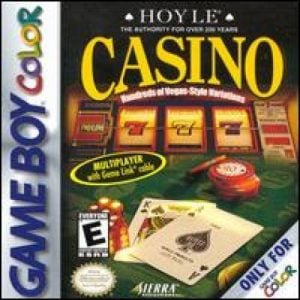
    Probably the best quality picture I could find. If my box wasn't crushed to hell, I'd just scan mine in.
    Probably the best quality picture I could find. If my box wasn’t crushed to hell, I’d just scan mine in.

    Hoyle Casino is a game sponsored by the Hoyle game company, which primarily is a playing card company, though these days they’ve also branched out to publishing digital games based on TV shows like Ice Road Truckers. This game is also unique because it was one of the few games Sierra published for the GBC, with the others being sister title Hoyle Card Games and a version of 3D Ultra Pinball: ThrillrideHoyle Casino came to other systems, but today I’m looking at the portable release.

    Pulsar Interactive worked on this, and they were mostly known for Game Boy games like Barbie Fashion Pack, as well as assisting in Quest for Glory V and Blood & Magic, as well as IBM’s Manage This!, which is not a video game but they were more than proud to feature it on their website.

    I figured I played this a bunch because of the aforementioned fascination with casino games. Plus since it was on a portable and this was before everybody had smartphones, it was a great time waster when you had nothing to do, which was fairly common in my high school years.

    Now, my gold standard for casino games is Nintendo’s Vegas Stakes – both the original SNES version and it’s Game Boy counterpart – so let’s see if Hoyle Casino is good enough to dethrone the king of casino video games.

    Hoyle Casino is a proud sponsor of VICE. I’m more of a MisterCard person, personally.

    We’re introduced to this screen where you create your character, complete with portrait. It’s merely cosmetic, but I decide to go for the classy gentleman portrait for this one.

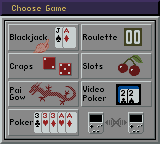
    This game boasts "hundreds of variations." I'm not seeing hundreds, here.
    This game boasts “hundreds of game variations.” I’m not seeing hundreds, here.

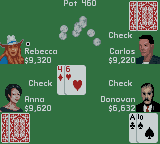
    Hoyle Casino has seven base games in it: Blackjack, Slot Machines, Craps, Roulette, Pai-Gow Poker, Video Poker and just “Poker.” Considering Hoyle is best known for playing cards, I’m not surprised how much poker games are in that.

    As I select the Poker option, suddenly I am given a deluge of various choices.

    More poker than you need. Not like these variants matter considering everybody just plays Texas Hold’em these days…

    Holy crap, that’s a lot of poker games. They got most of the common ones, including Seven Card Stud that I remember playing in Vegas Stakes, as well as the now-iconic Texas Hold ‘Em, the one type of Poker everyone knows because it was on TV for a long while.

    (more…)
  • Kiss Psycho Circus: Glam rock meets the paranormal.

    Kiss Psycho Circus: Glam rock meets the paranormal.

    I am not a fan of Kiss. I only know a few of their songs, mostly because they appeared in Rock Band. I’m aware of Gene Simmons’ mastery of marketing the band, complete with corny ’70s live-action specials, their shift to hair metal in the 80s, and of course, the infamous Kiss Kasket.

    They have a couple good songs, at least. “Love Gun,” “I Was Made for Lovin’ You,” even “Strutter” is pretty solid. Kiss is a band I can appreciate and respect, but I don’t really care for them.

    The late ’90s was the time for a Kiss comeback: The original line-up got back together and released an album in 1998 called Psycho Circus. With that title, and probably with a pinch of Gene Simmons’ marketing mastery, it eventually lead to a comic book series written by Spawn creator Todd MacFarlane, and of course, a video game. Prepare for the Nightmare Child.

    This is one of four different covers. I guess they hoped people would buy all four in a way to recuperate the development cost?
    This is one of four different covers. I guess they hoped people would buy all four in a way to recuperate the development cost?

    Kiss Psycho Circus: The Nightmare Child is a video game adaption of the Psycho Circus comic book series by Image Comics and Todd MacFarlane Productions. The comic involved the band members becoming supernatural beings and saving the universe as part of the silly team moniker Four-Who-Are-One. The video game borrows elements from the comic, but has a wholly different story.

    This was released on PC and Dreamcast in 2000, not long after games like Quake III Arena and Unreal Tournament were getting big. Though this being released on the Dreamcast and not the then-forthcoming PlayStation 2 is rather baffling, but maybe it’s for the best.

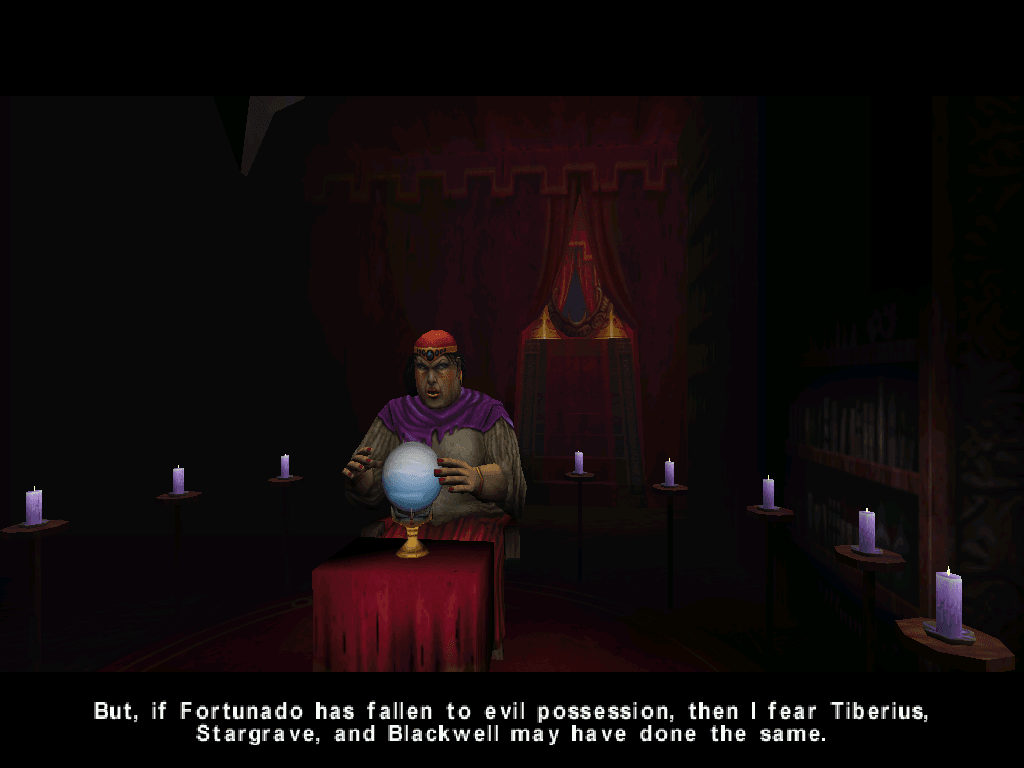
    Instead of playing as members of Kiss, you play as members of a Kiss tribute band who get teleported to a special world ran by this gypsy named Madame Raven. She tells you about this big bad called “The Nightmare Child,” one that will destroy the world, and your band are the chosen ones to stop them.

    I hope you love mystical dialog that barely makes any sense!
    I hope you love mystical dialog that barely makes any sense!

    Separated by the Hall of Mirrors, each band member goes through each world as they grab each of the six pieces that form the respective Elder to stop the mythical Nightmare Child. Admittedly, the story is rather nonsensical even in-game, I had to resort to the manual to understand this bizarre-ass story.

    I can say with authority that this story is so god damn ridiculous that it’s not worth looking further into. Then again, with this being co-opted by a band known for wearing silly outfits and the guy who created freakin’ Spawn, I’m not expecting System Shock 2 levels of storytelling here.

    Here's a goofy little easter egg: The statue is holding the logo of developer Third Law Interactive.
    Here’s a silly little easter egg: The statue is holding the logo of developer Third Law Interactive.

    This game was developed by Third Law Interactive, founded by one of the original members of the Daikatana development team during its first year or so when it was under the Quake engine, so already we’re off to a shaky start. They didn’t do a whole lot of notable stuff outside of this game, my brief internet search found out they worked on an Aliens vs. Predator 2 expansion and added stuff to the Game of the Year edition of No One Lives Forever.

    You may have noticed that’s all Monolith/Lithtech stuff. Unsurprisingly, this game runs on Lithtech 1.5, which is an absolute pain in the ass to get working on modern devices without needing an elder god and maybe dgVoodoo2. Worst off, that this is one of those games that has the pesky disc check, and no patch or update is out to turn it off. A shame, really.

    But let’s get to the meat of Kiss Psycho Circus. In the game, you choose one of the four supernatural characters and go through a set of levels, getting weapons, jumping on platforms, activating switches and killing enemies in your wake. Through the levels, you’re looking for the items make your character part of the Elder, like boots, shoulder pads, and finally the iconic Kiss masks.

    This guy's ready to pull the trigger on his gun. His Love Gun, that is.
    This guy’s ready to pull the trigger on his gun. His Love Gun, that is.
    (more…)
  • Far Cry 3: From partygoer to psychopath.

    Far Cry 3: From partygoer to psychopath.

    The Far Cry games have gone through this weird identity crisis over the years. The first game was a mostly linear, extremely difficult action game with aliens, Far Cry Instincts made your character become a mutated alien with superpowers, and Far Cry 2 was a promising game with too many stupid mechanics and probably the dumbest story to come out of a big-budget action game. To this day, I still don’t understand why people praise Far Cry 2 to the high heavens.

    Surprising no one, Far Cry 3 has nothing to do with the others. Seems to be par for the course for Ubisoft: Instead of making a cohesive story/saga with the series, just make them like Call of Duty games where they’re mostly standalone and different, with the only similarity being a jungle theme. It seems to be working for them.

    Far Cry 3 was one of my many purchases during the Steam Summer Sale this year along with Tomb RaiderDark Souls, the BioShock trilogy, all games I’ll eventually get around to playing someday. I bought it expecting that after the disappointment of Far Cry 2 that it could only get better from here. Turns out I was right, but with some caveats.

    Warning: Minor plot spoilers within.

    When I started Far Cry 3, I was welcomed to a video montage of a bunch of dudes partying out on some island, having fun and being idiots, all set the tune to M.I.A.’s “Paper Planes.” It’s like something out of a horror movie. Then it cuts away to our hero Jason being captured with his brother Grant, who eventually escape, but not without the villain Vaas deciding to kill Grant and leave poor Jason fighting for his life.

    Afterwards, you’re found by a guy named Dennis, who’s part of this jungle tribe called the Rakyat and then you go through the steps of trying to save everyone and get out of the island alive. Eventually it leads to a revenge plot, where Jason eventually wants to kill Vaas and his boss Hoyt while helping the Rakyat tribe along the way. Vaas is probably the best character in the game, as he’s a sign of the general psychotic nature of the hostile people on the island, and it works. Sadly, something happens to him mid-game and he’s pretty much gone, which is a damn shame because Hoyt isn’t nearly as interesting.

    Just ignore the floating magazine and we should be good.
    (more…)
  • Tony Hawk’s Pro Skater on the Game Boy Color: Let’s do some portable Benihanas.

    Tony Hawk’s Pro Skater on the Game Boy Color: Let’s do some portable Benihanas.

    Over the years, I have bought a fair share of games more out of curiosity rather than actually wanting them. Often times these are portable games, which I don’t think get talked about all that much beyond the more notable titles. Today, I’m gonna tackle one of those portable games I got on a whim, and it’s based on a rather iconic extreme sports star. (Plus it’s been a while since I wrote something about a game.)

    Tony Hawk’s Pro Skater. An awesome skateboarding game that was fun, even if you were bad on a real skateboard. A long-standing franchise with an impressive series of games that eventually got the common Activision treatment of “pump these games out until they stop making us money.” Nowadays, the franchise lies dormant, mostly remembered through nostalgic memories of the early games in the series with an occasional new installment that’s often hit or miss. The less we talk about Tony Hawk Ride, the better.

    Of course, a series had to start somewhere, and looking back at the first Tony Hawk’s Pro Skater, it was clear the game had some good ideas that just needed some refinement. Naturally, the game came out on every platform imaginable for the time period, like the Dreamcast, Nintendo 64 and PlayStation. But to go back to talking about portable games, I forgot this franchise appeared on a system that I wasn’t expecting.

    The closest you will get to an 8-bit Tony Hawk.

    Yes. Tony Hawk’s Pro Skater was on the Game Boy Color. Naturally Nintendo’s handheld was still modestly successful — albeit mostly buoyed by Pokemon — and while the Game Boy Color wasn’t nearly as big as the monochrome original by this point, it did bring us a lot of unexpected games on the system, including this one.

    This is a long long way from Harvest Moon…

    This game was made by Natsume, publisher of the Harvest Moon franchise. I can’t think of a weirder choice for a developer of a portable Tony Hawk game. Honestly, I didn’t even know they made games beside Harvest Moon until I had played this. They’ve probably been games for a long time, and I probably played a couple of them, so please refrain from sending me corrections.

    I don’t even remember how I got this game, honestly. I think a neighbor had it years ago and just gave it to me since they didn’t have a GBC. The only other thing I remember about this game is that I wrote a scathing user review of this on GameSpot. You can probably find it if you check the game page for it, but I’d rather not link it, it’s like a lot of my past writing where it’s… a bit rough.

    (more…)

  • Late to the Party: Red Dead Redemption.

    Late to the Party: Red Dead Redemption.

    I had written this shortly after I finished the main campaign of Red Dead Redemption in mid-2011. I was intending to post it as a community blog on Destructoid, but I didn’t get around to it for whatever reason. As I was sifting through my past writings, I found this one and decide to post it here. I only changed minor grammar and spelling errors, and changed the formatted BBCode back to HTML.


    So, I wrote a blog back in January on how I’ve always been behind on video games. Thankfully, I’ve gotten better this year at trying to keep up, but I can’t afford every single game at launch. Because of this, I end up getting games long after their release date, sometimes end up playing them much later after that. Since L.A. Noire just came out a week ago, I think it’s topical that I write about another Rockstar-published game that came out last year. This, my friends, is me being late to the party on Red Dead Redemption.

    Shout out to whoever made the cover. It’s rather stark. If only the rest of the game looked like this.

    Red Dead Redemption
    Played on 360
    Released on May 18, 2010
    Started January 18, 2011, Finished May 14, 2011

    (Finished in this case means “Finished last story mission, roll credits.” Since it’s a free-roaming action game and all.)

    My dad was the one who got me to notice this game. He’s not a gamer, he just pays attention to TV ads and asks if I’m familiar with certain games. This, coupled with the Man from Blackwater Machinima that aired on FOX shortly after the game’s release, made me mildly interested in it. I asked for it as a Christmas gift, and started by dabbling with multiplayer in early January. (First achievement I got? “Red Dead Rockstar.” The viral achievement.) After a while, I started playing the single player on and off, playing it around the same time as other games like Need for Speed: Hot Pursuit and Saints Row 2.

    Now, I hadn’t played a recent Rockstar game. The last Grand Theft Auto game I’ve played was GTA: San Andreas, so I can’t make any comparisons from RDR to GTA4 as I haven’t played it. I also never played the spiritual predecessor, Red Dead Revolver. That game was released back in a time where I didn’t have a large Xbox/PS2/Gamecube collection. I was essentially going into this with little expectations other than who published it — Rockstar, known for high quality and critically acclaimed games — and who developed it — Rockstar San Diego, the guys who brought us Smuggler’s Run back in the PS2/GC days, as well as the Midnight Club games.

    For 2010, this looks rather alright.

    I’ll refrain from spoiling large chunks of the story, as it’s a decent story for a Western-style game. When I started the game, I just assumed that John Marston’s role is similar to The Man with No Name’s from the famous Dollars trilogy of Spaghetti Westerns.

    (more…)

  • Chaser: The Total Recall game we should’ve got.

    Chaser: The Total Recall game we should’ve got.

    One thing I’ve been trying to do this year is to tackle my long, burgeoning backlog. I’m limiting this to mostly current generation stuff like the 360, PS3, PC and Wii. But only because I wasn’t really up to digging out my Xbox to play Brothers in Arms: Road to Hill 30 and or play through the gauntlet that is Shin Megami Tensei: Persona 4. If I tried to finish everything I owned, I’d be left with a task that would be impossible to finish in my lifetime.

    I’ve been making a slight dent at that backlog in recent months, tackling Borderlands and all its DLC, Saints Row: The Third (which is good timing considering Saints Row IV hits later this year), F.E.A.R. 2: Project Origin and Uncharted 3: Drake’s Deception. Lots of shootybangs, basically.

    BADASS SPACE MARINE COVER

    So it makes sense my most recent completion was this little-known budget FPS called Chaser. A first-person shooter that was developed by Slovakian developer Cauldron and published by JoWood Productions in 2004. I had heard of the game in the past thanks to owning a PC Gamer demo disc that had a demo of the game’s multiplayer. While the demo wasn’t amazing by any stretch, it did seem like an interesting shooter that I might play someday.

    Fast forward to 2012, when I see the game on a Steam daily deal for $2.50, which got reduced even further to $1.24. I have a soft spot for bargains, and when a game hits that “$2 or less” threshold, it’s an instant impulse purchase. Then it sat on my Steam backlog until very recently, when I had decided to try it shortly after beating Redneck Rampage, wanting an “old-school” FPS fix of a different kind.

    Douglas Quaid John Chaser in an unusual predicament.

    You play as John Chaser, an amnesiac stuck on a spaceship being hunted down, with no memories of what happened prior. You eventually make it to Earth and become acquaintances with members of “The Family,” as you try to do missions to find out who you are and what happened. Eventually you find the truth, befriend a few people along the way, and find out you were doing a mission on Mars. So you get your ass to Mars, go to the Hilton and flash the Brubaker ID at the desk.

    Obligatory sewer level screenshot.

    Okay, I know a Total Recall reference sounds dumb here, but Cauldron clearly was looking at the Schwarzenegger sci-fi classic for inspiration: From the amnesiac main character, to befriending people who would later be enemies, being chased through a spaceport, even having to go through murky Mars caves to find the truth. This is the closest we’ll get to a “Total Recall: The Video Game” that isn’t that terrible NES game from many years ago.

    Let’s be honest here, shooting a bunch of dudes is better than punching similar-looking monsters and dodging glory holes.

    The game is not perfect, though. Being made by a game studio where English is not their primary language, there’s that weird case of “eurojank” to Chaser‘s design. Voice acting is a very mixed bag, leading to awkward line deliveries and unusual word usage. Subtitles don’t always match what’s spoken. Jumping physics seemed a bit off, where I was more likely to miss a platform than land on it. There are many points where it wasn’t clear where I needed to go next, which lead me to walking around a lot and frequently backtracking, among other problems that are common to unpolished shooters.

    Cauldron’s CloakNT Engine makes for large, expansive levels. Impressive for a game released in 2004, however it makes later stages like the last few levels drag on considerably.

    Chaser is not just a rough unpolished game, it’s also very difficult. On Normal difficulty, it didn’t take much for the bad guys to whittle my full health and armor down to zero pretty quick. Enemies occasionally drop medkits and armor, but I ended up losing that as quickly as I got it. This even applies to fall damage — later stages have you dropping down on pipes, taking off small bits of your health as you descend, making it pretty easy to miss a jump and easily crater, forcing you to quick save repeatedly.

    This is cruel irony.

    Lately I’ve been trying to avoid playing games on harder difficulties, but Chaser was incredibly difficult to play on Normal, leaving me to go through the remaining 2/3s of the game on Easy just to get through it. Even on Easy difficulty, some of the later stages still kicked my ass, with enemies having grenade launchers that one shot me even with near-full health and armor. The quick save key became my best friend.

    Even the game’s ending is especially bleak. I won’t spoil it, but I was honestly expecting a much different outcome, and playing a shooter with a downer ending, especially the long journey it took me to get there, is disappointing. I would preferred a choice, like in Singularity, another game I played fairly recently.

    That isn’t to say this game is bad per se, it’s just difficult because it was clearly made in a different mindset than most first-person shooters today. Chaser hearkens back to the late ’90s-early 2000s era of first-person shooter design: reflexes, speed, exploration, backtracking, rationing items, and quick saving often to make progress. The average player today would likely have a very difficult time playing through Chaser if they’re used to the Call of Duty style of game play.

    Despite that challenge, I enjoyed the varied level design — from space stations, to cities, to the Russian tundra, even the redness of Mars looked pretty neat. The soundtrack was good, reminding of MOD tracker music that was popular in Unreal Tournament and Deus Ex. There’s a bit of charm to Chaser that I had a soft spot for, despite it’s ridiculous length and punishing difficulty.

    It’s on Steam at an affordable price of $5, though it does go on sale occasionally. It’s worth checking out if you want some early 2000s eurojank in your life. Just remember that it’s gonna kick your ass, but stick with it. Despite that eurojank, it’s not a bad shooter. I’ve played worse shooters out there. Much worse.

    Some screenshots taken from the Steam store page and Mobygames.

    (Update 8/20/2019: Updated the post with a few changes here and there.)

  • Plunder & Pillage: A pirate mod with a seedy past.

    Plunder & Pillage: A pirate mod with a seedy past.

    I have a very stream-of-conscious sort of thinking. I’ll be in the middle of something like watching a video, listening to music, playing a game, then suddenly think about something related to what I’m doing right now, like information on a movie or song. It happens to me very often, leading to me going on weird tangents about silly stuff. In some cases, it can lead me down a rabbit hole I wasn’t expecting, such as how a jingoistic military FPS lead me down to a pirate mod.

    I wonder where he got the background from.

    Plunder & Pillage is a standalone modification for the Build engine where, naturally, you play as a pirate sailing the high seas. From creator Jesse Petrilla, he seemed to be a bit interested in modifying the old Build engine long after engines like Unreal Engine and id Tech 3 were available.

    I could give you the plot summary, but I’ll just quote the modification’s readme file:

    You are Capt. Jess Murdock, a renegade pirate who has lost everything in a shipwreck on the high seas. You wash up on the shore of an island inhabited by pirates of other gangs, you must fight your way through the island, and plunder and pillage all that you can in an attempt to regain what was lost and make a name for yourself as the most feared pirate on the high seas.

    This isn't Blood caliber level design, but it's probably better than most fanmade levels.
    This isn’t Blood caliber level design, but it’s probably better than most fanmade levels.

    Yeah, it’s a simple game, this isn’t Secret of Monkey Island levels of story complexity, it’s a by-the-numbers first person shooter. There isn’t anything wrong with that.

    After I downloaded Plunder & Pillage and gave it the proper tweaks for it to work in DOSBox — as of this writing, no Build engine source port supports this abandonware — I stepped into the boots of Jess Murdock, “arrrrrr”ing like the rest of them.

    The “quick kick” function from Duke Nukem 3D is also here, which in this mod is his cutlass sword. Thus you can pretend you’re the kraken and have multiple arms.

    Plunder & Pillage shows three episodes, but in reality there’s only one episode with three short, quick levels. In the first level, Murdock kills some pirates to get a new ship. The second level involves him going through Parrot Island and… plundering the place? I guess that does fall right into the game’s title.

    Unfortunately this has all the hallmarks of a Duke Nukem 3D total conversion, and not done very well. Enemies will do devastating damage even at range, and a lot of the items and weapons are just identical to the base game. Murdock starts out with a flintlock pistol and can get more weapons like a blunderbuss that works like a shotgun, and an explosive crossbow, which acts like the game’s rocket launcher.  Even the setup menu references stuff like the Holoduke and Jetpack, something our Cap’n doesn’t get the opportunity to use.

    I’m pretty sure that villager sprite is stolen straight from Strife. How unprofessional.

    At one point, finishing the second “episode” lead to a cutscene from Duke Nukem 3D plays, the one where Duke Nukem kills the Overlord boss. I’m genuinely surprised 3DRealms didn’t get on his ass. Guess they were too busy “developing” Duke Nukem Forever to care.

    Plunder & Pillage is surprisingly short. There’s only three playable levels, and as far as I know the only version available is this three level demo. It would’ve been nice to see some more levels with interesting designs, but I think Jesse Petrilla should’ve gotten some level designers, because all three levels here are unremarkable and rather straightforward.

    You think that would be the end of this saga, which would make for a fairly short article. But now here comes the twist, and it’s gonna go in a way that you don’t expect.

    After the tragic events on September 11, 2001, Plunder & Pillage designer Jesse Petrilla completely switched gears and was hard at work on a new game. Sticking with the aging Build engine, he changed the premise: going from fighting pirates to fighting… the War on Terror.

    (more…)