Hey folks. Sorry that my posting is still somewhat erratic at the moment. Things have been going on in my life, and for a good while I didn’t have anything interesting to write about. I’ve amassed so many junk items over the years that they’re all strewn about in my room, hoping one day they’ll be played and/or written about.
So instead of struggling to think about something, I’m gonna do some posts about some of the games I’ve beaten throughout 2018. Surprisingly it is a small list, as I had fallen into the trap of playing the same quick pick up and play games instead: Killing Floor 2, Payday 2, Asphalt 8: Airborne, and more recently, Quake Champions.
Despite having a massive backlog, I still did finish a few games throughout the year. This was originally gonna be a post with two reviews, but this particular review got so lengthy that I had to split it up.
So let’s talk about a failed reboot of an iconic franchise, shall we?
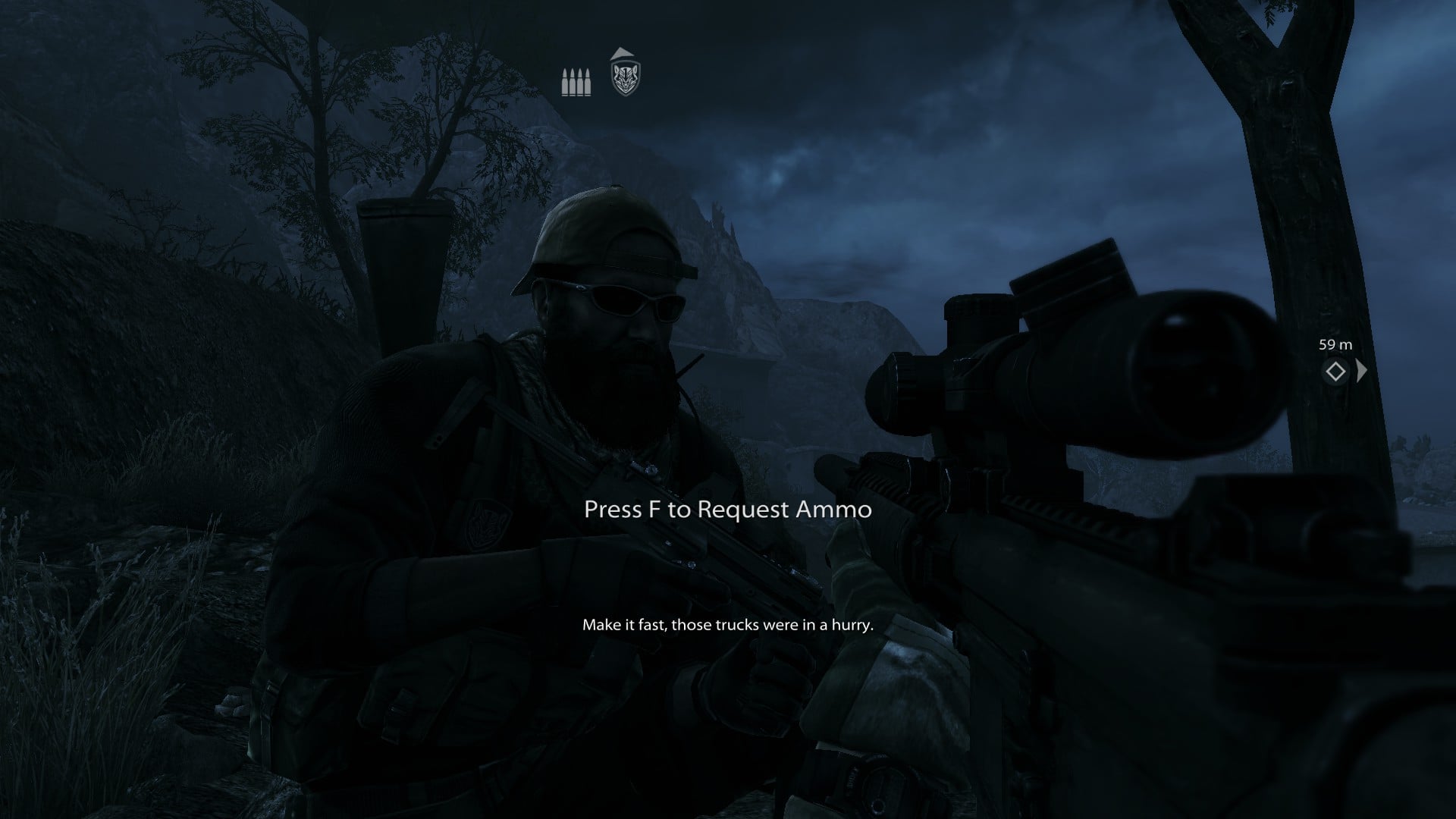
Mr. DudeMcLargebeard getting ready to shoot the evil people.
(Warning: Spoilers for the story of Medal of Honor 2010 and Call of Duty: Modern Warfare 2 lie within.)
Back around 2014, I had written (but oddly didn’t publish) a thing about Medal of Honor: Airborne, which I had replayed because a friend was streaming the game. It’s one of his personal favorites, and while I liked some elements of it like being able to drop anywhere on the in-game map, or even the creative weapon upgrade system, it just felt like a tired shooter going through the motions, and was going beyond the more historical angle of Medal of Honor, even having Nazi super soldiers wielding MG42s like it was nothing.
At the end I had written something to the effect “It’s not as amazing as Frontline or Allied Assault, but it’s probably better than Medal of Honor: Warfighter.” At the time, I hadn’t played the most recent Medal of Honor games, and 2018 felt like the time to tackle Medal of Honor 2010 – as I’m gonna call it from here on in, to distinguish it from the 1999 original – and I felt disappointed all the way through.
I finished this back in January, as the very first game I beat in 2018. This was not a good start to the year.
Realizing World War II games were on their way out after a near ten-year period of them constantly coming out, EA was in a bind. Medal of Honor was considered this prestigious franchise, and they didn’t know where to take it. Their solution was to see what their competition already did three years prior and follow suit: Go modern, and see if it stuck.
The problem was that this came out right after the extremely successful Modern Warfare 2, and was out the same year as Call of Duty: Black Ops – probably in my top three favorite Call of Duty games for various reasons – so already EA was climbing a very, very steep hill. With Medal of Honor 2010, EA didn’t get to the top, but instead slipped and started rolling down the hill, giving themselves bruises and broken bones along the way.
Gameplay wise, it’s a boilerplate roller coaster of a modern military shooter. Shoot the bad guys, reload, occasionally use a grenade launcher or call in airstrikes. Right click aims, Left click shoots. Occasionally you get medals for headshots or multikills, a holdover from Medal of Honor: Airborne that doesn’t make sense here. There’s even a level where you’re in a helicopter. Occasionally soldiers go “hooah” and speaking military lingo so frequently that it’s almost self-parody.
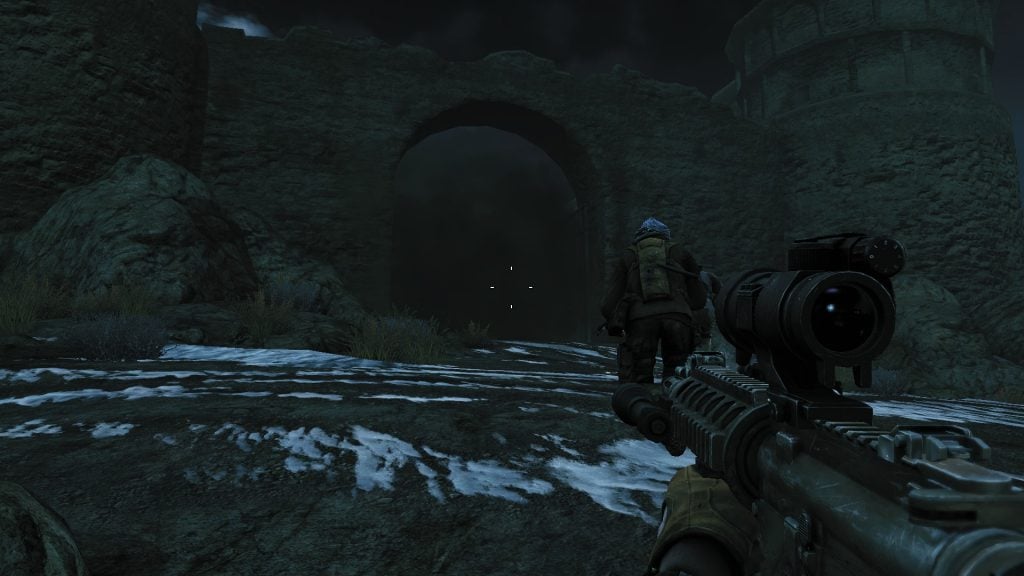
Even something like this has been done, and done better elsewhere.
It’s clear Danger Close was glancing at what Call of Duty 4 did years prior, and tried to copy it, but didn’t understand what made Call of Duty 4 such the blockbuster success.
Over the many years I’ve been collecting games, I’ve always found particularly unusual game show games. Besides the common Jellyvision/Jackbox collective, I’ve found stuff like Outburst, a board game that decided to become a poor man’s You Don’t Know Jack; Another Jack clone that was endorsed by MTV’s TRL, the list goes on. I even have Pat Sajak’s Lucky Letters, which makes me one of the 34 people who bought a physical copy, and that’s also worth talking about. But this one’s a bit different. It comes from across the pond, and features one of the most notable fads of the mid-2000s…
I wonder if us Americans thought Carol Vorderman was like Mavis Beacon.
It’s Carol Vorderman’s Sudoku. A somewhat obscure Sudoku game, this came out courtesy of Secret Stash Games, a weird Eidos Interactive imprint. Though Empire Interactive is also credited on the box and in the game itself, which mostly published games in the UK (and were the original distributor there, presumably).
So you’re probably asking: Who the heck is Carol Vorderman, and why is she endorsing a Sudoku game? I’m going to assume the people reading this post are not from Britain and/or game show nuts, so I’ll give the skinny on who she is: Carol Vorderman is a long-standing television host, being the co-host for a British game show called Countdown.
Countdown is a fairly simple game show where players either try to come up with the longest word from a semi-random pick of letters, or solve a mathematics puzzle by hitting a target number with six randomly chosen set of numbers.
Carol solving a particularly devious numbers round.
Vorderman was well known especially for the latter, sometimes getting solutions to the math problems that even the players couldn’t figure out. She was on the show for a very long time, from the show’s early beginnings until 2012. She’s almost like Britain’s Vanna White, but does more than touch screens and clap all day.
As for Sudoku, it’s a little more complex. A long standing game that got an unusual resurgence around the mid 2000s, the game involves placing the numbers 1 through 9 on a 9×9 grid split into 3×3 subgrids. The goal is to make it so each row, column, and subgrid have one of each number without any duplicates. It’s a nice mental puzzle that gained traction in unusual ways, and it’s one of the mini-games in Nintendo’s then-popular Brain Age games. It’s certainly more enjoyable than Jumble or Crossword puzzles, anyway.
Presumably this was made for a pittance, since this was around the time Phoenix Games were churning out sub-par budget games in the UK, so this likely got tossed in that same pile. Though in my case I only paid a few bucks for it at a gaming convention, so it’s no big loss.
So here’s the first problem I have with this game. Carol Vorderman doesn’t have the name recognition that someone like Gordon Ramsay or James Corden has outside their native England. Had I not told you who Carol Vorderman was, you would probably assume she was a fictitious entity like Mavis Beacon.
But I assure you, she’s a real person who endorsed a Sudoku game, and for some reason somebody thought it was fitting to bring it here without any context of who she is or where she’s from.
This looks like this was made in like five minutes while the Ui designer was taking a bathroom break.
But enough about what person gets to endorse the sudoku game, let’s get back to the game itself. The version of Carol Vorderman’s Sudoku I’m playing on is the PS2 version. Though it did get a PC release, I couldn’t get it to work on Windows 10. I assume both versions are identical in terms of content, but when it comes to something like Sudoku, you can really only change so much.
About a year or so back, I wrote about Modern Combat 5. I did so because I had jumped from Windows 7 to Windows 10, and never got to experience the Microsoft Store ecosystem.
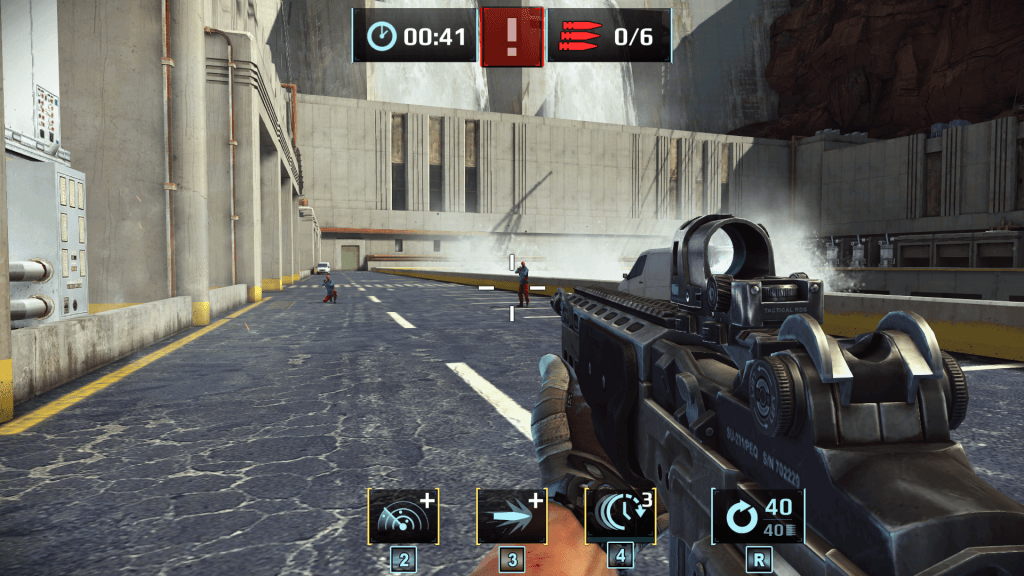
One of the games I had downloaded, Sniper Fury, weren’t really worth talking about all that much. Just felt like Modern Combat 5 but more like a rail shooter.
I was going to do a series based on Windows 8-10 apps, but I got sidetracked by other things. The other games I had installed had either gotten super grindy to make progress unless I paid, or in the case of Asphalt 8: Airborne, that they are such a daily ritual for me that I’m still grinding to get that last achievement to this day. The only other games that could be interesting to write about are too well-known like the Killer Instinct reboot.
But there was one more game I had installed, and until recently, never tried. Then I tried it, and thoroughly regretted playing it.
STERN MILITARY FACE RETURNS
Overkill 3 is the third installment in a modestly popular franchise originally released on mobile platforms. Co-developed by Spanish developer Game Troopers and Czech developer Craneballs – props for the goofiest developer names I’ve seen yet, this is the first game available on the Windows platform.
From what I’ve seen of screenshots from the previous titles, Overkill 3 takes a mild curveball in terms of how it plays. The previous titles were first person rail shooters, and while Overkill 3 still plays like one, we actually get to move to third person, over-the-shoulder rail shooting. So it’s a bit of both a rail shooter like its predecessors and a cover shooter like other games out there. At least they’re spicing things up.
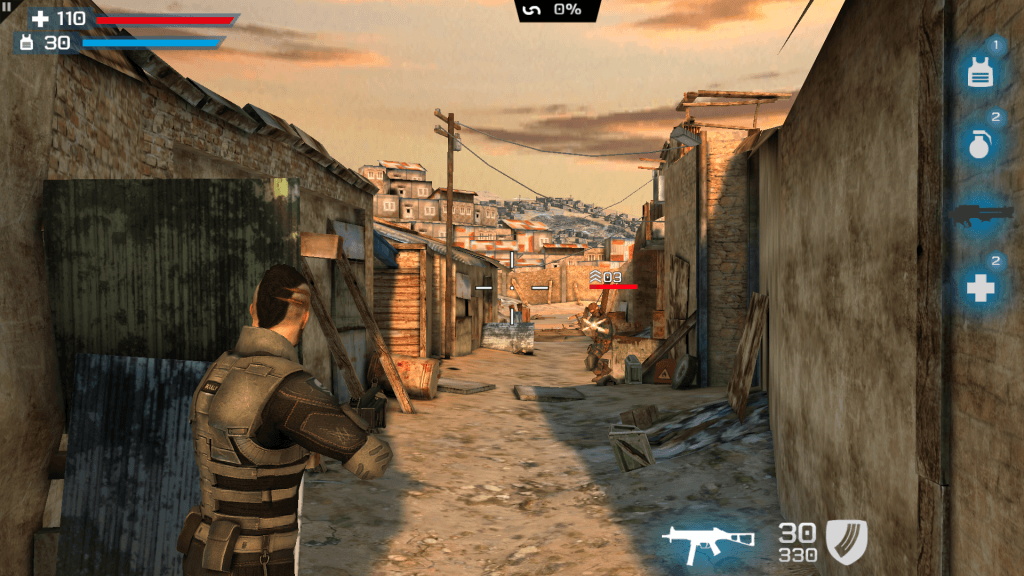
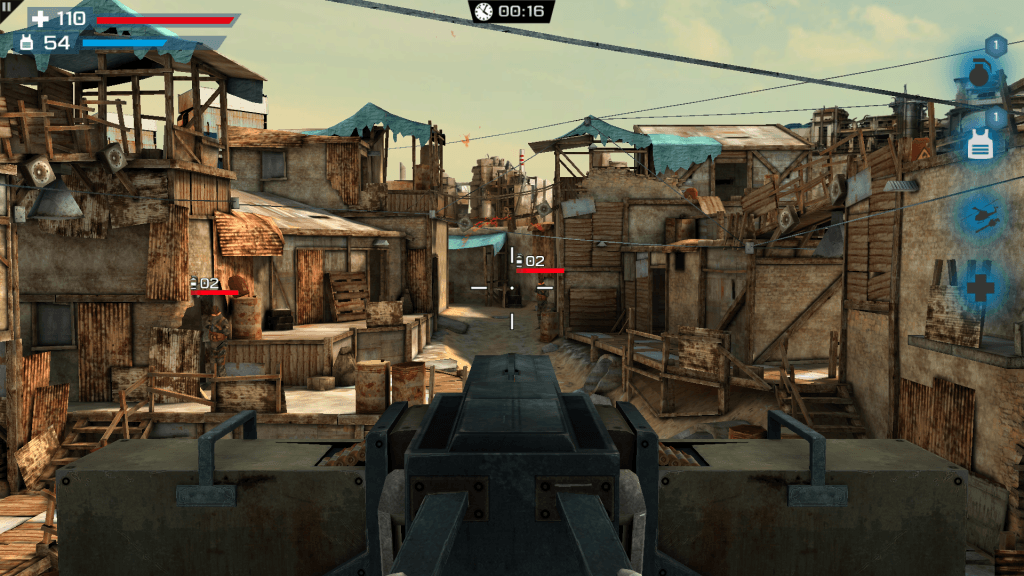
Here’s our resident shootyguy who must kill the evil big bads from… doing the bad things. Honestly I couldn’t tell you much else.
There is a plot to the gmae, but it’s so razor-thin that there’s no reason to pay attention to it. You play as John Scully, a military soldier who goes from various places around the world fighting off big bads that vary from generic soldiers to outright mechs. There is no principal villain, just Scully going from place to place, hiding behind cover, and shooting dudes repeatedly. Scully also wins the award for the most ridiculous protagonist hairdo I’ve seen this side of Soap MacTavish, which is something.
Each mission has Scully shooting enemies, and completing certain tasks. Some are simple: Finish the mission, complete the “slide the screen” quick time events, don’t die. Others are fairly grindy, like killing x number of enemies, or staying in a stage for a period of time. Completing challenges gets a star and some cash or medals that can be used to upgrade or buy new things.
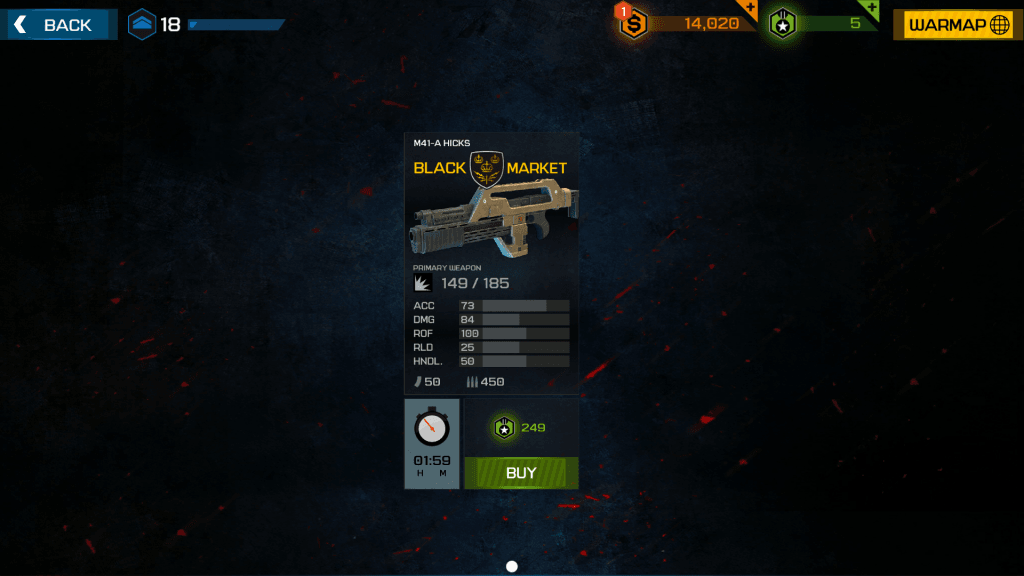
How cute, I could get the Aliens pulse rifle if I get some more premium currency. Bet it doesn’t have the sound effects.
Overkill 3 hits this weird territory of being tonally inconsistent with the world and its plot at times. While there are human soldiers who wield real guns like an AK-47, a Desert Eagle, and a Barrett .50 cal, there’s also futuristic space guns, even ones like the pulse rifle from Aliens, and… stuff like a giant mech robot with a minigun.
Johnny 5 is alive! …and he’s fuckin’ PISSED!
It’s like the team wasn’t sure if they wanted to stick to being a modern military game, or saw what Call of Duty was doing at the time and thought future warfare was The In Thing; so they decided to go with both. I assume the previous games were mostly grounded in reality, but since they were on iOS I can’t really confirm.
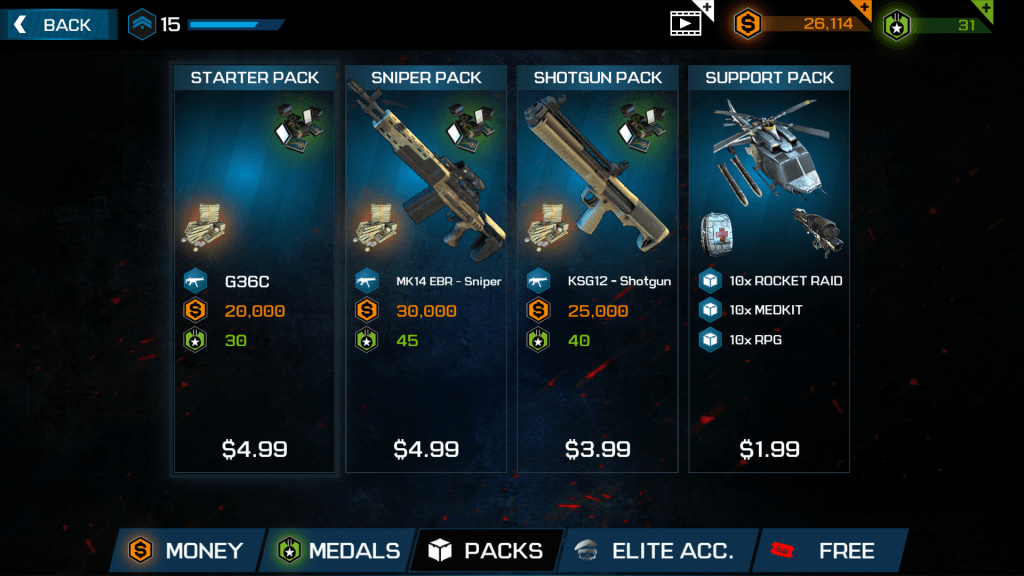
Since this is a freemium mobile app, they’re gonna barrage you with packs for real money to get you to invest in their ecosystem. Thankfully I didn’t spend any money.
So you probably read “buy new things” and asked, “This is a freemium game, isn’t it?” You’d be right. To get certain weapons and armor, you need to have the right amount of credits and medals. Credits can be acquired by just doing missions, but medals require either leveling up, completing specific challenges, etc. Of course, you could just buy your way to victory, but I do not encourage this because this game really doesn’t deserve any money.
There was a point where every time I started playing Overkill 3, that there was a glimmer of hope, that there might be something good. As I progressed, there were missions that became so annoying and remotely unfair in spots that I must’ve tried and retried a dozen times, and that’s even when given the opportunity to revive just by watching an ad. I basically was grinding myself down in a vague attempt to make some progress, and it certainly wasn’t fun.
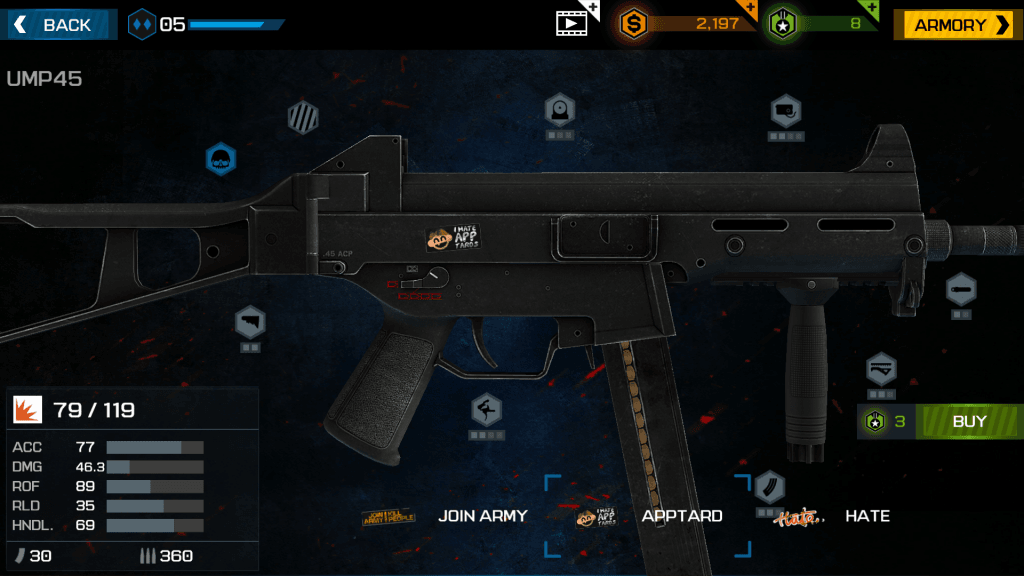
I can’t tell which of these is worse, the sticker with the ableist language or the “JOIN ARMY | KILL PEOPLE” sticker…
It doesn’t help that even while in cover, Scully was still taking damage. Sitting there, not firing, having him nag at me for not doing anything, and he would still take chip damage. At one point, I had just finished off the last enemy – a mech robot shooting rockets at cover – and took just enough damage to die, thus denying me the reward for finishing the level, having to start over.
This seems more in line with the other games in the series, just being a gun that shoots everything in front of them.
I could upgrade my armor, but I also hit that wall where I needed medals, and I didn’t have enough of those. I could get a better, more powerful gun, but those cost a lot of credits and require lots of grinding. I could upgrade my weapons or buy grenades or rocket raids, but eventually those cost medals as well. And if I use medals, I then can’t get certain weapons or armor unless I grind or spend money to get them. Lather, rinse, repeat.
There is a reason there’s a fair share of disdain among people who play these kind of free-to-play games and hit the brick wall of being stuck unless they’re willing to do the grind or give up and pay their way to make progress. For Overkill 3, the gameplay loop is so rote that it just wasn’t fun.
I was willing to put up with the paper-thin story, the wonky controls that were made more for a tablet touchscreen and not a common mouse and keyboard PC, hell, I was even willing to play the endless mode to get some extra cash. But I just got sick of it, and realized there were many other, better games I could be playing instead.
This mission in and of itself took a dozen tries, mostly because I went from full health and armor to zero in a matter of seconds. This game ramps up the difficulty unfairly.
I hate leaving games unfinished, but if the goal to completion is “grind or pay up,” I tend to abandon it without much of a second thought. Unless it’s a game I really find enjoyment in, like Asphalt 8, I can’t stick with it. I gave up roughly around the halfway mark, and feel no urge to come back to it, because I know even if I returned to it, all the elements of the grind would rear its ugly head once more, and I’d get sick of it again. So I abandoned it, and moved on to something else.
Even though this is a mobile game ported over to Windows, this is not where the legacy of Overkill 3 ends. Game Troopers moved on from the crowded mobile game market to the not-nearly-as-crowded virtual reality market. For the low low price of $20 — VR headset sold separately — you can play Overkill VR, which is this exact same game in Virtual Reality! At least it probably doesn’t have scummy microtransactions to slow down progress.
Let’s make tap to high-five the new “Press F to pay respects.”
There is one thing I do appreciate about Overkill 3, though: Sometimes Scully will ask you to do a high-five upon completing a mission. I’m not even bothered by the fourth-wall breaking moment, it’s just so goofy that I’m always amused when it happened, no matter what.
I will always appreciate games from countries you won’t expect to have a burgeoning games industry. Hell, I wrote fair praise about Chaser a few years ago, a game by a Slovakian game development studio. It’s just not a good game. If they were to release an Overkill 4, I’ll be okay with skipping that, if this game is any indication. At best, Game Troopers and Craneballs deserve a gold star for trying and not much else.
id software’s amazing run of first-person shooters in the ‘90s are in some of my top games of all time: Doom, Quake, even Quake III Arena was pretty good in spite of Unreal Tournament’s more fun, absurd nature. But one game I had a fondness for was Wolfenstein 3D.
For a long time, I tended to look at the more community side of these games, looking towards the mods and user-created levels people made. Even for something like Wolfenstein 3D, which is nothing but 90 degree angled floors, there was some charm and enjoyment from them. Hell, I even found some amount of enjoyment in the third-party Spear of Destiny mission packs that FormGen put out.
Wolfenstein 3D is a fairly simplistic shooter by modern standards, but it started laying the groundwork for what made their games tick: Exploring areas, defeating enemies quickly, and strafing around arenas in a quick pace. It’s operatic ballet but with guns and nazis. What happens when you try to make it work in an actual 3D engine and try to shoehorn in awkward mechanics that just don’t fit? You get Wolfram.
Already we’re off to a great start with this menu…
I have to give a shout out to the Video Game Music Preservation Foundation, which for some reason has an article dedicated to this game. Being a fan of the Wolfenstein games, I had to see if this was the remake of Wolf3D that would be better than the original, like how Black Mesa to Half-Life. Sadly, I was in for a world of disappointment.
Back in the mid ’90s, when Sega slowly was losing its competitive edge against veteran Nintendo and newcomer Sony, they were also publishing a fair share of their games on Windows PCs. This isn’t as well known as their other stuff, considering most of them were ports of existing Genesis and Saturn games now running on the Windows 95 PCs of the era.
Most of the ports were of somewhat lesser-known stuff like Comix Zone and Tomcat Alley. Eventually they started releasing more iconic games, some even in compilations. But then a certain blue hedgehog burst onto the PC scene, and for real this time, rather than fan games made by Sonic diehards in Klik’n’Play.
Featuring The Best Sonic Game. Anyone who says Sonic the Hedgehog 2 is the best Sonic game is a liar.
Sonic & Knuckles Collection was released in late 1997 for Windows 1995, and was the second major Sonic game to reach PC, the first being two different ports of Sonic CD. Though the Hedgehog was branching out to other ventures, including the educational Sonic’s Schoolhouse, this was probably one of the biggest gets for PC gamers who didn’t really dabble much in the Sega Genesis/Mega Drive library.
I was strictly a Nintendo kid pretty much until the late ’90s, when I got my first PC. A Windows 3.11 Packard Bell machine. While I did own other platforms, including a Genesis, I never really got to really experience the platform’s greatest stuff until many years later, thus I never got to play Sonic 3 & Knuckles until this PC release.
Well, that infamous platform jumping section through rising water in Sonic 2‘s Chemical Plant Act 2 traumatized me pretty bad when I was younger. I ended up getting Sonic 3 not long after it came out in 1994, but when I got to Hydrocity Zone and realizing it was involve a lot of water, I got so scared that I shut off the Genesis and asked to return the game. While it doesn’t bother me nearly as much these days, I can still get a bit of a twinge whenever I hear that damn drowning music when playing a Sonic game. Damn you Yukifumi Makino, making a 10 second ditty that haunted kids for generations!
Nooo don’t send me down there
Over the years I have procured one, not two, but three copies of this dang game. The first one I got was part of a Jack in the Box promotion in 1999, which was part of a kid’s meal promotion the restaurant had around that time. had a few other Sega PC games such as Sonic 3D Blast, Bug! and the original Ecco the Dolphin. The others were a complete-in-box copy I found at in the bargain section at an office supply store, and a CD jewel case copy that was part of a Sonic three pack with Sonic CD and Sonic R.
They do say that you can never have enough of a game, but I think three copies is a tad much. But hey, it’s kinda hard to get rid of stuff like this, y’know?
The menu where you choose what game you want to play. I like the fairly random “2-PLAY OK” on the side.
I don’t get super-political on this blog, but you can probably tell my absolute disgust for the NRA. Gun regulation is a big problem here in the United States, what with lots of gun homicides and mass shootings happening almost regularly. The NRA often use scapegoats to distract from the real issues about guns in this country. Lots of countries in the world have already figured out gun laws, and yet we sit here with them blaming everything but the product itself.
It doesn’t surprise me that they would be absolute hypocrites when they blame video games, yet made their own game. Well, rather, they gave endorsement for a video game.
Look at all those gradients!
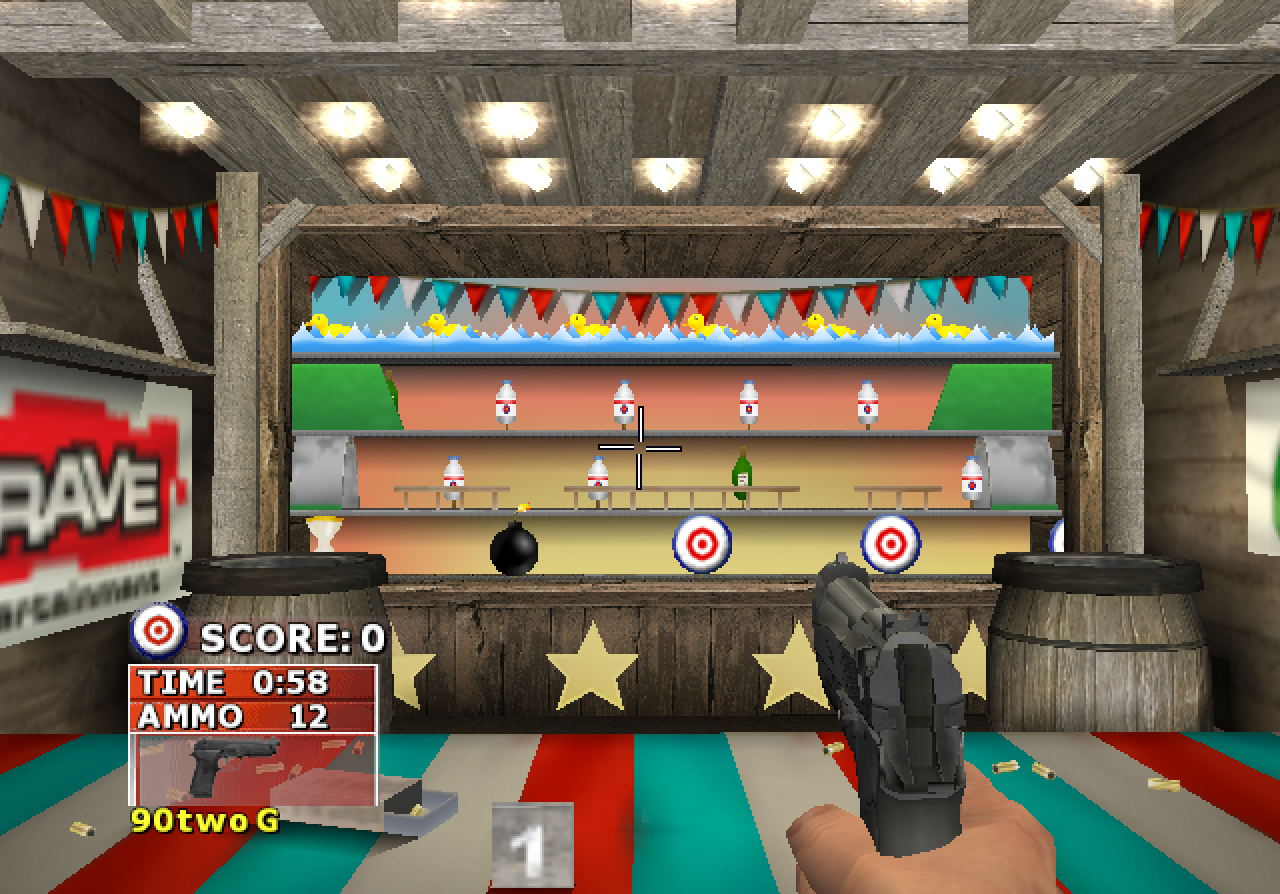
This is NRA Gun Club. A first-person shooter published by Crave and developed by our good friends at Jarhead Games. I’ve covered Jarhead’s stuff in the past, with such thrilling hits as CTU Marine Sharpshooter, which I wrote about here, as well as Navy SEALs: Weapons of Mass Destruction. As far as I know, this game would be their swan song, not living long enough to make it to the 360 generation. This would also be the sole game they made on the PlayStation 2, and it shows.
This game runs on the Gamebryo engine. Gamebryo must be proud to know the same engine that powered Fallout 3 and The Elder Scrolls IV: Oblivion also ran this wonderful game.
Or at least his first name, this game has a six character name limit.
After being introduced to the bland title screen, I am asked to make a profile name. Since this is based on the NRA, I’d thought it’d be nice to name my profile after Wayne LaPierre, the NRA executive vice president and mirror-universe Stephen King. He’s probably the most notable personality of the organization next to like, Charlton Heston.
The only mode with any sort of progression is Certification Mode. Here, there are four courses, each one unlocked after completing the previous one, with certain requirements needed to pass. There’s Plinking, Bullseye, Trap/Skeet and “Practical Shooting.” I’ll describe each one the best that I can.
This is probably one of the few games that you could genuinely say “looks like a PS1 game.”
The “Plinking” challenge involves rapid-fire scoring for points. Choose a weapon, shoot at targets, score points, repeat until time runs out. Most of the targets award 5 points, but some target like the cans award 10. Each of these are done in “Strings,” where the range is reset each time, with the final score averaged out of the best runs. If the average meets the minimum required score, it’s considered a passing grade.
The challenges are split between pistols, long range rifles and shotguns. Once you qualify in each challenge, it ends with a “Multi” course that combines all three weapons. Successfully pass that, and the Plinking challenge is complete.
If you’re like me, you probably have a massive backlog of games. It’s not surprising, Steam sales have become the bane of our existence. In my case, I sometimes buy games and wonder why I bought them, like Chrome. I almost wrote something about that game, but I kept dying even on easy, so I bailed out of playing that one.
This is just a small excerpt of some of the games I’ve bought on countless Steam sales and never played or finished.
So let’s see what else I got. It’s a bit early in the year to write about Amnesia: The Dark Descent, stuff like The Elder Scrolls: Skyrim has been done to death, and I don’t think there’s interest in me writing about the Telltale Wallace & Gromit games…
“Doom 3 meets Smash TV” is quite an unusual boxquote.
Here we go. Shadowgrounds, a game from Frozenbyte, a Finnish developer who’d later be known for the Trine series of games. This was one of their earlier efforts, and holds a bit of a memory for me. We have to go back to the far-flung past of 2006 to explain this story.
While Steam is an absolute juggernaut and considered the gold standard of PC digital distribution now, back in 2006 Steam was a much different beast. Besides Valve’s own titles, there wasn’t much third party support for the storefront, outside of a few indie games like the wonderful Darwinia and the one-note forgettable Rag Doll Kung Fu.
Frozenbyte’s Shadowgrounds was one of those early adopters of Valve’s content delivery service, and while it probably wasn’t a breakout hit, I remember it being one of those standout games during Steam’s early years. Considering this was during the transition period for PC gaming where games were still sold in physical boxes in stores, this was probably a better place for the game than being stuck in a bargain rack at a GameStop.
I bought this along with its sequel, Shadowgrounds: Survivor during a Steam summer sale. I was familiar with the game through a demo, but I figure the full game was probably worth a try. It being $1.24 during a Steam summer sale probably helped too, as I’m a sucker for impulse-buying games for super cheap.
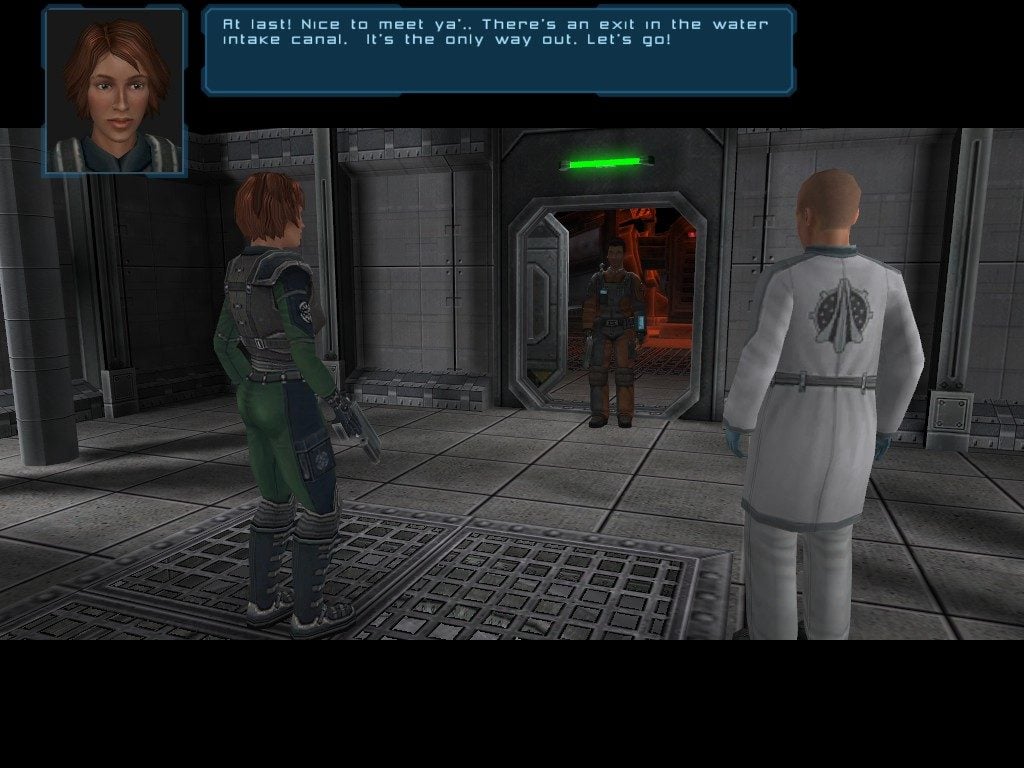
You play as engineer William Tyler, who is sent to the moon Ganymede to do some routine generator repair. As expected in fiction like this, stuff goes wrong and aliens begin to invade. Armed with only a pistol, Tyler must fight loads of aliens as he fights for his life while trying to find out the mystery of this invasion. Along the way you meet people that try to help you make sense of this mess.
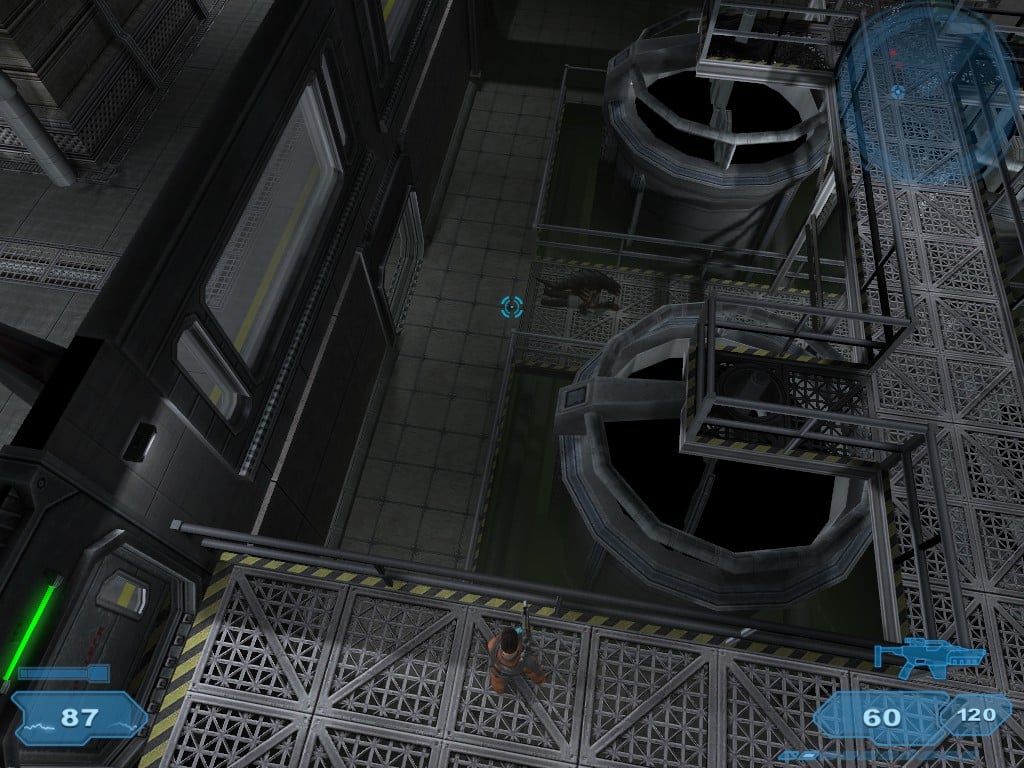
Even for a top-down shooter, this game has pretty good level complexity.
Shadowgrounds is a top-down shooter. It reminds me of Valve’s Alien Swarm, though European readers may liken this more to Team17’s Alien Breed series of games. The game is fairly straightforward: Shoot the aliens before they attack you and kill you.
A lot of the arsenal is fairly commonplace stuff for these kind of action games: You start with a pistol, then later get an assault rifle, shotgun, rocket launcher, stuff like that. The only unique weapons on display is a laser rifle, a longer-range railgun and an electric zapper weapon towards the end of the game.
You can’t tell in the screenshot, but the character’s head-in-a-box has a moving mouth, but not their in-game version. Looks kinda weird to me.
Throughout the game there’s a lot of PDAs and computers that explain the shady dealings that this military base does, which is kinda cool. While this does give some Doom 3 vibes, it at least seems more interesting especially when one of the PDAs is a small gag about a chef’s love for meatballs.
For a while, I wasn’t going to upgrade to Windows 10. But then a friend convinced me of a few cool features, and I decided to finally take the plunge since it’s free as of this writing. Since my current PC was on Windows 7, I missed out on all the cool apps that came out during the Windows 8 era. After perusing the store, I found a few interesting games. Boy, I wasn’t expecting this…
It’s time for STERN MILITARY SOLDIER POSE
Modern Combat 5: Blackout is probably the most generic title for a game ever. This is the product of Gameloft, a French-based development studio known famously for their mobile phone and handheld games. Naturally, this is a “port” from iOS/Android devices, supporting cumbersome touch screen controls.
While I haven’t played the previous entries in the Modern Combat franchise, I am familiar with it. One of the games, Modern Combat: Domination, made it to consoles and I remember Giant Bomb covering it once. At the time, it looked like a mish-mash of Call of Duty 4 with a pinch of Counter-Strike‘s elements. By default, I go into any new game I play with mild skepticism and low expectations just so I don’t hype myself up for disappointment, so I wasn’t expecting much here.
This is a hell of a way to start a game…
You play as Phoenix, a mercenary for works for some corporation. With the help of a bald marine named Bull, you two storm through San Marco, escaping from evil terrorists, and eventually escaping a helicopter in a boat chase sequence. Pretty exciting for the beginning of a Call of Duty clone.
Is this some spirit animal allegory I’m not aware of?
Afterwards, Phoenix wakes up in Japan, taken over by raiders during some terrorist attack or something. I’ll admit, I barely remember the story of this game, and that’s coming from a guy who played through Battlefield 3 and 4, which had really unremarkable generic campaigns. But from what I gleaned from a wiki for the series, it’s basically double-crossing between various factions, and a surprise plot twist that the CEO of the Gilman corporation is also a mercenary soldier who caused the double-crossing. Hardly oscar-caliber story writing, but I got what I paid for. (Nothing.)
Something I noticed while playing was that a lot of the voice actors for this game are familiar to me. They’ve voiced characters in the Pokemon anime, mostly as minor characters. However, there is one voice I was surprised to hear: Jason Griffith, once the voice of a certain blue hedgehog, voices a minor character in this game. How the mighty have fallen, I guess.
One of the many classes you can choose from. You get Recon to start, and the rest require you to either grind levels or pay up to unlock.
Modern Combat 5 has a leveling system and unlockables. There’s a create-a-class option, weapons can be upgraded by using them in the game to unlock attachments and better weapons, and each class has special skills that are upgraded using SP. SP is gained between some missions, leveling up, and between events Gameloft put up. One thing I liked is how the rankings persist between both single player and multiplayer, which I wish more games did.
There are seven tiers of each weapon. While all the weapons are based of real guns, somebody at Gameloft thought that Tier 7 should be future-looking versions of old guns. The SMGs get a futuristic Thompson called the “Bromson,” Sniper rifles get a modernized Lee-Enfield called the “BSW 77,” and the pistol gets a future space Luger called the “Mrager.” I am not making this up. This is so ridiculous that I had to get screenshots of them:
Multiplayer is typical military FPS in a post-Call of Duty 4 world: You have perks, you have a powerup you can use, there’s killstreaks like recon drones and EMP strikes, and you get XP for kills. There’s the common FPS gamemodes: Free-for-All, Team Deathmatch, Capture the Flag, and an unusual TDM variant called VIP where the VIP is always visible on the minimap and killing them rewards more points than killing other players. Fun, but a VIP kill is 5 points and the scorelimit is 50, making the matches go by faster than expected.
My dad once said that combat drones will be the future of combat. I guess he was right.(more…)
PC gaming in the ’90s was a real wild west affair. When games like Doom took off, everybody started making shovelware compilations of anywhere from hundreds to thousands of levels. Most of them were downloaded off BBSes without crediting people, which is pretty scummy in itself. But if you had no internet connection, this was a way to get levels with ease.
“Direct from the Internet.” Kinda rude to take those without permission, you know?
After a few years of this, companies like WizardWorks started making their own unofficial expansions for games like Quake, Descent and Warcraft II. While this was an improvement – level designers could actually license their stuff for commercial use – the internet was really starting to bloom in the late ’90s, making these unofficial “expansions” obsolete.
Today, I’m gonna look at one of these unofficial expansions for a little game called Quake…
This looks like something I’d see on some pick up artist’s vlog channel.
Forgiving the groan-worthy punny title, Aftershock for Quake is one of several expansions made to capitalize on Quake‘s success. Published by Head Games, this featured “advanced levels”, adding three episodes and a bevy of deathmatch maps.
Unlike the official expansions – Scourge of Armagon and Dissolution of Eternity – these have no new monsters, powerups or weapons. These are vanilla Quake levels, designed to run with a registered copy of the original Quake. The episodes are drastically shorter than vanilla Quake, only having five levels for each episode.
Unsurprisingly, I couldn’t get the installer to work on my PC running Windows 7 64-bit since it’s a 16-bit application. Thankfully, all I had to do was to copy the /AS/ folder from the CD into my Quake folder and I was off to the races.
The blood on the logo looks rather ominous.
There isn’t much of a story to these maps. Considering Quake‘s story was already bare-bones to begin with, this is relatively par for the course. With the exception of episode three, there aren’t any credits to who made this. It’s unfortunate, because I was hoping to see someone who would go on to later claims to fame in game development, as a “before they were stars” moment. Kinda like how Viktor Antonov worked on the infamous Redneck Rampage as an art designer before crafting out the styles of Half-Life 2 and Dishonored.
By the way, there’s no new music in this. All of it is recycled from Quake, with the exception of one level having no music whatsoever. It would’ve been nice for them to go all out, but I’m glad they even bothered to even assign music tracks. Makes me want to put in a music CD to get a different feel to it, like when I wrote about Red Book CD Audio a couple years back.
Wonder why they put both a knight and an ogre as if they’re equal threats? One has a grenade launcher, for chrissakes.
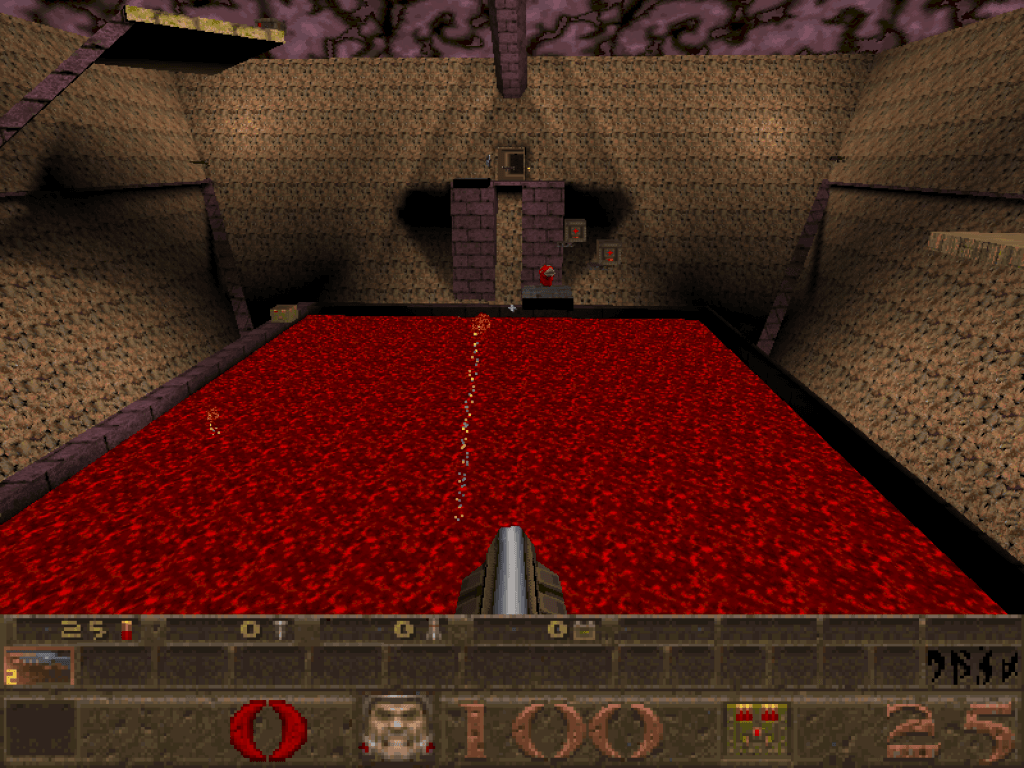
Episode 1 has some interesting design. E1M1 starts you with an ogre, a knight, and a pool with armor in it as a secret. A later level has you hit a hard to see switch to move a boat across to grab the gold key, otherwise you die in hot slag.
Better get that quick save key ready. I shudder to imagine trying to do this with keyboard only.
A lot of the level design for Aftershock feels very amateur. Lots of precarious platforming over death pits, unclear instructions, and rather plain-looking level design. A lot of the levels are simple, poorly lit, boxy, and have no sense of balance. One level starts you near a rocket launcher, but then drops you into a trap room with two shamblers, a few fiends, and a couple of pentagrams and megahealth to aid your fight. A lot of these levels have several “kill all the enemies to progress” rooms, and it’s a bit frustrating.
I dub this image “myfirstquakemap.map.”
Granted, this was around 1996-97, and people were still trying to figure out this fancy new 3D engine, but if you’re selling this level set for money, you gotta make sure it can hang with the big boys of the official product and its expansions. And the first episode gives a rather less-than-stellar impression.
On the bright side, the makers of the mod didn’t seem to know how to strip the player of their weapons upon completing an episode, so if you’re playing the episodes in order, the later episodes can be a breeze because of a full arsenal.
I’m sorry but what the hell is this
Out of all three episodes, episode 3 is the one that feels more fleshed out. With more custom textures, and even proper credits — the whole episode’s made by one Greg MacMartin, who’s still in the biz today working on Consortium and the Homeworld games — this is the best of the stuff on display. Though he did have a fascination with putting the gold key in death trap areas…
This is rather cruel enemy placement for a key.
While I didn’t have any strange bugs while playing, I did experience a rare game crash. When I finished E3M5, Quakespasm, the source port I use, crashed with an unusual pushwall error. I was worried that this was an issue with the source port, but surprisingly I could not recreate the error after that. If there’s anyone reading who’s Quake-savvy who could explain what a pushwall error means, let me know in the comments.
That’s about it on the single player front. Aftershock for Quake also comes with about 13 deathmatch levels also made for the expansion, but most of them are simple box levels or have gimmicks, such as the two LAVABOX levels.
Since Quake multiplayer was in its infancy, a lot of these were likely made for 1v1 skirmishes. None of these maps are anywhere near levels of DM3, but when you just wanted to frag your buddies, you were happy to get whatever maps you could get your hands on.
Now who the heck would want a pool full of hot slag?
You think that’s it, right? There’s enough there to give you something to play around with. Remember when I said that these were made when shovelware compilations were extremely common? Hidden on the disc is a level creator, called Thred, and a bunch of levels that come with it separate from the main Aftershock campaign. Though, the back of the box calls it the “Aftershock 3D Level Editor,” which sounds like a fake program I’d hear on a TV show.
There isn’t anything outstanding in this collection – no Iikka Kiranen levels or anything cool like that – and some of these levels are merely tutorials for how to do things in the Quake engine. Most of these levels are freely available online through places like Quaddicted, but you’re probably not missing out.
Dare you walk down the ramps of death?
Aftershock for Quake is not an amazing expansion. Episode 3 and the various DM levels are the only reason to check this out, the rest of it is shovelware fodder that was prevalent during this time. I only spent a few bucks on this, so I don’t feel cheated out of this, but I got at least an hour or so of fun playing what Quake‘s community maps were like in 1996, so there’s that.
As far as I know, this is abandonware. Head Games no longer exists, and there’s probably no penalty for pirating an unofficial Quake expansion over twenty years after its original release. While not as outstanding as some of the other expansions, it’s a cool curiosity from years past. These kind of shovelware expansions should be documented more, there’s probably some interesting stuff about them we’re missing out on.
Demon Gate cover courtesy of Mobygames. Aftershock for Quake cover courtesy of the Quake Wiki.
Updated 8/1/2020 for paragraph changes and some updates.
It’s the holiday season, and what better way to celebrate than playing something Christmas-related? How about a game based on one of the best damn action movies of the 80s, Die Hard?
I don’t care what anyone says, this is a Christmas movie in my book.
Okay, I may be stretching it a bit here. But it’s better than trying to find some Christmas-themed game involving Santa Claus. It’s also appropriate, considering Die Hard‘s legacy.
There have been many Die Hard games over the years. There was the top-down action game for the NES that’s been featured by the Angry Video Game Nerd and Games Done Quick, the multi-genre Die Hard Trilogy, even the Sega brawler Dynamite Deka which was rebranded as a Die Hard game when it hit stateside. But we’re gonna be talking about a little-known budget shooter that featured our old pal John McClane, Die Hard: Nakatomi Plaza.
Love how they don’t try to give a Bruce Willis-like face for McClane.
This game had an interesting history. Starting out as a “Die Hard TC” for Duke Nukem 3D, it eventually made the leap from the aging Build engine to the new GoldSrc engine in 1999. Development on Nakatomi Plaza went silent in 2000 as rumors went around 20th Century Fox sent a cease and desist on the project.
Eventually the game got re-announced the following year, now with the proper Die Hard license. Since 20th Century Fox had their own games publishing arm (at the time), the game got one more engine change: the fancy new Lithtech Engine. The engine that was used in The Operative: No One Lives Forever a year prior, and would be the primary engine for Monolith Productions’ stuff for years to come. The engine was also fairly cheap to license, which meant Lithtech powered lots of budget games I’ve actually talked about before. We’re talking stuff like CTU Marine Sharpshooter, Vietnam: Black Ops and…
But enough about the engine that powered a dozen junk games. Let’s get into the game itself. Nakatomi Plaza is a loose retelling of the original Die Hard‘s story. If you’re reading this and you’ve never seen Die Hard, stop reading this and watch the film. NOW. Alternately, you could read the book the movie’s based on, Roderick Thorp’s Nothing Lasts Forever, which I heard is actually a good book. If you have seen Die Hard, then continue. Preferably read this while listening to that GuyzNite song about the Die Hard franchise.
Since this game’s hits all the famous parts of the original movie, I won’t go into a play-by-play of the game, only for what the game has changed from the film itself.
The game starts out exactly the same as the film: John McClane arrives at Nakatomi Plaza thanks to Argyle the limo driver, meets up with Mr. Takagi, Ellis and Holly Gennaro, before Hans and his terrorist buddies come in and wreck stuff, leaving John barefoot with his 9mm Beretta.
It’s weird to be playing an FPS with a left-handed protagonist. What is this, Counter-Strike?(more…)