Author: beverly jane

  • Avicii Invector: A rhythm game tribute to an electronic musician.

    Avicii Invector: A rhythm game tribute to an electronic musician.

    (content warning: mention of suicide.)

    My tastes in music are… rather eclectic. If you’ve ever been a longtime reader of the site, you’ve probably had me write about some of the weirdest stuff and sometimes finding good stuff in them. I end up picking up soundtracks a lot because of the licensed music. Hell, while I may not talk about it a lot on the site here, I really enjoy rhythm games. So when I saw a rhythm game based on one of the most notable EDM artists out there, I had to give it a try, even if I never heard of him before playing it.

    Is he about to drop the sickest beat?

    Avicii Invector is a rhythm game developed by Hello There Productions, a small developer based out of Gothenburg, Sweden. Originally released in 2017 on the PS4 as simply Invector, the game was updated and re-released in 2019 to more prominently feature the artist whose music was used in it, Avicii. Avicii is the stage name of Tim Bergling, a Swedish EDM musician who was a major worldwide success, releasing two major albums and a few EPs in his lifetime.

    Tragically, Avicii committed suicide in 2018 at the young age of 28. In the years that followed, there’s been work released posthumously, an Avicii museum in Stockholm, Sweden, and his family launching The Tim Bergling Foundation, a mental health/suicide awareness charity, in his honor.

    I grabbed this game on a cheap discount on Fanatical, a digital discount storefront. Since I’m a fan of rhythm games – glancing at the hundreds of dollars I’ve spent on Rock Band and Guitar Hero stuff over the past decade – I figured I could probably enjoy this game even with only knowing Avicii as “a guy who has a game dedicated to his music.”

    So I’m basically Faith from Mirrors Edge but piloting a spaceship? Cool.

    The story is rather barebones: A female ship pilot has to send things to various planets, while blasting the songs of Avicii to get from planet to planet. These cutscenes play every few songs, and while they’re mostly non-contextual, they bring a bit of life to the game’s overall feel. After all, if you’re a rhythm game, you either play it super-serious like a Rock Band or you go full over-the-top like a good chunk of the Guitar Hero games did, so for Hello There Games to go for the latter route is a wise call.

    I assure you it’s a bit more complex than this.

    Avicii Invector plays rather simply: Press buttons in time with the music for points and to build a combo. While most of the time you’ll be pressing the face buttons, sometimes you’ll also need to hit either shoulder button for lines that are on the track. Changing lanes is handled with the left stick. Higher difficulties add more buttons to press and a lot more lane shifting, which can be quite disorienting if you’re not used to it. Much like most modern rhythm games, if one hits enough notes, they can activate a booster with the triggers which doubles score for a brief time.

    While I’m used to games like Rock Band where it’s less about timing and more about making sure you hit the notes, Avicii Invector takes its cues from games like Dance Dance Revolution, where hitting notes right on time gets more points and a bigger combo. This took a bit for me to get used to, but thankfully the timing seems to be rather generous, even with that little gameplay quirk.

    (more…)
  • Slingo Mystery: Who’s Gold? – A casual classic meets the modern casual game.

    Slingo Mystery: Who’s Gold? – A casual classic meets the modern casual game.

    In the many years I’ve been writing about oddball video gaming stuff, I thought I covered it all. The unofficial expansion packs, the weird cross-promotions, the mostly forgotten cheap games that came out during the 2000s. But it wasn’t until recently did I realize there was one genre I never talked much about: The hidden object game.

    A genre I haven’t really covered on here, the hidden object game involves usually finding a bunch of items inside a room to make progress. For a good long while, the hidden object genre was the go-to game for super casual gamers everywhere. I assume it’s still modestly popular, but I figure most people have since moved on to Candy Crush Saga and similar easy-to-understand mobile game offerings.

    Normally, I wouldn’t cover these, but then I found an interesting hidden object game. One mashed up with a classic online game I remember from my teen years. When I spotted this game at a thrift store, I had wondered how they decided to bring back a mostly dormant franchise and combine it with one of the most popular casual gamer genres out there. Turns out it’s quite a journey.

    James Bond this ain’t.

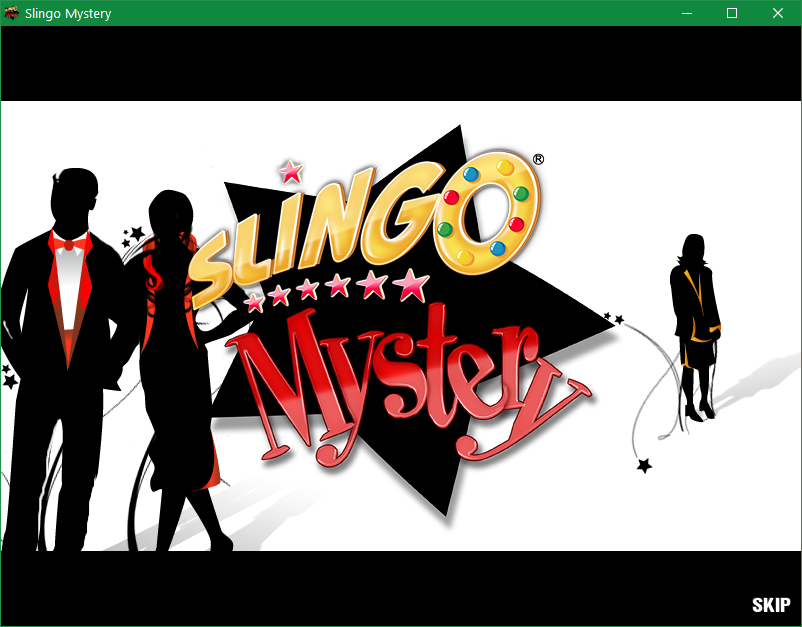
    Slingo Mystery: Who’s Gold? is a game developed and published by Funkitron Games – no relation to Toejam & Earl – that combines the popular hidden object game with Slingo, a game show-like game that mixes slot machines with bingo. Released around 2007 for PC platforms, this game seemed to slip through the cracks, as I didn’t realize this existed until I picked it up last year at a thrift store.

    A screenshot of Slingo Deluxe, one of the earlier offline versions of the game. Sadly, there isn’t much footage of the original online game available, so this will have to do.

    But before we get into the game itself, a small primer on what Slingo is. You have a bingo card and every spin of the reels gives you five numbers to fill the card with. Alongside the numbers are jokers – a wild card that can be used to mark any number on the column its on, gold coins – gives you extra score, and the devil, which cuts your score in half. You have up to 20 spins to fill the card, and the first to do so wins the game.

    Slingo is a game I fondly remember from my days of playing it on America Online. For people of my generation, Slingo was one of those classic games people played in the early 2000s, web 1.0-era internet. That, Yahoo Games, You Don’t Know Jack: The NetShow and Acrophobia are many of these online games I fondly remember. Sadly, most of these are gone now, or live on through fanmade clones.

    Totally forgot how jovial the Zynga Slingo joker was.

    I’ve talked about Slingo once before: Way back in 2012, covering the time Zynga licensed the game for a Facebook mobile game that was fairly short-lived. It was perfectly fine, but filled with microtransactions and nagging your Facebook friends for help, which was pretty common at the time. Thank god we kinda moved past that.

    But I’ve waxed enough nostalgia. Let’s get into the hybrid Slingo meets hidden object game that is Slingo Mystery: Who’s Gold?

    Freddy doesn’t really seem happy to be there…

    You play as Maggie Gold, a divorced, destitute woman who finds out from her friend Kyle Sparks that her ex-husband Freddy has passed, and decided to give his massive Las Vegas casino, “The Gold Casino,” to his current wife Gloria. Throughout the various areas of the casino, Maggie tries to find out the secrets of the casino, which involves a bunch of unusual item hunting and puzzle-solving.

    This is the usual fare for hidden object games: Mostly licensed properties like Gameloft’s The Blacklist: Conspiracy.

    Now, normally I wouldn’t talk too much about hidden object games. They always seemed to be the kind of genre that would flood the bargain bins of office supplies and department stores, sitting alongside a rack of cheap PC releases of games past like Braid or Far Cry 2. To me, these kind of games peaked when books like I Spy and Where’s Waldo came out. I couldn’t imagine these kind of games were anywhere near my wheelhouse.

    (more…)
  • Some Stuff I Bought: First half of 2023 Edition.

    Some Stuff I Bought: First half of 2023 Edition.

    Damn, half the year has already gone, hasn’t it? Since we’re now in the back half of 2023, it’s time to give my twice-yearly update of some stuff I bought for the first half of the year.

    Admittedly, my purchasing habits slowed considerably. The beginning of the year was a rough time for me, which lead to a lot of impulse purchases. Not anything here worth blogging about, but those purchases certainly made a dent in my funds. I’ve gone out more frequently than before, but most of the time I went and checked out a few places and hung out with some folks on the weekends instead of actively seeking out stuff.

    However, that doesn’t mean I didn’t buy stuff that could potentially be article material. For instance, Who Wants to be a Millionaire: The Album, an article I wrote about back in April, was a random eBay purchase. But the hunt only works when it’s more spur-of-the-moment, not done on a computer. And of course, I did buy a few things that I think are interesting to me, at least.


    $10 at FanExpo Portland:

    – Baseball Kids (Game Boy, Japan)

    – Power Mission (Game Boy, Japanese version)

    Back around February, I went to FanExpo Portland. A catch-all nerd convention, but of the old-school Comic Con kind, where there’s a lot of local artists and lesser-known comic book artists alongside the headliners, which were most of the cast of Back to the Future – Michael J. Fox, Christopher Lloyd, Claudia Wells and Thomas F. Wilson – but they were asking a bit too much to see them, plus the lines were too long, so instead I settled with selfies with acclaimed voice actor Nolan North instead.

    I wasn’t really intending to shop much, but I did find a booth that had some Japanese Game Boy games, of which were $5 each. Downside is that I overpaid, as both games go for less than a few bucks each loose. Oh well.

    Power Mission did come to the States under the same name, but I figure owning the Japanese release would be amusing. A strategy game where one controls ships and planes on a grid, it probably plays similarly to the Advance Wars series of games. I honestly thought it was gonna be a Battleship knockoff, but it is far from it. And might be a bit more challenging than I can possibly play. Well, at least it has the writing of somebody’s name in Japanese, which is a nice souvenir.

    The other, Baseball Kids, is a Jaleco baseball game with a cartoony cover: A baseball player sliding into home plate, with the onomatopoeic word “SPLURP!!” drawn on it. I’m gonna be honest, I only bought it because of the cover. Baseball games of this era were fairly simple and while the game featured looked at least somewhat fun, it probably isn’t gonna be my favorite sports game.

    But I will always remember “SPLURP!!”. It’s so silly.

    SPLURP!!

    (more…)
  • Total Overdose: Mex Payne.

    Total Overdose: Mex Payne.

    If there’s anything I kinda miss about gaming these days, is the sense of people copycatting ideas from other games because they became a breakout success. Sonic the Hedgehog was popular, so here’s a bunch of platformers of characters with some ‘tude. Tony Hawk’s Pro Skater rejuvenated a fading extreme sports genre and had a few copycats throughout the 2000s.

    But the biggest was around 2001, when two major franchises released that would shift the balance towards what games were for the first half of the decade: Grand Theft Auto III and Max Payne. GTAIII was a free-roaming open world game that was actually critically acclaimed. Its success suddenly had many games pivot to making GTA clones or even open worlds to drive around in an otherwise linear action game. Likewise with Max Payne‘s release, a fair share of games started taking the bullet time shooting mechanic as well, though not as big.

    Now most of these copycats are perfectly fine, solid game, but they rarely stood out unless they had some kind of gimmick attached to them. One game in particular decided to copy both of those games together, with a pinch of Mexican cinema pastiche for flavor.

    hey, watch where you point that, buddy

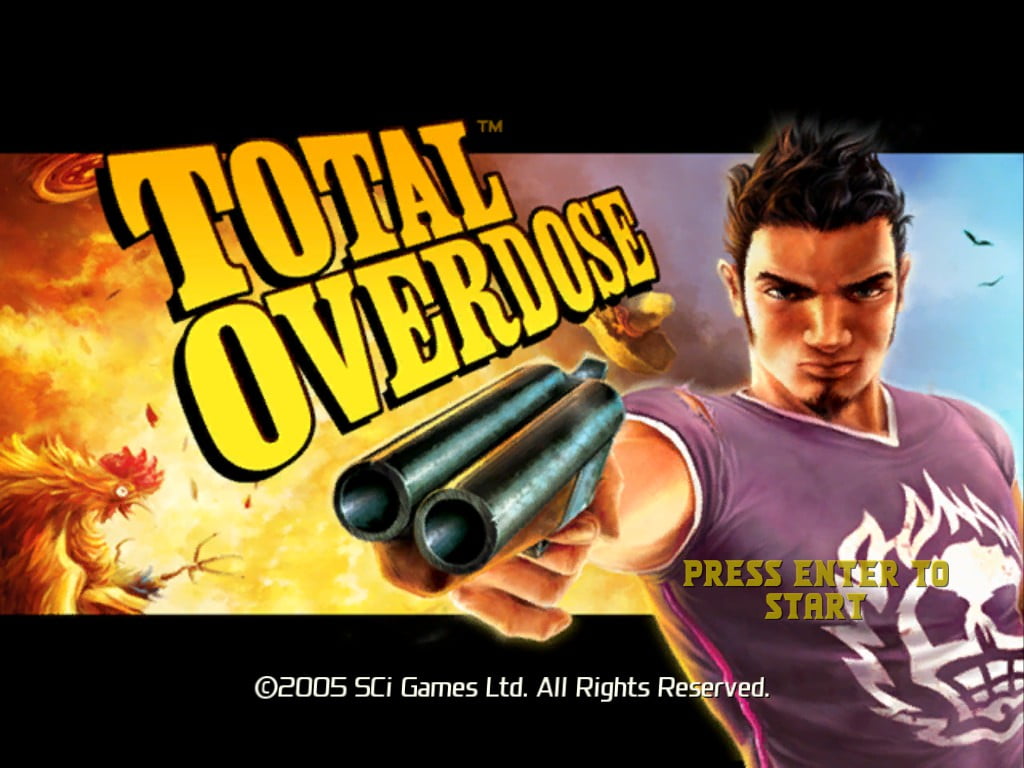
    Total Overdose: A Gunslinger’s Tale in Mexico is a game definitely in that Grand Theft Auto and Max Payne mold, but with a little Latin flavor. Developed by Deadline Games, a Denmark development studio mostly known for adventure games, this game has them trying to make something previously unknown to them: the third-person shooter meets open-world sandbox.

    Guess you gotta start things off action-packed somehow.

    The game starts in 1989-era Mexico as DEA agent Ernesto Cruz tries to find Papa Muerte, a major drug kingpin. While shooting his way through a Mayan jungle, Ernesto makes his escape on a plane before forcibly being removed from it. The death was reported as a drug overdose.

    Cut to a few years later, when Ernesto’s son Tommy, who’s also a DEA agent, tries to figure out the mystery of his father’s death, where he goes undercover working for some drug cartels. But an unfortunate incident at a gas station leads to him being stuck in a wheelchair and being strictly reconnaissance for the time being.

    Real smooth there, dude.

    Enter Ram Cruz: Tommy’s delinquent brother who helps him out by doing missions for the DEA in exchange for his freedom. While Tommy is kind and supportive, Ram is a massive dickhead at the start. This doesn’t last for long, though, as he eventually sheds a lot of that attitude for a more casual personality towards the end.

    Dive, shoot, survive. Easy to learn, difficult to master.

    Total Overdose starts like a conventional mid-2000s shooter for the time. WASD moves, left mouse button shoots. Since this is taking a page from the Max Payne playbook, hitting the shootdodge key – Spacebar by default – Ram can dodge and shoot enemies for bonus points. Holding right mouse button gives a more precision headshot that can be a one-hit KO if timed correctly. There’s other little tricks Ram can do, including climbing up walls and rappelling down wires while shooting, giving that sense of style that Max Payne refined just a couple years earlier.

    perhaps they took inspiration from Tony Hawk’s Pro Skater as well…
    (more…)
  • Hell Yeah! Wrath of the Dead Rabbit: Cutesy, yet gory.

    Hell Yeah! Wrath of the Dead Rabbit: Cutesy, yet gory.

    (content warning: cartoony violence and blood within. there’s also an aside about a game designer’s transphobia, but not in the game itself.)

    Ever had a moment where you’re scrolling through your library on Steam or some other digital storefront and spotted a game in your library that you have no memory of acquiring? Something that made you wonder “when the hell did I buy this?,” causing you to frantically search Humble Bundle and the 3-4 other discount key storefronts you have accounts on just to have the record of when you purchased that game? Well, the game I’m writing about this time was like that for me, a game that somehow was in my Steam library for literally years. I was confused on how it got there. Maybe I bought it from hell or something.

    Or, as the game calls it, “Ugh yeah!!!”

    Hell Yeah! Wrath of the Dead Rabbit is a… rather bizarre action-adventure/metroidvania (ugh) game that was in my Steam library for a long time. Released in 2012 for Xbox 360, PlayStation 3, and Steam, it’s an unusual choice of game in my library mostly because of the game’s publisher: Sega.

    “SEG-” *frantically mashes start to get to the main menu*

    You know Sega, right? The company that puts out okay-to-great Sonic the Hedgehog games, the amazing Yakuza/Like a Dragon games, and occasionally dabbles in their back catalog once in a blue moon, right? In addition to its main headquarters in Tokyo, Japan and the oft memed USA branch, there’s another important division, an unsung hero of the company: Sega Europe, publishers of iconic PC gaming franchises like Total War, Company of Heroes, Endless Space and Football Manager. They dabble in other games as well, but Sega Europe’s is the reason Hell Yeah! was published by them and not like, 505 Games or something.

    Pretty sure this is also the name of a my bloody valentine tribute album.

    Hell Yeah! was offered as one of the free gift packages in “Make War Not Love,” a promotion Sega Europe was doing with its iconic strategy game franchises where playing either of those games – Company of Heroes 2, Total War: Attila and Warhammer: Dawn of War II – would result in unlocking content for those respective games. Hell Yeah! was packed in alongside other Sega games like Viking: Battle for Asgard, Renegade Ops and some of the games in the Sega Genesis/Mega Drive Classics Collection. All of these were offerings for the third “Make War Not Love” event, which happened in February 2016, just in time for Valentine’s Day.

    But let’s talk about Hell Yeah! itself. Developed by Arkedo Studio, a games studio based in Paris, France, was mostly known for relatively forgotten platformers in their “Arkedo Series” of games. Said games had fairly unremarkable titles like Jump!, SWAP!, and Pixel!. Hell Yeah! would be their last major game released while the studio was still active. Eventually one more game would be released not long after the studio shut down: Poöf vs the Cursed Kitty, released one year later and published by Neko Entertainment. Surprisingly this game doesn’t end with an exclamation point in its title.

    Don’t try to go to that web address, it doesn’t exist. Though, watch as Google suddenly makes .kom a top level domain…

    In Hell Yeah!, you play as Ash, a bunny rabbit who reigns supreme over the realms of hell. Through negligence on his part, pictures of him are taken by paparazzi and spread around the shores of hell, causing it to damage his reputation. With help from his servant Nestor, Ash opts to seek revenge by finding the culprit who leaked those photos in the first place, which requires defeating 100 monsters around the world.

    Why does it feel like I’ve waltzed onto a bullet hell shooter?

    Ash has a fairly modest arsenal to start. Not long after the beginning, Ash acquires a super-sawing jetpack that allows Ash to drill through certain materials and fly to certain areas. In addition, Ash can acquire a slew of weapons: Slow-firing missiles that can blast through rock and destroy enemies with ease. Eventually after the tutorial area, Nestor gifts Ash with a second weapon: A machine gun, one that looks similar to the famous M41A Pulse Rifle from the Aliens films.

    (more…)
  • Who Wants to be a Millionaire: The Album – One of the strangest soundtracks I’ve seen.

    Who Wants to be a Millionaire: The Album – One of the strangest soundtracks I’ve seen.

    The soundtrack album is a neat little thing. Music used in the film that you can listen to outside of the movie. I always liked soundtrack albums because sometimes you’d find cool songs on there you wouldn’t find anywhere else. It’s one of those things that I tend to grab when I find them in a thrift store because there’s some good songs on there.

    Then there’s the “music inspired by the film” soundtracks. Usually made when there’s only a handful of songs that play in the film, yet they have to fill up a CD, so they get a bunch of songs that fit the film for padding. These are a bit less inspired, but can be still interesting based on the song selection. Not particularly my favorites, but if the song selection’s good I can forgive it.

    I had recently acquired an “inspired by” soundtrack, and it’s kind of a wild one. It’s not of a hit movie, or a teen drama. It’s… a soundtrack inspired by a game show.

    Ah, Regis Philbin in his element: smiling with a wad of bills.

    Who Wants to be a Millionaire: The Album is one of those “music inspired by” albums. Released in 2000 during peak Millionaire mania in the United States, the album features a myriad of songs that are, as mentioned on the album cover featuring host Regis Philbin, “inspired by the hit ABC television show.”

    Normally, there wouldn’t be a whole lot to say about this kind of album. Since it’s inspired by the TV show, it’s a bunch of licensed songs. But the album does put its own spin on the formula, with not only licensed songs, but two new songs, both themed after the big quiz show.


    We start with a rather insipid Millionaire song homage called “I Want to Be a Millionaire,” performed by Jack & Jemma. Jack is one Jack D. Elliot, a remixer/producer of pop artists like The Backstreet Boys and Britney Spears. Jemma is his wife, so they were probably trying to see if they could make success as a pop producer/singer duo. As far as I can tell, this didn’t get very far on the music charts anywhere. Even with having veteran music producer David Foster co-producing the record.

    YouTube player

    “I Want to Be a Millionaire” is a fairly unremarkable dance hit where Jack raps about the show: “Is it A or B or C or D / So I could win a million dollars on TV.” After the verses, Jemma sings the chorus: “I Want to Be a Millionaire / So I can buy anything, never work another day / Ask me nicely, I might share because / I’m gonna be a Millionaire.” That’s all she contributes to the track outside of an occasional “oh oh oh oh,” it’s more Jack than Jemma in this case.

    Surprisingly, Regis Philbin appears in the song as well, asking Jack the toughest $1,000,000 question: “What is the name of controversial rapper Eminem?” with Jack making jabs at bands like Sugar Ray while name-dropping Eminem’s real name. I get it’s supposed to be a bit like conventional hip-hop sketches, but this is just… lame. (As far as I can tell, Jack did not got the opportunity to remix/produce something with Eminem. Probably for good reason!)

    “I Want to be a Millionaire” is like when you hear a radio station’s morning zoo crew try to perform songs of their own, usually themed on the city or the sports team. It’s kitschy, yes, but it’s not good. Definitely a terrible god damn earworm, that’s for sure.

    (more…)
  • BlackOPS for Half-Life: An interesting mod with a hard-to-search name.

    BlackOPS for Half-Life: An interesting mod with a hard-to-search name.

    You know what I haven’t covered in a while? A game mod. How about a game mod for Half-Life, one of my favorite games of all time? Sounds good.

    I’ve always been fascinated by Half-Life‘s mod scene, which had some really creative stuff being made for it. Even to this day people are doing some outstanding work with the that 25-year-old game engine. But let’s jump back to 2005, when Half-Life 2 was new. Let’s talk about Black Ops.

    No, not that one.

    Not that one either. We talked about that one years ago.

    There we go. Third time’s the charm.

    BlackOPS — or Black Operations as it’s called in-game — is a Half-Life mod that covers the Black Ops soldiers, the reskins of the HECU soldiers initially introduced in Half-Life: Opposing Force. Released in 2005, BlackOPS was primarily the work of three folks: Stephan “little_otis” Grabenhorst, Volker “Thrillhouse” Schreiner and Daniel “DeeGee” Grabenhorst, who came from the German custom mapping scene.

    By this time, Half-Life 2 had been released and the fancy new Source engine was starting to be one of the go-to engines to mess around with. Despite that, GoldSource — the old Half-Life engine — still had some legs in it, so much so that there were still mods being made for the seven-year-old game. Honestly, the Half-Life mod scene post-HL2 is really interesting to me, so let’s check it out.

    Anomalous materials, eh? I see what you did there.

    The mod starts with an exposition of the creation of the Black Operations squad in game, and mentioning the Black Mesa incident that happened in Half-Life. Eventually we’re dropped into the Black Ops HQ as the protagonist, Declan Walker, is briefed upon his mission: Go to Metro City, find Dr. Gallagher, a rogue scientist, and procure a special case he was holding onto. Doing this while fighting off any aliens and soldiers along the way.

    “Here, have some dessert: Lead!”

    Initially armed with only a silenced pistol, Declan fights his way through the apartments of Metro City, fighting mostly headcrabs, zombies, houndeyes and even the Alien Controllers from later on in Half-Life. Declan’s journey eventually takes him to a subway, into the belly of a drug-addled club, through the obligatory sewer, before arriving in Chinatown.

    (more…)
  • Jeopardy! and Wheel of Fortune on the Nintendo 64: GameTek’s last hurrah.

    Jeopardy! and Wheel of Fortune on the Nintendo 64: GameTek’s last hurrah.

    Game show video games are fascinating to me. They’re neat ways to enjoy your favorite shows, it can be good practice for how you’d actually do on the show itself, and it’s interesting to see how they adapt certain game shows to video game form. I never understood why some retro gamers balk at these games, a lot of them seem to miss the point why they’re fun.

    If you’ve visited the site before, you’ve probably read a few pieces on me talking about game show games in various ways, from comparing game music versions of iconic game show themes to game show-adjacent games. But if you haven’t, let me make this clear: I like game show video games. And once again, we’re gonna talk about them.

    Yes, in this image, it’s deliberately off-center. Don’t ask me why.

    For a good chunk of the 80s and 90s, GameTek was the definitive game show game publisher in North America. A subsidiary of IJE Inc, the publisher would license various game show franchises – usually Wheel of Fortune and Jeopardy!, two of the biggest game shows in the USA – and put them out on every platform imaginable. Nintendo Entertainment System, Sega Genesis, DOS, Windows, you name it, they likely published a game show game on a system you had.

    They published other stuff too: They helped publish Frontier: Elite II for instance. Hell, their UK branch helped distributed the work of Capstone, “The Pinnacle of Entertainment Software.” Despite this, they will always be the game show game guys to me.

    Unfortunately by the late 1990s, GameTek was struggling, and in December 1997 they had filed for Chapter 11 bankruptcy. Some of the projects they were making, like RoboTech: Crystal Dreams, got canceled. But in spite of the bankruptcy, they had one last hurrah, by releasing two games that they were mostly well-known for: game show games based on the one-two punch of one Merv Griffin.

    Wheel of Fortune – released around November 1997 – and Jeopardy! – released in February 1998 after Take-Two Interactive acquired GameTek’s assets – are the final two game show adaptations published by GameTek. By this time, GameTek was developing the games in-house, forgoing the early NES/SNES days of having contract developers make the games for them. For a company who had a decade+ of game show games under their belt, having their last games be yet another version of Wheel and Jeopardy! was a sad way to go out.

    I remember these games because Nintendo Power had covered both games in different issues of the magazine: Wheel of Fortune in December 1997’s issue, and Jeopardy! in the January 1998 issue, of which I owned. It’s surprising to see these games to get a multi-page spread on the magazine.

    “Vanna?” I know that these are probably made months in advance but you couldn’t check to make sure that you’re covering the right game show here, fellas?

    Why they decided to dedicate magazine space to these two games is a bit weird to me. I know the Nintendo 64 was struggling for a good while, but to give multiple pages about these games makes me think the system’s library was pretty dire until The Legend of Zelda: Ocarina of Time. Of course, maybe I’m wrong and they always covered stuff like this.

    I’m going into these with the assumption that you know what these shows are and how they play, mostly. If you don’t… well, you might wanna catch up on that first. With that preamble out of the way, let’s give these a shot, shall we?


    I kinda liked this logo. But only because using the actual Wheel as part of the logo makes it look cooler to me.

    I’ll start by covering the one that came out first: Wheel of Fortune. This was one of the first games I got for the Nintendo 64, alongside stuff like Diddy Kong Racing and Super Mario 64. Me being a game show fan meant naturally I was gonna have this game in my collection.

    It’s like I’m talking to Vanna through Zoom.

    Much like most Wheel games until around 2010, our “host” is Vanna White, the show’s co-host and letter turner. Or in this case, “letter toucher,” as this was released just as the new modernized puzzle board was revealed, something prominently shown on the cover.

    This menu definitely isn’t a looker, that’s for sure…

    Like most adaptations, there’s character customization, AI opponent difficulty, even the option to play 3-5 fixed rounds of play, or a “full game” which can go for the maximum six rounds or until the game decides time is up and goes into the Speed-Up portion, complete with Vanna giving the Final Spin of the day.

    Wheel‘s core format is fairly simple: A puzzle similar to Hangman is revealed, spin the wheel, land on a dollar amount, call a consonant and hope it’s in the puzzle. Wanna know if a vowel’s in the puzzle? You can buy one for $250. Try not to hit Bankrupt as you’ll lose all your money you’ve earned that round. Highest scorer wins.

    (more…)
  • I Am Alive: Ubisoft’s dollar store version of a survival action game.

    I Am Alive: Ubisoft’s dollar store version of a survival action game.

    I never really cared for post-apocalyptic stuff. That stereotypical dystopia of derelict cities fighting off some zombie horde or devastating dust storm while people living in squalor… It all felt a bit too played out to me. Considering what’s happened in the past few years with us living through a global pandemic, I can’t say I’m really interested in playing too many things that hit a bit too close to reality like that.

    That doesn’t mean I never play those kind of games. I’ve played stuff like Fallout 3 and Telltale Games’ The Walking Dead which take place in dystopian worlds and yet still enjoyed them. But it’s definitely not something I actively seek out.

    Yet, I decided to start 2023 by playing a game that took place in a post-apocalyptic world. One that was recommended to me as something interesting, but fairly clunky. And as you’re gonna learn, feels like the dollar store brand of something more notable.

    I mean, it’s better than being dead, I suppose.

    I Am Alive – a title that while grammatically correct, still sounds weird to my ears – is a survival action game published by Ubisoft and developed by Ubisoft’s Shanghai studio. Released in March 2012 for the Xbox 360, PlayStation 3, and later the PC through Steam and Uplay Ubisoft Connect; the game was one of those aforementioned post-apocalyptic games, coming out just as the survival action genre was starting to take off.

    Originally announced as just Alive in 2008, I Am Alive was being developed at Darkworks, a French studio who had done other similar games, such as the interesting survival horror game Cold Fear and the mostly-forgotten Alone in the Dark: The New Nightmare

    After an initial trailer showing a player surviving a catastrophic event in Chicago, Illinois, the game went dark, with only occasional news reports of the game still being alive (no pun intended). After countless delays, the game was rumored to be canceled until Ubisoft moved the development in-house around 2010, while also shifting the game’s focus from a major retail title to a smaller digital-only title. Darkworks shuttered its doors not long after.

    Unless some Darkworks developer held on to some unfinished development code, this particular version of I Am Alive is presumably lost, with only some proof of concept trailers still available online.

    Even after moving development to Ubisoft Shanghai, they opted to take Darkworks’ concept and start completely fresh, basically making a new game under the same name. Let’s see if they revived this concept, or if it should’ve stayed dead.

    It’s like I’m watching a found footage movie!

    In I Am Alive, we’re introduced to the playable character, a boring, run-of-the-mill dude protagonist whose name is never mentioned at all during the game. For some reason, I thought his name was “Ethan,” but all the sources I checked have him unnamed, so he’ll be named Our Hero going forward. 

    After The Event – the nebulous term the game uses for the apocalyptic event that ravaged the country – Our Hero returns to Haverton, a fictitious New York-like locale. He goes to find his wife and daughter – who do have names unlike Mr. Unknown here – but after finding that they’re not home, Our Hero then gets wrapped up in a journey that involves reuniting other families, getting supplies, and taking advice from various strangers around Haverton to eventually escape out of this hellhole.

    Ezio Auditore he ain’t.
    (more…)
  • I Bought Some Stuff! The Rest of 2022 Edition.

    I Bought Some Stuff! The Rest of 2022 Edition.

    Well, it’s the end of the year. When I wrote about visiting The Last Blockbuster back in August, I had promised a regular post as well as another I Bought Some Stuff article at some point. I’ve since fulfilled the former, and now it’s time for me to fulfill the latter.

    Since the last I Bought Some Stuff, I’ve… kinda slowed down on buying things. That combined with my fluctuating mental health gave me little incentive to go out and shop. Though, when I did head out, I found some really neat things. This will cover May to December of this year, and mostly rides the gamut of music and video games. Let’s wrap up this year with some oddball stuff.

    I will forewarn you like before that I will nerd out about music in this one, like I did in the last one. There are games in here, don’t worry!


    Not long after the previous entry, I ended up checking a Goodwill around my neck of the woods right at the end of May. It’s not one of the usual places I visit, I was doing something that required me to be around that neighborhood and I figured since there was a Goodwill nearby I might as well poke inside. Well, I’m glad I did.

    Ooh, a new stand! This is my bookshelf that I intend to get rid of next year.

    $2 each:

    • Back in the High Life by Steve Winwood
    • El Oso by Soul Coughing
    • The Futureheads’ self-titled debut album
    • Mission: Impossible and Other Movie Hits by The American Film Orchestra.

    Already I’m starting with some rather eclectic choices. Hey, I never said my purchases make sense!

    Back in the High Life is one of those albums that we already have but was in terrible condition, so this is one of those “replacement” discs. Much like a lot of ’60s-era musicians, Winwood mounted a brief comeback thanks to “Higher Love,” which was a Billboard Hot 100 number-one hit. The title track is alright, but otherwise the whole album is inoffensive yuppie pop music. Stereogum’s Tom Briehan in his article covering Billboard number one hits, called “Higher Love” white man’s overbite music, and I agree with him.

    El Oso may not be an album you’re familiar with, but if you’re a Person of a Certain Generation and watched a fair share of Cartoon Network in the mid-to-late ’90s, you’re probably familiar with their song “Circles” being used as a montage for Hanna-Barbera cartoons, almost in a proto-Anime Music Video sort of way:

    YouTube player

    Another song from this album, “Rolling,” was also used the same way as a music video, set to a Betty Boop cartoon. I honestly grabbed this album because I remember those songs, and thought it might be an interesting listen.

    The Futureheads are one of those 2000s indie rock bands that populated the landscape around that time. I’m familiar with them because one of their songs, “Decent Days and Nights,” made it into the Burnout 3: Takedown soundtrack courtesy of EA Trax. (Remember EA Trax? That was definitely A Thing.) I basically grabbed it only for that, and also because they covered Kate Bush’s “Hounds of Love,” and considering how “Running Up That Hill” was gaining traction thanks to Stranger Things, I figure it was nice timing to get this.

    Finally, one of my go to YouTube channels is Oddity Archive, where Ben Minnotte covers the pop culture and technology obscura. One of my favorite series from him is Record Ripoffs, where he’ll cover the myriad of knockoff albums “performed by The Original Artists*” and how they stack up to the original article. That album was basically me being curious how a composer made an album to capitalize on a big Hollywood hit at the time — in this case, 1996’s Mission: Impossible. And according to the album, this is literally one guy, Lee Johnson on keyboards. It’s… an interesting listen.

    (more…)