Author: beverly jane

  • The Version Everybody Knows: A rant about music discovery in the streaming era.

    The Version Everybody Knows: A rant about music discovery in the streaming era.

    A while back, I was looking for an alternate version of Tommy Tutone’s “867-5309/Jenny” that appeared in Rock Band 3, but every time I tried to look for this version, it kept giving me the original version from 1981’s Tommy Tutone 2. Even with putting in the album name (Tutone-ality) and “re-record” into my searches, it kept coming back to the original album version and not this unique re-record. That made me sad, because I genuinely want to listen to this version of the song in a way where I don’t have to hear game sounds from Rock Band 3.

    This surprisingly happened a lot with songs in music games. Either the masters were lost to time, or legal issues between the band and record label have necessitated a re-record – similar to the Taylor’s Version fiasco – thus they either got the current lineup in the studio to make a similar-enough sounding version to the original, or they’d opt for a cut from a Live album instead.

    One thing that really irks me about the streaming world of Spotify et al is that if you wanna find a classic rock or pop hit, they’ll just give you the most popular version. Usually that’s the version featured on the original album. Which, hey, if you’re just looking for that song to listen to, that’s great, you’ll be happy, end of story.

    The thing is that it leads to a problem I’ve called The Version Everybody Knows. You hear about a song, you wanna listen to it, places like Spotify or Apple Music give you the original version. But sometimes, especially in the days before the internet, that may not have been the version that was the hit. That isn’t to say the album version wasn’t popular, but it clouds the history of the songs a little.

    For me, I have a softer spot for alternate mixes and radio edits. This was incredibly common in the 1970s, where there would be a song from a hit album of which they’d speed up and edit it down for radio airplay. This continued after the age of album-oriented radio, but usually would be relegated to special remixes and 12” mixes that would be played at clubs. Most of the time they’d play the original song from the album, perhaps cut down so the radio station can get more songs and commercials in.

    YouTube player

    Here’s a few examples. Example one: Gerry Rafferty’s “Baker Street.” You search for that, you get The Version Everybody Knows from his 1978 album City to City. A smooth, catchy 6 minute jam with that famous Raphael Ravenscroft saxophone lick.

    However, the version that charted in the Billboard Hot 100 was a completely different mix, featured above: It’s a little over 4 minutes, it’s moved up one key, a bridge or two taken out to immediately get to Hugh Burns’ guitar solo. This might sound weird to your ears if you’re used to the album version like I was, but for folks who were around back then when it was new, this is likely the version they remember.

    (more…)
  • A little thing about Legacy of Rust, the new Doom level set.

    A little thing about Legacy of Rust, the new Doom level set.

    They really didn’t need to do this.

    In 2019, Doom got a remastered port handled by Nerve Software, and while it wasn’t perfect, it was serviceable enough. It got a few updates that fixed a few of the major problems – including requiring Bethesda.net to login – but it was fine. A perfectly playable version of the 1993 classic.

    DOOM + DOOM II is a bit of an unwieldy title, tbh

    Five years later, at Quakecon 2024, they remastered Doom again. This time handled by Nightdive Studios, the wizards who remastered a whole bunch of games, from Turok to Quake II. This time they added support for Boom, a Doom source port framework that added a whole bunch of new features and expanding older ones. But they weren’t done with that. Of which has become tradition with all id Software remasters by Nightdive at this point, they added a new episode called Legacy of Rust.

    Mild spoilers for Legacy of Rust within.

    (more…)
  • Forza Horizon 2 presents: Fast & Furious – It’s about family.

    Forza Horizon 2 presents: Fast & Furious – It’s about family.

    (Updated 10/21/2025 for some minor adjustments, like changing “7th generation” to “to the current Xbox One and Series consoles” because it makes more sense than using Wikipedia’s strange generation numbering.)

    The Fast and the Furious franchise is one of many movie franchises I just haven’t really watched. Much like the Marvel Cinematic Universe, the various Star Wars and Star Trek spinoffs among many, many other series, I just can’t really see myself sitting down and watching these by myself. I know this is partially a fault of me treating watching things as a social experience, but some day I will watch those popcorn action flicks with Cool Cars and equally Cooler Stunts.

    Naturally with a franchise that’s been around as long as it has – over two decades! – there’s been video games. Official licensed ones such as the unremarkable Fast & Furious Showdown, Cruis’n for Wii, which was a port of the Fast & Furious arcade game but without the licensing, even the TV show spinoff Fast & Furious: Spy Racers got a tie-in game: Rise of SH1FT3R. But I wanna focus on one that was a tie-in to an existing popular franchise that also involved cars and wild stunts.

    Is this the car version of that Distracted Boyfriend meme?

    Forza Horizon 2 presents: Fast & Furious was a tie-in game released on Xbox One and Xbox 360 as a tie-in to Furious 7, which is when the franchise started using weird names to refer to its sequels. Developed by regular Forza devs Playground Games and Turn 10 Studios, alongside Sumo Digital for the 360 port, this was a free* tie-in that was a standalone expansion to Forza Horizon 2. I put an asterisk there because it was free for the first month or so of release, eventually requiring one to pay for it for the last few months it was available. More on that later.

    You play as a nameless protagonist who gets a call from Tej Parker, a recurring character in the previous films, with Chris “Ludacris” Bridges reprising his role. Through a semi-fictionalized version of Nice, France, the player must drive through the streets and complete races to gain enough street cred.

    If you think you need to understand the Fast & Furious films to play this, you don’t. The game starts with a clip montage of some of the wildest moments from past films, and you can get a handful of cars from the film, like Dom Toretto’s 1970 Dodge Charger. Otherwise, this is easily understandable even to a person like me who only has a bit of knowledge of the Fast & Furious franchise.

    For this article, I played the Xbox 360 version, as that’s the most recent console I own at the time of this writing. Yes, even in 2024, I still haven’t jumped to the current Xbox One and Series consoles. Which, y’know, when you got a powerful PC, it seems kinda pointless to grab a modern console unless you wanna play a game exclusive to that platform. Surely there’s no major differences between the two games besides graphical fidelity, right?

    The driving line: Something that folks like me should follow, but rarely do.

    Anyone who’s played the previous Forza Horizon games will be right at home here: Racing with driving lines, a rewind feature for mistakes, and a big amount of difficulty customization from racing game newbies to veteran Forza players. When not racing, you can accrue points for stylish driving, go through speedtraps to break your friends’ records if any, and even get “barn finds” for hidden cars that can help build the old collection.

    (more…)
  • Daikatana: John Romero’s “expert FPS.”

    Daikatana: John Romero’s “expert FPS.”

    Sometimes I think a lot about what defines “the worst video games of all time.” There’s a lot of games in that category that I question if they deserve that distinction. After all, sometimes people get swept up into the zeitgeist of it all and hate a product without really thinking if it deserves it. While I’m thinking about this topic, there’s one game that comes up in that category.

    So I’m on a Discord server where a random bad game is picked every month and people play it. This time around, the game chosen was John Romero’s Daikatana, a first-person shooter developed by Ion Storm and released in 2000 for PC and oddly, Nintendo 64.

    Yep, this is how the game starts: Right in the Single Player menu. No splash screen, at least on this fan patch.

    I’m not gonna go too deeply about the game’s history here. There’s lots of places that have documented the history of this infamous game and Ion Storm as a studio overall, and I kinda wanna make this something shorter than my usual fare. If anything, I just want to get past talking about that one ad where they proclaim that “John Romero is about to make you his bitch.” (You can thank Mike Wilson of later Devolver Digital fame for that one.)

    Everybody loves a sewer.

    I’m no stranger to Daikatana. I remember watching the Something Awful Lets Play by Proteus4994 and Suspicious, which was my first experience of seeing the game beyond cultural osmosis. Stuff like “Thanks, John” is permanently burned into my lexicon thanks to this LP. (I don’t think if it’s worth watching nowadays, there’s probably a lot of offensive language that makes it age like expired cottage cheese.)

    I actually got to play it myself in 2016, and I don’t remember the experience all that well. The only thing that stuck in my memory was somehow getting Superfly Johnson stuck under a stairwell. Besides that, it was just shooting enemies in various time periods.

    To this day I don’t know how this happened.

    For this replay, I decided to send my NPC allies to the shadow realm, and Hiro Miyamoto would fight everything singlehandedly. From advice from a supporter of Daikatana – elbryan42 on Youtube – I turned on auto-aim, which made hitting a lot of the smaller enemies a lot less painful. I also decided to kick it up to Shogun difficulty, just for the extra challenge.

    This was available three days early for Patreon subscribers. Wanna be one of those? No Daikatana needed, just head to my Patreon and chip in at least a buck and you’re already there!

    Don’t try fighting these folks without auto-aim. It’s complete suffering.

    The first episode that takes place in the 2200s is an absolutely terrible first start for a game. Lots of small enemies that are hard to hit and hard to see. Lots of green, showing off all that pretty colored lighting that Quake II popularized.

    What was with FPSes of this time and using fruit as healing items?

    And of course, fruit you can interact with to heal yourself. The later levels of Episode 1 throws so many enemies and very little health that there were a lot of moments where I’d finish a combat section, then make the long backtrack to the nearest health “Hosportal” to refill. It didn’t help the game gives weapons that will do damage to you if you’re not careful: Stuff like the C4 Vitzatergo and the Shockwave Cannon will do lots of damage to foes, but it’s easy to kill yourself with them than the enemies. Even stuff like the Shotcycler seem like an interesting idea in concept but realizing you’re gonna be wasting ammo by killing an enemy with a single shotgun blast.

    (more…)
  • Wild West Showdown: American Gladiators meets Mad Dog McCree.

    Wild West Showdown: American Gladiators meets Mad Dog McCree.

    Around 1989, a plucky little sports competition show debuted that captured the hearts and minds of Millennials everywhere: American Gladiators, a show where contenders fought against “gladiators,” men and women who had background in stunts, sports or otherwise. Its campy stadium-like presentation combined with the play-by-play commentary of hosts Mike Adamle and Larry Csonka – with a few other folks before and after – it seemed like peak weekend viewing, after the Saturday morning cartoons have ended and you want something else to watch in a pre-internet world. (As a funny coincidence, there’s been rumblings of a new version of AG casting as of this writing, which has me mildly optimistic. Can’t be any worse than the 2008 version where they thought letting Hulk Hogan host was a good idea.)

    You can’t tell me kids weren’t trying to imitate this stuff.

    The original American Gladiators went off the air in 1997, which lead to a slew of imitators like Battle Dome to take the space. But even during AG’s peak, there were shows taking the formula and putting it in different environments. Stuff like Knights and Warriors leaned more into American Gladiators original intent of being a competition with a bit of a Medieval Times-like theme to it. There was a kid-focused spinoff called Gladiators 2000 featuring a then-unknown Ryan Seacrest. Even Nickelodeon GUTS likely took inspiration from American Gladiators. But there was one of these shows that captivated not just the game show nut in me, but also my friends who weren’t even that big into game shows. That show was Wild West Showdown. Grab your cowboy hat and boots, y’all, we’re heading into the old wild west for this one.

    Okay, this isn’t an amazing logo, but hear me out, it gets better.

    Wild West Showdown was a short-lived, mostly forgotten American Gladiators clone that aired for one season in 1994. Produced by The Samuel Goldwyn Company and Four Point Entertainment – the same companies that produced American Gladiators – their approach was to take their formula and give it a new twist. While it might seem gauche to rip off your own show, it’s not uncommon: When Allan Sherman and Howard Merrill was pitching a show to Mark Goodson/Bill Todman Productions, I’ve Got a Secret, they pointed out it was basically a ripoff of their existing show What’s My Line?. To which Sherman reportedly said, “You might as well, because if you don’t start copying your shows, someone else will.” (This comes from a memoir from former Goodson/Todman staffer Gil Fates about the history of What’s My Line? and may not be 100% accurate.)

    Taking place in the fictitious town of Broken Neck, the town is constantly harassed by outlaws – this show’s versions of the gladiators – and it’s up to three cowpokes to try to stop the outlaws and hopefully make off with a bit of money in the bank.

    Wonder if he loved getting back into the saddle again.

    Our host is “West,” played by the late, great Alex Cord, a veteran character actor. Most people will probably know him best as Archangel in Airwolf, a TV series I’ve never seen but cannot deny has quite the banging theme song. While I initially thought this was strange casting at first, it made more sense when I found out he’s been in a handful of western films, as well as bit parts of some notable western TV shows like Gunsmoke. So in essence, this was perfect casting. Cord gives off a storyteller style to the proceedings, talking about the town, its outlaws, and the game outcomes.

    Dang, having a lady co-host years before AG did. Inclusivity!

    Alongside West, the contestants are interviewed by the local town reporter, K.C. Clark, played by Lisa Coles. She tends to fill the co-host role like in American Gladiators, where she interviews contestants after the game, getting their thoughts on how they did, and telling them if they won or not. So even though the show leans a lot into the wild west theme, there’s still a tinge of the show’s inspiration there.

    Partway through the run, they introduced a play-by-play announcer, Joe Fowler, who replaces Cord’s play-by-play while trying to be a part of the proceedings off-camera. This honestly was a grave mistake. While Wild West Showdown is inspired by American Gladiators, Fowler’s commentary feels incongruous to the rest of the show’s overall theme, and completely kills the style the show is going for.

    The rules go a little something like this: Three cowpokes – usually two guys and one gal – compete.

    This looks like something straight out of Most Extreme Elimination Challenge.

    Each of the games varied from show to show, usually with one cowpoke against one of the outlaws in various events, such as climbing a water tower to grab the fuse out of a stick of dynamite, “Rawhide Drag,” where the cowpoke has to grab the harness off a lasso while being dragged by an outlaw in the fastest time, or “Runaway Stagecoach,” where they catch a runaway stagecoach the fastest. Each game is for $100 cash, with the last game being for $200.

    (more…)
  • PopStar Guitar: We have Guitar Hero at home.

    PopStar Guitar: We have Guitar Hero at home.

    For several years, it really felt like the mainstream rhythm games of the past, like Guitar Hero and Rock Band, had been thrown to the dustbin of the past. Mostly to be fondly remembered by those who played it. The diehard fans moved on to open-source versions of those games like Clone Hero and YARG, while challenging themselves with unique custom songs made by artists like Chaotrope and Exilelord. While Rock Band 4 was getting new songs regularly, it strictly was for those who bought in early. It seemed like if you wanted to get in, you should’ve gotten in 10 years ago or even earlier. Getting used guitars and adapters were being scalped for hundreds, sometimes thousands, more than getting an actual guitar would cost.

    The king returns.

    Then in December 2023, things started brewing again. Epic Games alongside Harmonix – the studio best known for bringing Guitar Hero and Rock Band to the world, also an Epic Games Studio released Fortnite Festival, a spiritual successor to that rhythm game formula: A rhythm game with a highway where you tap notes in time to the instrument you’re playing as. While it strictly supported only gamepads and keyboard controls to start, just a few days ago they released Season 3, which had rudimentary support for Rock Band 4-era plastic guitars and the forthcoming RIFFMASTER guitar, with support for other instruments coming hopefully in the near future.

    Thanks to Festival, I’ve been on quite a rhythm game kick lately. I rekindled my love for classic rhythm games, and really dug into the spiritual successors that people have been making like the aforementioned Clone Hero, YARG, and even fanmade mods for existing games like Guitar Hero II Deluxe.

    Though, with the good we also have to take the bad. I started looking into the mostly forgotten, fairly busted games that tried to capitalize on the white-hot popularity that Guitar Hero and Rock Band had in the late 2000s. Though, in my case, it wasn’t the usual punching bags in the rhythm game community like Rock Revolution or PowerGIG: Rise of the SixString. Oh, no, I wanted to go deeper. Into the more crustier, mostly forgotten knockoffs. I ended up finding one that felt like I was playing the AliExpress of rhythm games, and that game is PopStar Guitar.

    “Help, the guitars are trapping us!!”

    Released in late 2008, this wannabe rhythm game was published by XS Games in the US, a noted publisher of mostly forgotten shovelware, and developed by Broadsword Interactive, makers of similar knockoff software of rhythm and racing games, including most infamously, Spirit of Speed 1937, a notoriously bad racing game released on the Dreamcast. (Side note: I recommend Cassidy’s Bad Game Hall of Fame article for more information on that game, it’s a doozy to read.) So, knowing the pedigree of these companies, I was already going in with low expectations.

    Peak shovelware, right here.

    PopStar Guitar had released on both the Wii and PS2, as expected for a lot of games from this period. You might’ve even heard about the Wii version and how infamous it is, being one of those games that required a lot of waggle motions to play. It even came with the AirG, a plastic shell over the Wiimote that could be used to make it easier to hit each of the buttons on screen. From what I’ve seen, it seems the Wii version is an absolutely insufferable experience to play because of that, so I went for the PS2 version instead, which supports conventional five-button Guitar Hero controllers just fine. Though, if you want me to suffer playing the Wii version, you could contribute to my Patreon and request it, perhaps? I’ll even buy the bundle with the plastic shell for maximum suffering!

    A question for the ages: Can beats storm?

    There isn’t a whole lot of story to be had. You make a band, create a name, customize all your band members, and start your way from being a bunch of nobodies playing at high school gymnasiums to being the true PopStar. It’s like Rock Band, where you Start a Band, Rock The World, but with only one instrument.

    As expected, it’s a completely vertical highway. Blame Harmonix for owning the patents on that.

    If you’re familiar with most rhythm games and especially Guitar Hero, it doesn’t take much to get started. Notes come down the screen, hold the button that matches that note, strum it with the strumbar when it hits the strike line, get score. Hit more notes than you miss and you’ll pass the song, gaining a score and some fans. Fairly common stuff for the genre.

    (more…)
  • WRATH: Aeon of Ruin – Revisiting an early access boomer shooter.

    WRATH: Aeon of Ruin – Revisiting an early access boomer shooter.

    Have you ever written a critique about something, then come back to it years later to see if it still holds up? I have that feeling with a lot of things I’ve played. Since I try to improve myself as a person, sometimes I have to reassess my opinions on something or if I’ve changed. With how games change from day one to day 365 thanks to the wonders of patches and Early Access, it has me occasionally revisiting stuff to see if it’s gotten better. And in this case, it’s going back roughly 4 ½ years ago… when the boomer shooter craze wasn’t at a fever pitch. I’m gonna look back at WRATH: Aeon of Ruin.

    Developed between small indie studio KillPixel Games and slightly larger studio Slipgate Ironworks, and published by 3D Realms – the new one ran by Fredrik Schrieber, not the old one that gave us Duke Nukem Forever – the game initially came out in Steam early access in November 2019, the game went through a dormant dry spell before finally being released in February of 2024, nearly five years later.

    A friend had gifted me the game back during that early access period, and I was… pretty darn harsh on the game. To quote my now out of date Steam review from that time:

    This game, on the other hand, has problems. Lots of questionable design decisions that don’t make sense. Enemies that take too much damage, on arenas where circlestrafing is not an option. An unwieldy inventory system which is counter-intuitive to the style of gameplay this wants to emulate. And whoever thought that reviving the “save gem” concept from Daikatana was a good idea needs to be smacked in the head with a baseball bat […] I cannot recommend the game in the current state it’s in. It needs some balancing adjustments to be mentioned in the same breath as the aforementioned retro FPS throwbacks.

    This game definitely didn’t have it’s balance set correctly in 2019. (Taken from the Early Access period.)

    Basically I lauded the look and style of the game, while also feeling the gameplay needed some improvement. By 2019, the concept of a retro FPS/boomer shooter requires a type of finesse to make it stand out from the others. A lot of New Blood’s work, like DUSK or Amid Evil, is a good example of this. This is more important 2024, when we’re in peak Boomer Shooter Heaven, where everybody’s getting in on the craze. So let’s see how KillPixel and Slipgate Ironworks did to improve from their early access version.

    I feel like I’m crossing the River Styx.

    A quick story primer: You play as the Outlander, an unknown figure who meets with The Shepherd of Wayward Souls, where one must find the sigils of an area before fighting a big boss at the end of three episodes. The Outlander transports to levels and defeats any monsters in their way to get the sigil at the end. Basically a little bit HeXen, a little bit Turok: Dinosaur Hunter, with a pinch of Blood and Quake for flavor. (Fitting, since WRATH is made on DarkPlaces, a source port of Quake’s engine.)

    Sharp. Pointy. Zoomy.

    Much like other boomer shooters, the Outlander has a myriad of weapons at their disposal. First is the Blade of Ruination, a good go-to melee that also has an alternate fire where you lunge forward, which is great for getting past gaps and doing massive damage to certain foes. Then there’s your usual FPS arsenal of a handgun, a double-barrel shotgun, a “Fang Spitter,” which amounts to the game’s rapid-fire automatic weapon, an acid-spitting launcher and even a railgun equivalent. There’s other weapons too, but most of these are in those early episodes. All the weapons have an alternate fire that can be useful in sticky situations.

    (more…)
  • Celeste and my frustration with puzzle platformers.

    Celeste and my frustration with puzzle platformers.

    You know, there’s a kind of genre I don’t quite get why people like it: The puzzle platformer. I’ve tried playing some of the ones so highly recommended to me, only to leave with frustration and disappointment. A lot of puzzle platformers get me so frustrated that it soured the overall experience for me. But there’s one I played recently that got me rethinking my outlook on this genre, transgender memes notwithstanding.

    Celeste. The puzzle platformer from EXOK Games that came out on 2018 that has become a transgender allegory in recent years, due to some of the plot relating a lot to trans folk. Lead designer Maddy Thorson realizing her own trans journey through the game after the release probably helped a bit too. We always need more queer game designers, after all.

    I’m not gonna get too much into the non-gameplay elements here. The art style’s cool by using pixel art in a way that’s unique without feeling too much like deliberate retro bait, Lena Raine’s soundtrack is tense yet touching at the right moments (and I never got to play any of the B-sides which also sound like a bunch of bangers), and the story is rather touching and something I can relate to as someone who struggles through life. But I wanna talk about this game further cementing my belief on puzzle platformers.

    This part from Blood of the Werewolf still haunts me to this day.

    When I mention I get frustrated by these kind of games, I’m not kidding. When I think about some of the action/puzzle platformers I played for the blog last year, like Hell Yeah! Wrath of the Dead Rabbit and Blood of the Werewolf, I leave those games with frustration and anger. How one mistake will usually result in death, with little chance to redeem yourself. Some parts of these games are so malicious to the player that requires so much perfect timing that I’m surprised I haven’t thrown my controller into my computer screen after some of the bullshit I had to go through to beat it.

    This is apparently the only screenshot of VVVVVV I took. Rather fitting, really.

    But it doesn’t just apply to those mostly-forgotten niche platformers. It applies to the more popular ones as well. For example, I never finished the critically acclaimed VVVVVV. The gravity-shifting puzzle platformer with a pseudo-DOS art style and catchy chiptune music was an absolute chore to play at spots. A lot of hazards and pixel-perfect precision to make it across made it maddeningly to play, so much so that I only got about halfway through it before giving up on it.

    (more…)
  • Avenged Sevenfold’s “Free For All” in Fortnite, and a story about modern crossovers.

    Avenged Sevenfold’s “Free For All” in Fortnite, and a story about modern crossovers.

    You know, for a few years I had no interest in Fortnite. I played it a bit here and there, but mostly thought of it as a thing that wasn’t really for me, that whole building-while-shooting being the biggest barrier to entry for me. Shoot a guy and suddenly they’ve built a whole castle for defense just feels old. Then developer Epic Games introduced Zero Build, which got rid of that. That, combined with Chapter 4: Season 1 introducing the Doom Slayer from Doom and Geralt of Rivia from The Witcher, were the moments whereme and my friends got hooked on Fortnite.

    With Chapter 5: Season 1 currently going as I write this, where they introduced LEGO Fortnite (their rival to Mojang’s Minecraft), Rocket Racing (a racing mode by Psyonix, the makers of Rocket League) and Fortnite Festival (Harmonix bringing the Rock Band formula to Fortnite), I’ve basically abandoned my nature of being a gaming hipster and not following the current gaming trends to go for what amounts to the new hotness. Granted, Fortnite is 7 years old as of this writing, but I still think it’s the “in-thing”.

    While Epic (and the myriad of studios they own) have been creating their own unique games within the system, I’d been curious what the Unreal Editor for Fortnite (UEFN) worlds are like, where people can make their own creations within the Fortnite universe. Most of the time it’s ripoffs of existing games like Deathrun and Gun Game, but other times it’s filled with promotions by notable brands. Honda had a driving experience for one of their cars, for example. I remember playing an experience based on hip hop musician THE KID LAROI that was mostly forgettable. In this case, we get to talk about another notable musician who capitalizes on the hottest trends.

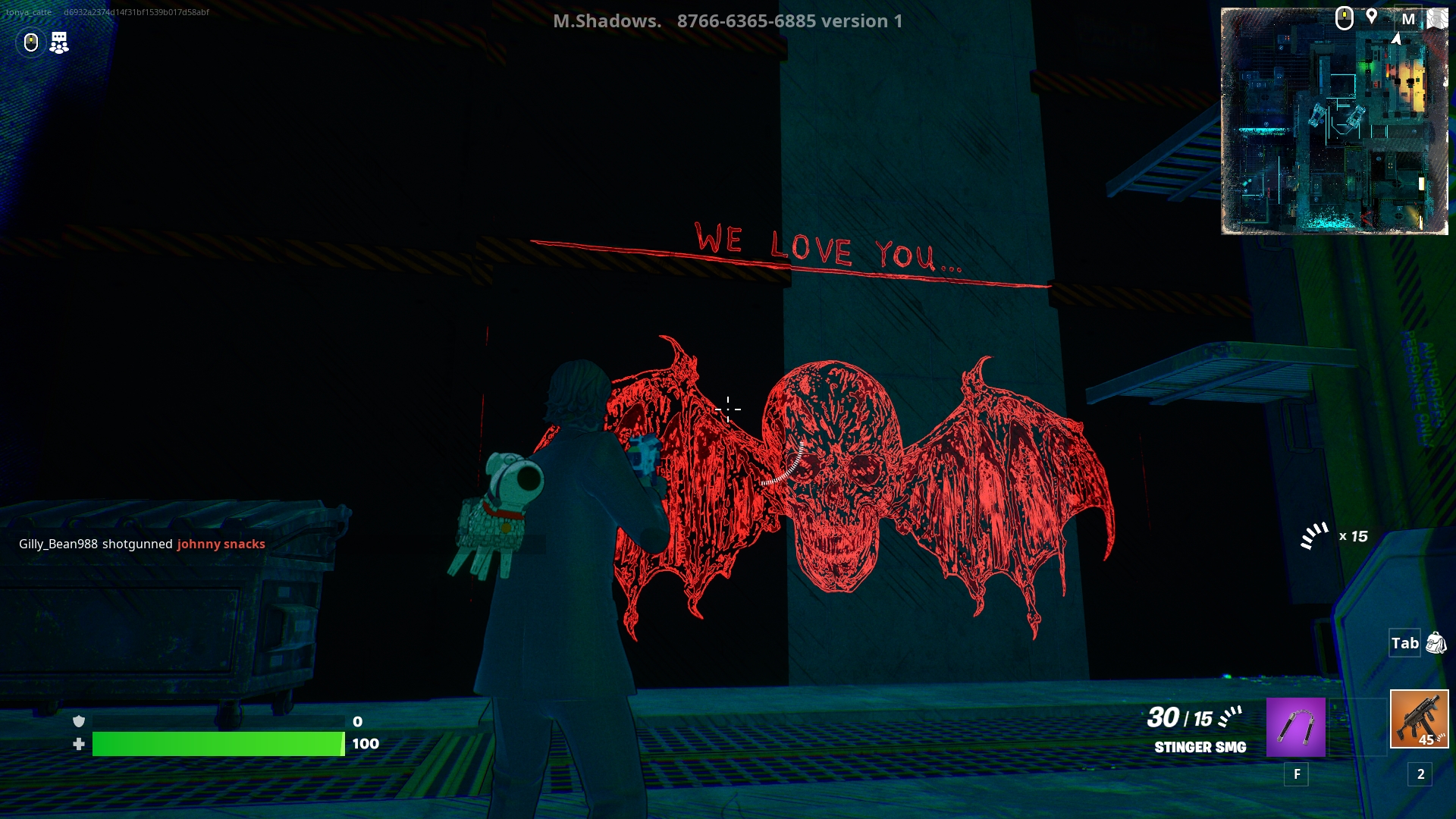
    Avenged Sevenfold’s “We Love You” is what it says on the tin: A map featuring an arena from the music video of the titular song, released by the band back around summer 2023. This was hyped up through the band’s social media pages, with it being announced on January 12, 2024.

    Now, Avenged Sevenfold is a band that I’m really only familiar with because of their ubiquitous appearances in rhythm games. I swear, every Guitar Hero and Rock Band game came with an Avenged Sevenfold song on the set list, which means I got to hear songs like “Almost Easy” and “Beast and the Harlot” a billion times. They’re a perfectly fine metal band otherwise, probably the modern day equivalent to what Metallica was back in the ‘90s: A metal band that’s just mainstream enough that even people not into the genre can enjoy them, but otherwise very shallow for anyone really well versed in the metal genre.

    (more…)
  • Some Stuff I Bought: The rest of 2023 edition.

    Some Stuff I Bought: The rest of 2023 edition.

    Well, 2023 is almost over. It’s been a tough time around in my neck of the woods, which has affected me writing any substantial articles, and I apologize for this. I’ll try to get back into the swing of things in the new year.

    For many years, I’ve documented the stuff I bought because I find it interesting. Around 2022 I started a new format where I post updates every June and December. Naturally, I’ve been keeping tabs of the stuff I bought throughout the year, and since we’re near the end I thought I’d give a recap. Lots of games and really… interesting things. At least to me, anyway.


    My collection story resumes in August. My partner and I went to a fancy little restaurant for brunch with a few friends that used to be the home of a pharmacy long ago. So much so that the current owners have embraced that location’s past, which is pretty neat. Better than the sports bar motif it used to hold for a few years. After having brunch with a few friends downtown, me and my partner went to a nearby thrift store that’s about a block or two away from the nearby restaurant we went to. Sadly I didn’t grab a whole lot, but I did grab something that caught my eye:

    50¢: Alistair MacLean’s Death Train by Alistair MacNeill

    Okay, this one’s a doozy. Alistair MacLean was one of those notable thriller novelists. He passed away in 1987, but before he passed on, he made an outline for a new series of books about UNACO: the “United Nations Anti-Crime Organization.” He wrote the story ideas, of which other authors would put them into actual books. I thought this was unusual, but this is surprisingly more common than I thought. Such as novels in the Ubisoft Tom Clancy games would be written by other writers; or for a more recent example, William W. Johnstone’s books being continued by his daughter J. A. Johnstone.

    I am not much of a fan of thriller novels, but I bought this book because I remember a TV movie adaptation released around 1993 called Detonator: Death Train. It starred a pre-James Bond Pierce Brosnan, Patrick Stewart towards the tail-end of Star Trek: The Next Generation, Alexandra Paul, Ted Levine, and freakin’ Christopher Lee. Pretty decent cast for a TV movie, honestly.

    YouTube player

    A trailer for the film that aired on USA Network around April 1993 (shown above) was being repeatedly promoted during USA Network’s 4-hour game show block that I had recorded around this time. Since I watched these tapes religiously when I was young, this particular promo has been burned into my brain. I eventually picked up a DVD copy of the film many years later and it’s a surprisingly alright movie, all things considered. It even got a sequel, Night Watch, which features a long-haired, handlebar mustachioed Pierce Brosnan. Bet it’s just as goofy as the first.

    I bet the book itself is a decent read. If not, hey, it’s a paperback I spent fifty cents on. I’m always looking for things to read when I’m bored, and need something to pass the time besides scrolling on social media all day.

    (more…)