
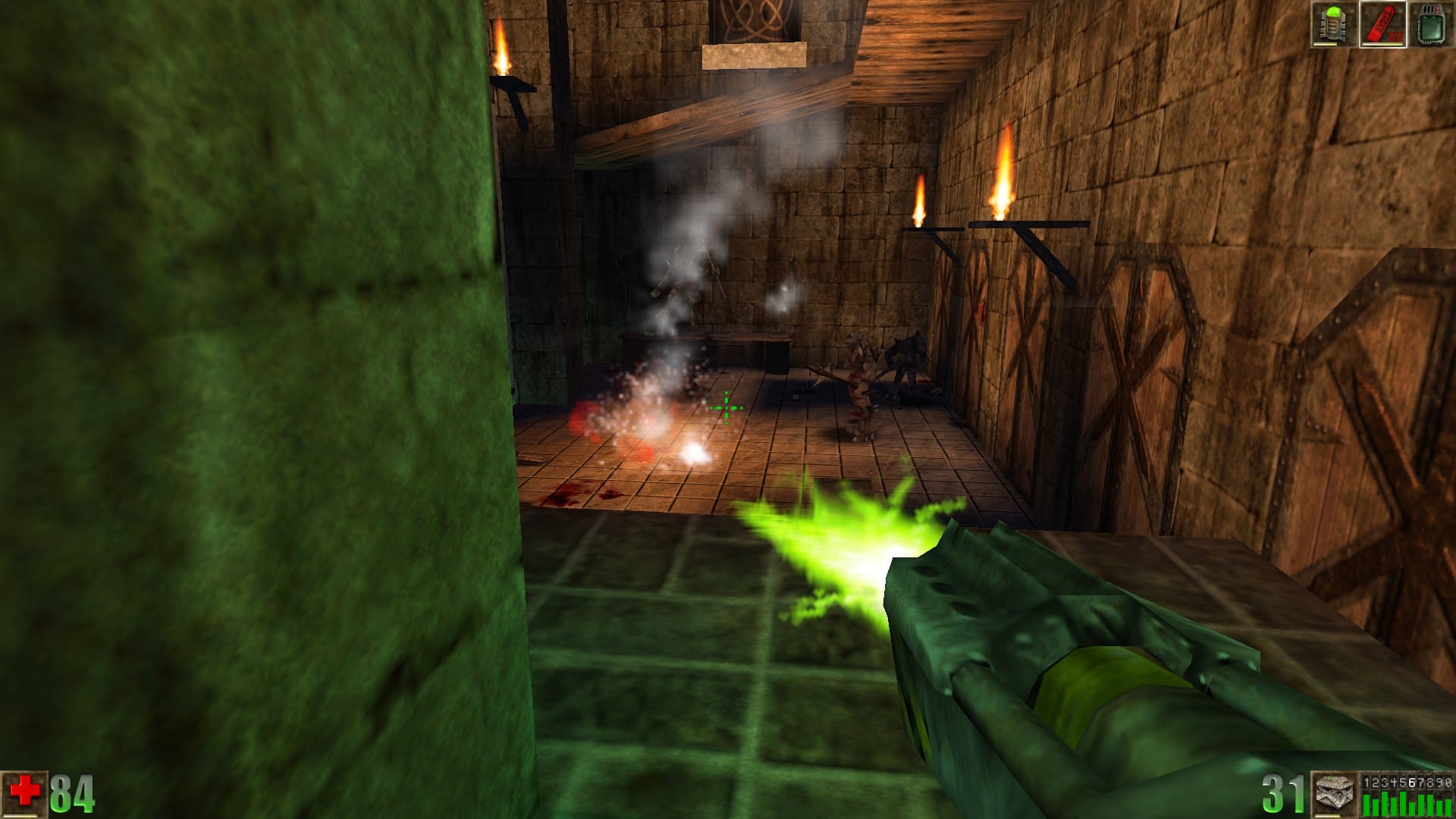
In the several years I’ve been writing about retro FPSes on this blog, I’ve covered some of the biggest. Doom WADs. Quake mods. Half-Life mods. But there’s one particular game franchise that I haven’t really tackled in written form. One that was an absolute technical marvel when it was released in May 1998. One that would spawn a franchise, an engine, and cement the legacy of two game companies. I’m gonna talk about Unreal.
Developed by Digital Extremes and Epic Games – then known as the superior-sounding Epic MegaGames – Unreal would end up being a critical darling, commercially successful, and a good incentive to get a 3D graphics accelerator card for your computer, just when those were starting to take off.
The two companies had worked together on the popular Epic Pinball, and wanted to make a shooter that could shun the term “Doom clone” to utter irrelevance. It went through several years of development, at one point intending to be released in late 1997 to compete against id Software’s Quake II, but eventually released in May 1998: After the Q2 zeitgeist, but before the freight train that was Half-Life would change things in the FPS space forever. Even then, Unreal ended up leaving a massive impact on the gaming world.
For this article, I played the OldUnreal patched version of Unreal Gold, a re-release of the game in 2000 which comes with the original game as well as the Return to Na Pali expansion pack. There might be slight differences between original Unreal and Unreal Gold, but I imagine they’re merely cosmetic.
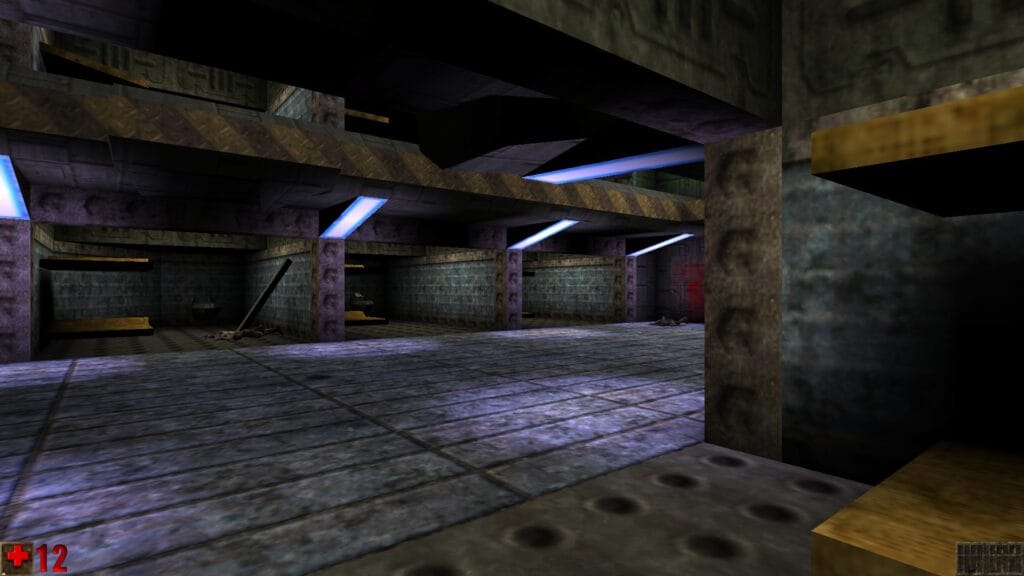
You play as a nameless soldier, Prisoner 849, captured on a Skaarj alien ship called the Vortex Rikers. Suddenly the ship crashes, and you’re all alone as you escape the wreckage of the Vortex Rikers, which then opens to the world of Na Pali, a tranquil place invaded by the Skaarj. Through logs strewn about the area, the player must figure out how to stop the Skaarj’s control from Na Pali and be the savior of the imprisoned Nali race.
Prisoner 849 initially starts with no weapons, but acquires a Dispersion Pistol that can be charged for a more powerful shot and can be upgraded around the area. What made Unreal really stand out from games from around the same time was them fully embracing being kinda weird with their weapons. Yes, there’s a pistol, a sniper rifle and a chaingun like most other Doom clones of the era, but then it opts to turn the weapon selection on its head.
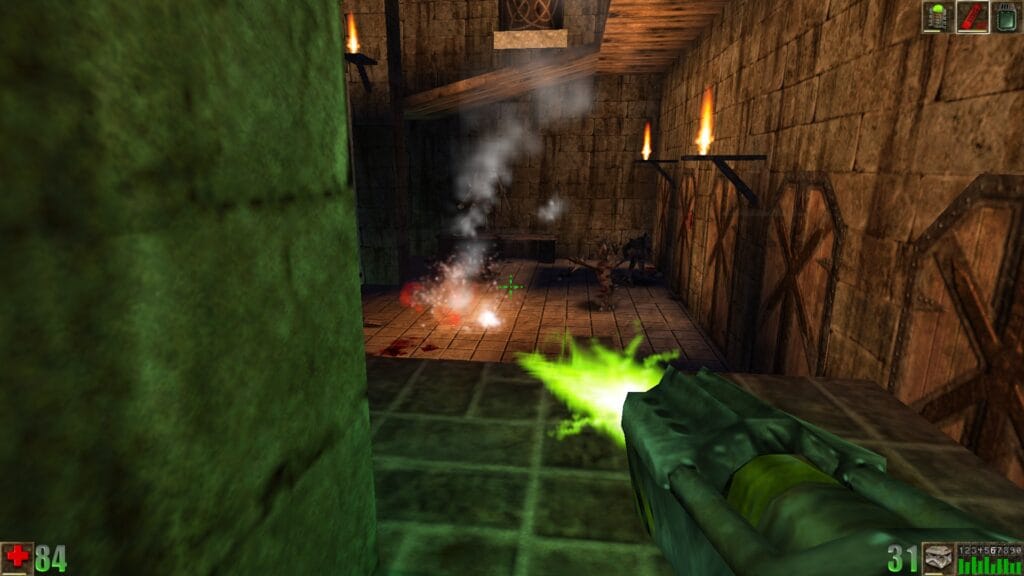
There’s the Stinger, an automatic gun that fires crystals with a shotgun blast alternate fire. The Eightball rocket launcher, where one can charge up to several shots at once, and alternate between rocket launcher and grenade launcher. Finally, there’s weapons that would later become staples of the Unreal franchise, like the ASMD rifle with it’s alternate fire ball that could be shot with the primary fire to make a massive blast, the Razorjack with its firing blades that could ricochet off walls and decapitate enemies, the GES Biorifle that shot rapid fire exploding goo, and the Flak Cannon with it’s recoiling flak shells that could also double as a portable mortar launcher of flak.
This makes the game really stand out from other games of the era, as it was trying to really get weird with it in a way most games weren’t. Weapons like the Flak Cannon are just outright fun to use, and the weapon variety makes it stand out for that reason.
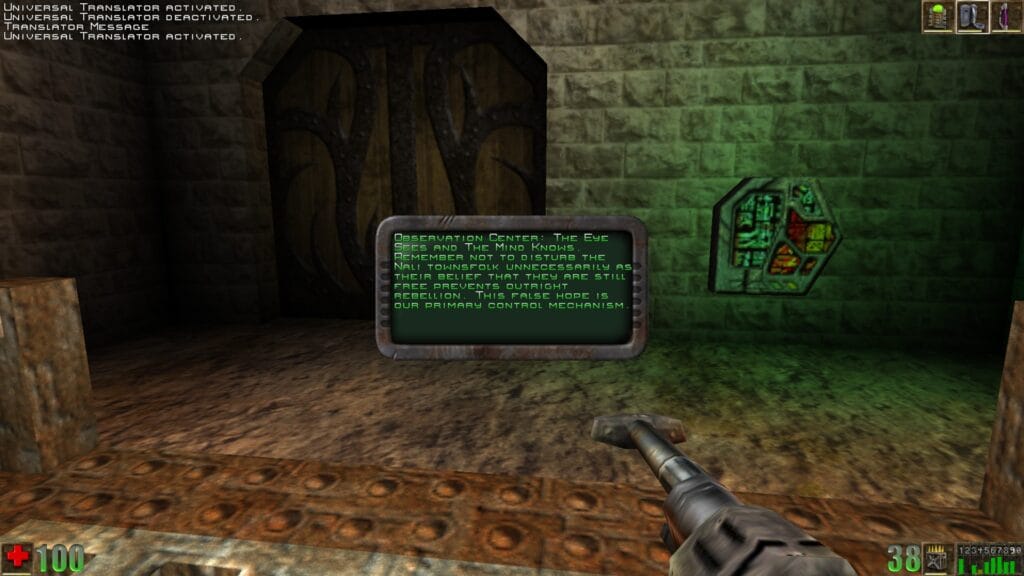
As a way to expand the story, they put all these books and notes that the player can find and read using a Universal Translator (F2 key), and it was pretty neat to put all this lore and incidental bits to make the game feel more alive. Feels more like an adventure game in that regard. The Nali people will occasionally help if saved from an enemy, leading the player often to some goodies like health and armor. It’s small touches like that that makes it feel a little more than a bog-standard shooter, something Half-Life would expand upon and several other games would follow.
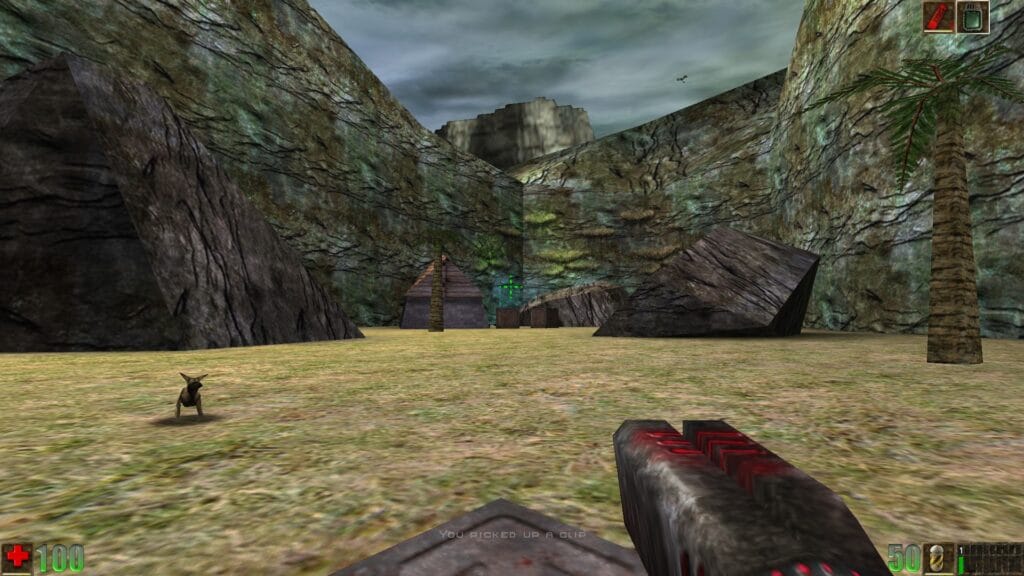
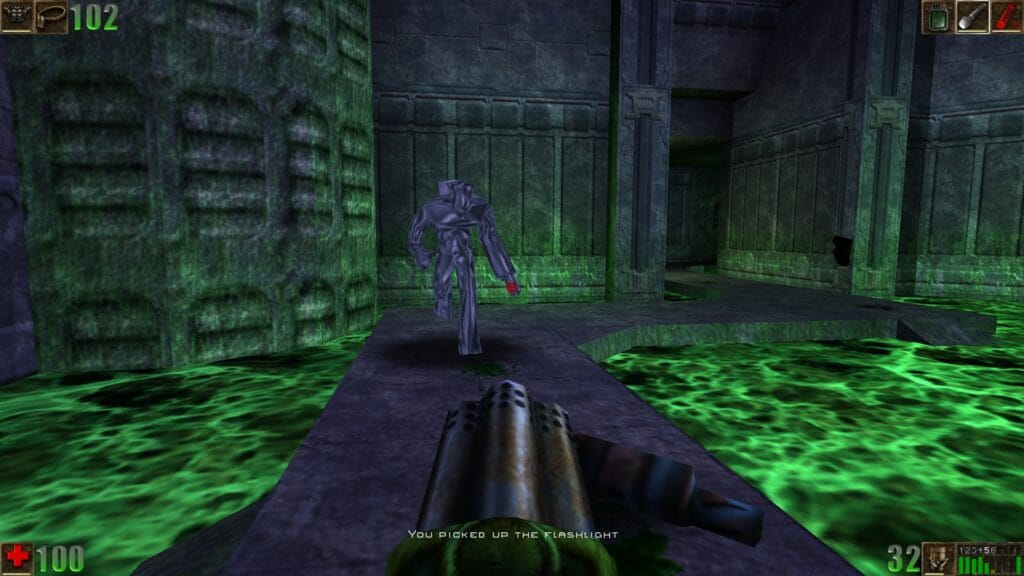
One of the big things everyone will probably notice is the absolute scale of the levels. Most shooters of the era never really had large, open maps to traverse, primarily because of hardware limitations. But the Unreal engine that powers Unreal showed how god damn impressive it was. Imagine stepping out of the Vortex Rikers and just seeing the absolute vistas of the world. It was really breathtaking in 1998, even though it can be a slog to travel through at times. The large maps do come with a tradeoff: enemy encounters are spread out and with more one-on-one fights. You would think this is a good thing, having to only fight about 2-3 monsters at a time compared to other games at the time which throw absolute hordes at the player to fight, but it really isn’t.
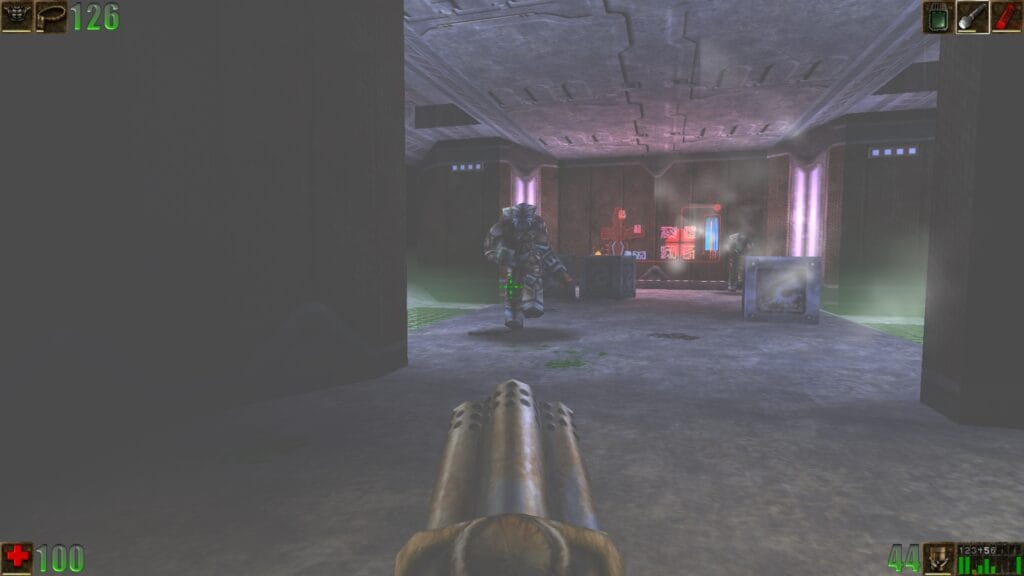
For me, one of the biggest frustrations with Unreal’s combat is how enemies are extremely spongy, even on Medium difficulty. A good chunk of my ammo was spent on taking a single foe down, who will often dodge attacks and act like a human player in a game of deathmatch. It feels like they take one more flak shell, one more rocket, 50 more bullets than they should, so combat sequences feel less exciting and become more tedious as I progressed through the campaign. Especially as the game starts having combat arenas where all the enemies in that area must be defeated to make progress. It just slows the game down to a halt, making an already frustrating experience unbearable. I could play it on easy difficulty, which is called “Tourist Mode,” but then it feels a bit too easy. The sense of balance is what ruins an otherwise fun game.
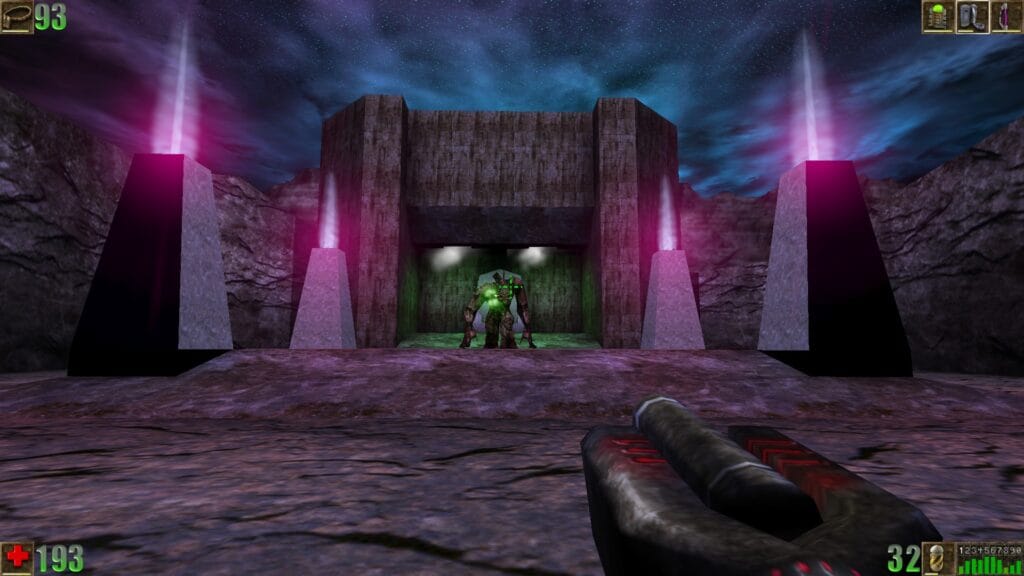
It’s worse once Titans come into the picture. These are large foes that will slowly lumber towards the player and throw rocks that can obliterate a full health, full shield player in a single hit. They’re annoying bastards, and they were always priority one whenever I had to fight one, even with other enemies around. Granted, with how large and slow they are, they could often be avoided entirely, but I didn’t wanna risk the chance of a stray rock hitting me from behind.
While I may sour on the combat, the rest of the game does do stuff that wasn’t common in shooters at the time. There’s a dodge function which requires a double tap in a specific direction, which can be useful but often was something I did by complete accident due to my constant use of stutter-strafing in combat. Hell, this is one of the games that in the manual started telling PC players that using the mouse alongside keyboard controls was the way to go for first-person shooters, and I have to give them credit for that, even if other games supported it before Unreal did.
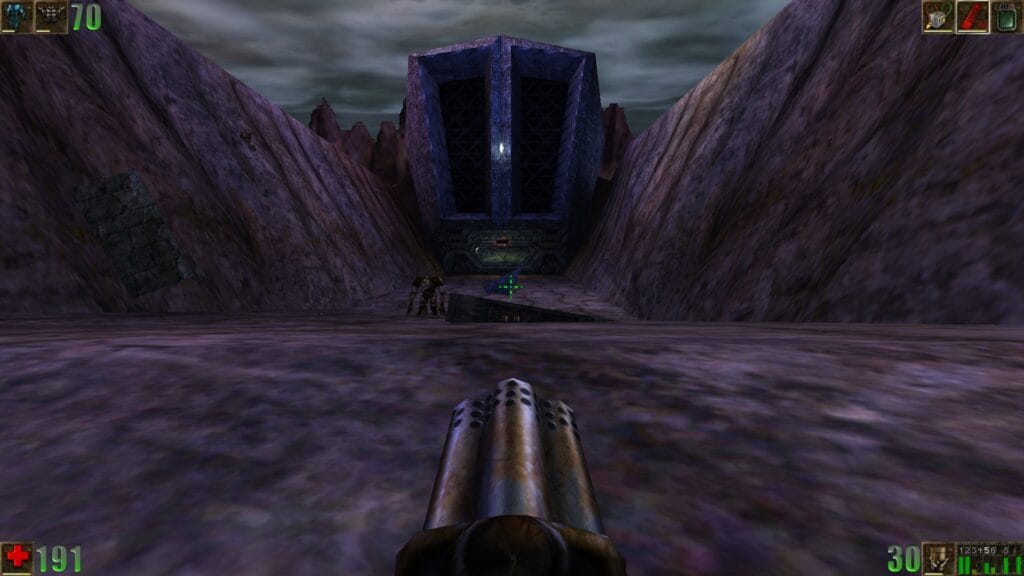
Unreal was very much a technical marvel, with colored lighting, particle effects, the works. This game was definitely a looker, and probably was a good reason for people to upgrade their PCs. I was looking at magazine and website articles about the game around 1996-98, which had people gushing how much of a technical powerhouse of a game it was. I wonder if Unreal was the 1998 version of “But can it run Crysis?”, where that game was used as a benchmark for new computers.
Oh yeah, I gotta talk about the music. Taking a page from their past published works like Epic Pinball, the game uses a dynamic soundtrack format that’s similar to MOD tracker files for PC games. Basically MIDI but with its own instruments. Alexander Brandon and Michiel van den Bos (along with contributors Andrew Sega and Dan Gardopee) made an outstanding soundtrack that fit the otherworldly vibes the game itself was going for. Often times I listen to background music when writing articles, and I’ve used the Unreal soundtrack a few times for that purpose. It’s great stuff! Worth listening to even if you’ve never played the game, it’s that good.
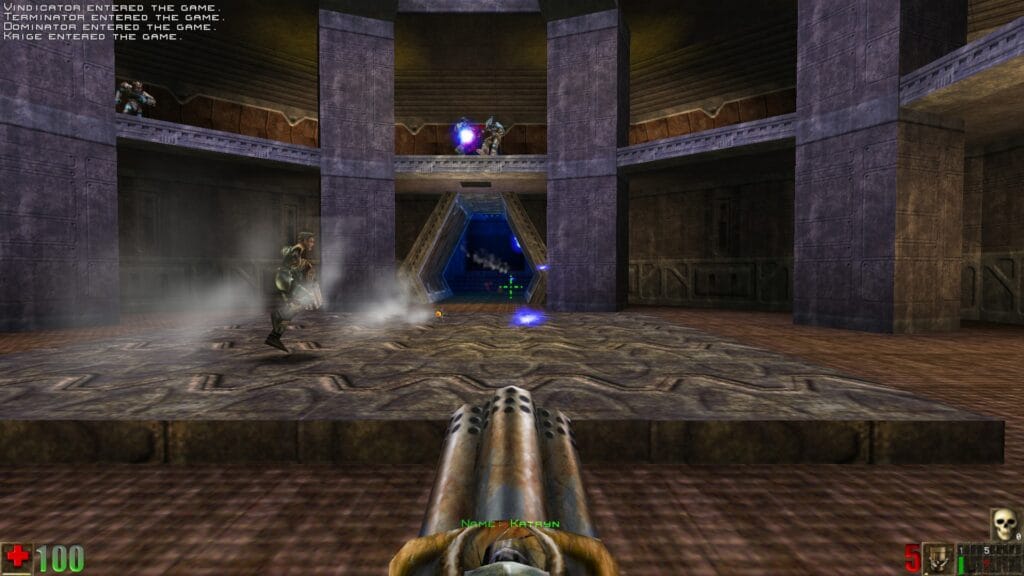
While I’ve been mostly talking about the single player, there was another important aspect of Unreal that I think is where the legacy of that franchise really came from: The multiplayer. It’s mostly your standard deathmatch, capture the flag and co-op campaign modes, which is expected for a game from 1998, but it’s fun all the same.
While the multiplayer in Unreal Gold is mostly dead nowadays, Epic rightfully made matches with computer bots available in addition to standard multiplayer, since they hired Steven Polge, creator of the Reaper Bot for Quake. After playing a bit of it with bots, I had an absolute blast. The gameplay just fits better for that fast frenetic combat when you’re fragging enemies and not trying to solve complex puzzles. It’s no wonder they pivoted to making Unreal Tournament the following year, because they knew that people were fragging to their hearts content and was the real highlight beyond the pretty single player.
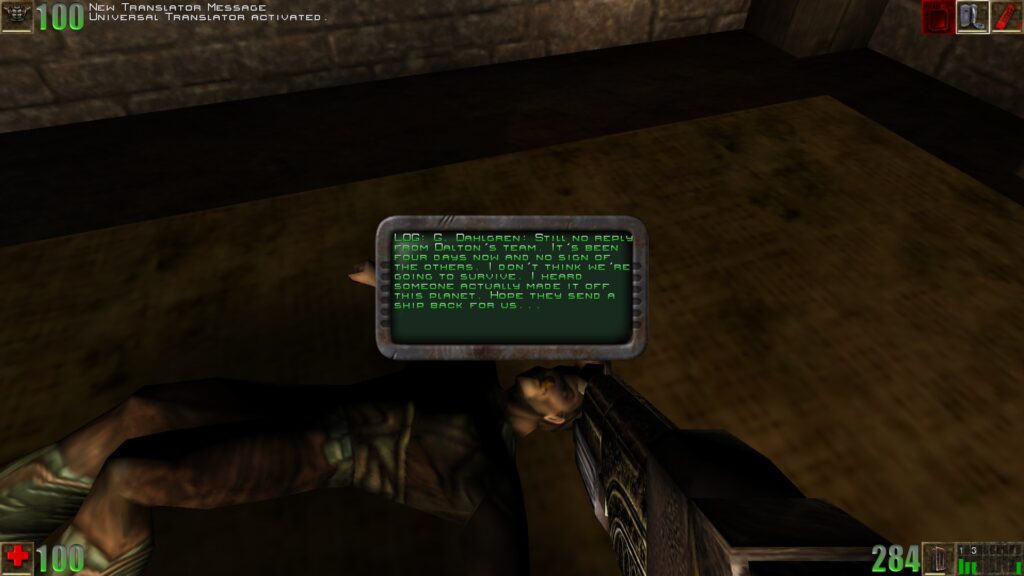
Eventually the success of Unreal would lead to an expansion pack. Called Mission Pack 1: Return to Na Pali, this was mostly handled by a different studio. I played a little bit of it, and one of the big differences was adding more conventional cutscenes and boring assault rifles alongside the game’s regular arsenal. I’ve heard less positive things about the expansion, and while I’ll probably play it in its entirety at some point, I figured the length of Unreal was enough to sate my retro FPS kick for the time being.
Even with Unreal Tournament becoming a big success, the main series wasn’t completely ignored after Return to Na Pali. There’s a sequel eventually made by those same folks who made Return to Na Pali called Unreal II: The Awakening, but from my past experiences of playing the demo in a PC Gamer magazine demo disc, it’s definitely a downgrade from the original game. I found more enjoyment with the demo for Devastation on that same demo disc than I did for Unreal II.
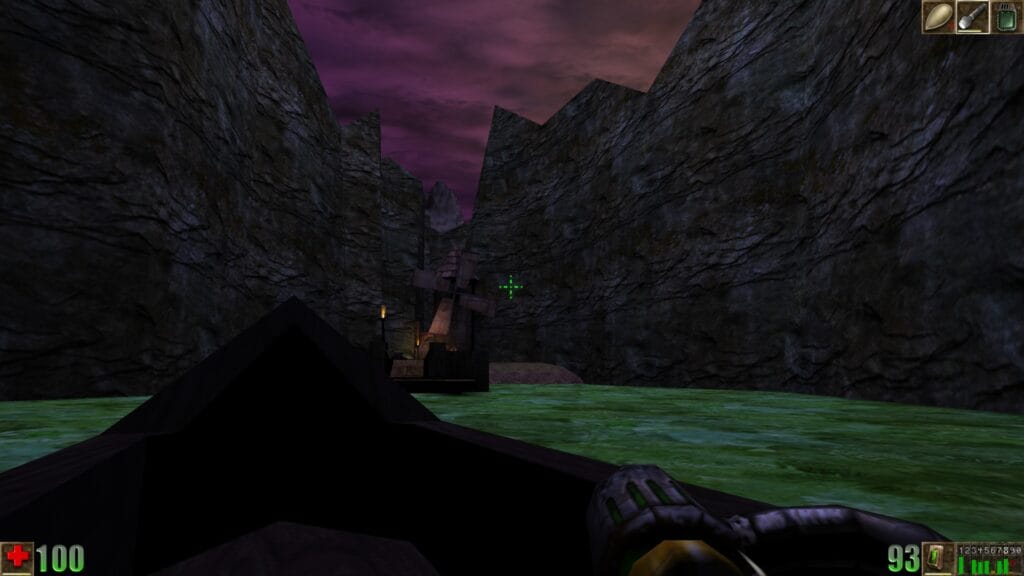
Looking back, I see Unreal as a “historically significant” video game, where the game itself doesn’t fully stand the test of time, but is a rather important game for what it did for the industry at large. What it did in terms of its technology, especially for what passed for PC gaming in 1998, was a technical marvel. The multiplayer likely kickstarted a brief trend of arena shooters in the late 90s. And of course, Epic going from being just a bunch of dudes like Cliff “CliffyB” Bleszinski making video games for funsies to an absolute game developer powerhouse. It may not be outstanding compared to its competitor’s works like Quake or Half-Life, but Unreal is still an important game regardless. Even with my gripes with the combat, I still recommend playing it, if only to see what computer games were doing in 1998 technology-wise.
In spite of having gorgeous 3D rendered graphics, powerful technology, a nice immersive world, and an amazing soundtrack,Unreal’s gameplay itself is just frustrating. I can knock some of id Software’s work like Quake for being low on story, but its gameplay makes up for it. With Unreal, it felt like I was fighting annoying bots on a multiplayer match except in single player. Even with its unique arsenal, it became a slog to play by the late game, and the bosses boiled down to the classic “PROTIP: Shoot at it until it dies” meme. It’s arguably the weakest element of the whole game, and no amount of pretty colored lighting can forgive it. I’m a gameplay gal by nature, and Unreal’s single player gameplay is frustrating at times. Thank god the multiplayer makes up for it.
It’s a shame how Epic Games have become just the House of Fortnite now. They have shunned their past and pretend Unreal doesn’t really exist. They’ll mention the franchise in passing and still refer to their game engine as the “Unreal Engine,” but rarely if ever acknowledge the franchise beyond that. They put Unreal in their version of the Disney Vault, except they’re never gonna be unearthed again any time soon. It’s not just Unreal, either: Studios acquired by Epic Games had their past games delisted off digital storefronts for no apparent reason, because acknowledging anything beyond their golden goose is considered shameful to them.
At least Digital Extremes came out unscathed. While they continued to work with Epic on future Unreal titles, they’d often bounce between contract work and original franchises, making games like Pariah, Dark Sector, that Star Trek game based on the JJ Abrams films, before creating Warframe in 2013, which they’ve been working on ever since. Probably a better outcome, honestly.
While I wouldn’t say I’m clamoring for a new Unreal game in 2026, the way Epic has treated Unreal is disgraceful. Night Dive Studios, the king of first-person shooter remasters, wanted to remaster Unreal and heard nothing back from Epic. Hell, with the original iteration of Unreal Engine being nearly 30 years old now, you think they’d at least make that open source for anyone to use and modify. I’ve been interested by recent games like MeowGun: Hell Denizen and BRAZILIAN DRUG DEALER 3: I OPENED A PORTAL TO HELL IN THE FAVELA TRYING TO REVIVE MIT AIA I NEED TO CLOSE IT, as both games that use an open source version of id Software’s Quake engine as a base. And I can’t forget the countless other games that use GZDoom/UZDoom as a base, like Selaco. Think of all the silly boomer shooters we could get using Unreal Engine 1 tech! That’s a missed opportunity right there. I blame Timothy Sweeney.
Thankfully, even with Epic removing Unreal Gold and other past games from digital storefronts, the community has come to the rescue. With the permission of Epic themselves, OldUnreal have put up a version of Unreal Gold to play freely, since the game is ostensibly abandonware now. The best part is that it works perfectly on modern systems, and even handles proper HUD scaling on higher resolutions. Even though the campaign may seem dated, the multiplayer’s still fun to play, even with bots. They also put up full installs for Unreal Tournament and Unreal Tournament 2004. It’s the way to play these games nowadays, surely.
Now that I’ve talked about Unreal, I’ve hit most of the notable retro FPSes that defined the genre. Talking about an iconic first-person shooter that I finally completed in 2026 feels pretty good in spite of my gripes with it. It’s important to always look back at stuff like this, just to see how far we’ve gone in the first-person shooter genre. Now I’m trying to figure out which old-school FPS from the 90s and 2000s I haven’t played yet…
This was available on Patreon a few days early. If you like what you see and want to support my work, I encourage following and/or pledging to my Patreon. You don’t even have to fight any Skaarj! Just $1 will get the chance to these articles in advance. Otherwise, sharing and commenting on this helps me out too. 🙂


Leave a Reply