Tag: rail shooter

  • Reload: Target shooting but without actually firing guns.

    Reload: Target shooting but without actually firing guns.

    The first-person shooter in the 90s was still a new thing for gaming. Called “Doom clones” for several years before the current nomenclature took hold, these kind of games were often seen as violent and filled with gore, primarily made for adults, with very few kid-friendly versions of the genre readily available. Then again, it was mostly cartoon violence, but you try telling old decrepit senators like Joseph Lieberman that.

    But then in 1997, Sunstorm Interactive, a developer of expansions for games like Duke Nukem 3D and Shadow Warrior, and publisher WizardWorks released Deer Hunter, a first-person hunting game. Still violent, but it’s hunting! People in the US of A love hunting, and that’s an untapped market!

    Cue several different hunting and shooting games by a myriad of companies, including the scores of Cabela’s video games by Activision Value. But it wasn’t just hunting games. Hunting is basically shooting on an open range, and target ranges are popular, so why not games based on that?
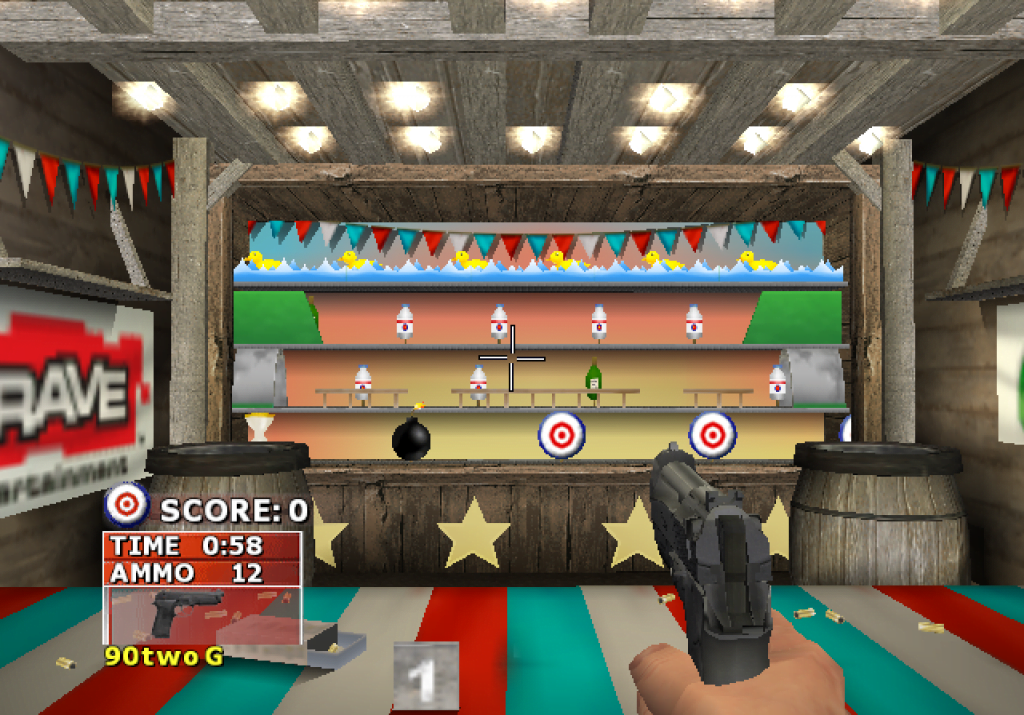
    A screenshot of NRA: Gun Club. Look at this riveting gameplay!

    There’s a handful of those too, including the infamous NRA Gun Club, a game I wrote about many years ago. In a sense, the game I’m talking about today is basically the spiritual successor to NRA Gun Club in more ways than one, and likely was made to cater to that same niche market that Deer Hunter did all those years ago. Except now it’s a bit more of a crowded market…
    That’s one chunky smartphone.

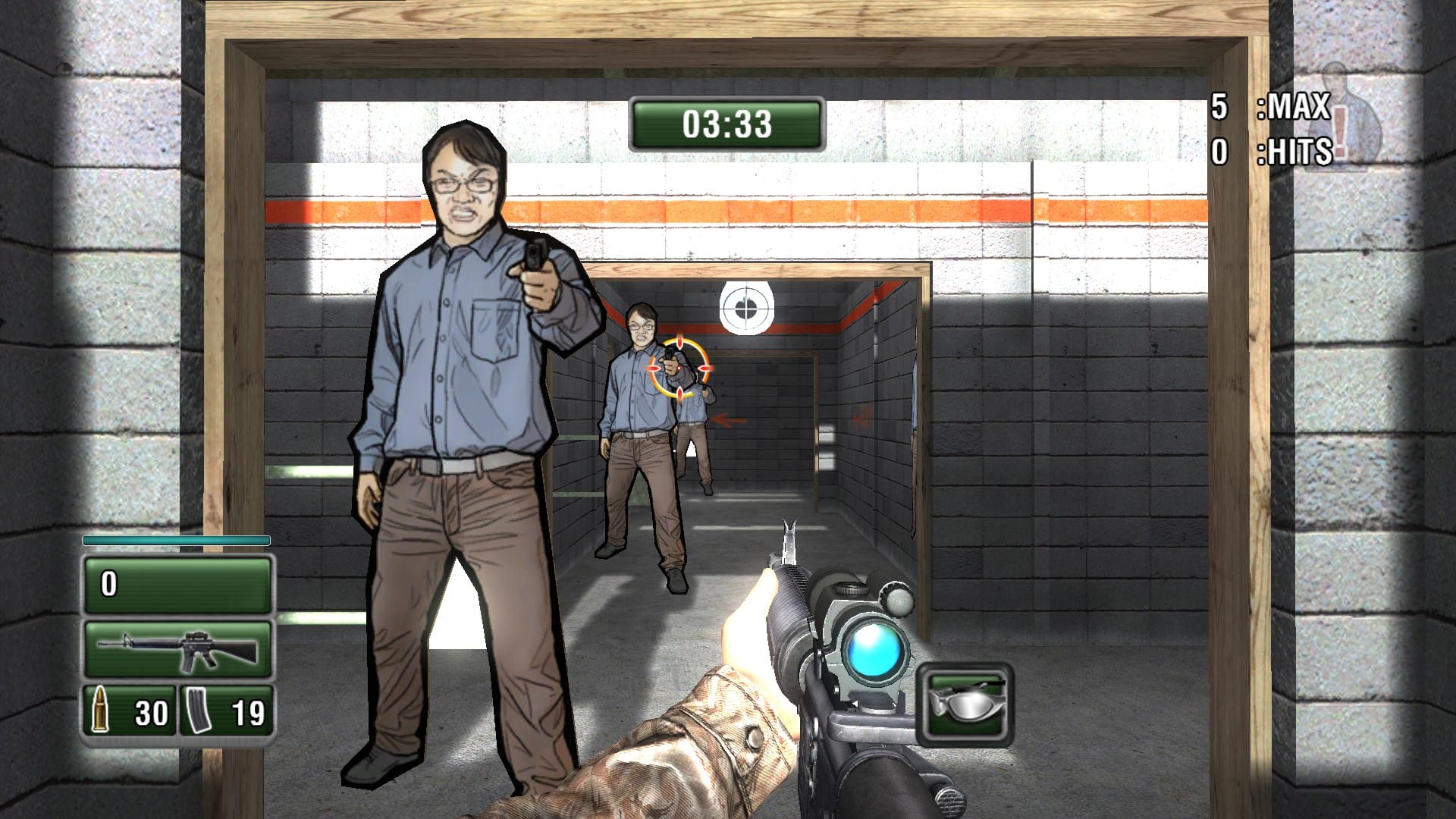
    Reload, also called Reload: Outdoor Action in some regions, is a lightgun rail shooter. Yet another game that’s hard to find info on the web, much like when I wrote about Legendary. Reload was published by Mastiff, a brand mostly known for making shovelware fare during the late 2000s to early 2010s, like the Heavy Fire series among many other games. The developer on the other hand, Top3Line, is not a developer I’m familiar with, but I figure they’re yet another a dime-a-dozen bargain bin game developer. Reload came out for the Nintendo Wii, and later, bizarrely, on PC. For this article, I’m playing the PC version through Steam. I can’t imagine the Wii version being any different except looking a bit worse and a bit more Wii remote waggle.
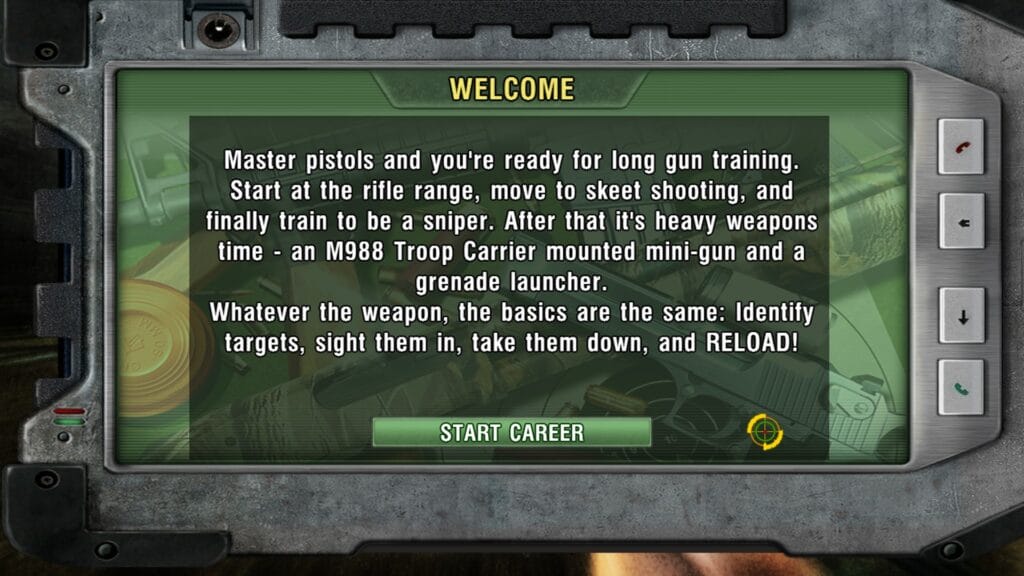
    “Welcome to Reload, here’s what you’re in for.” Pretty basic.

    There isn’t much of a story to Reload. Your player character goes to various target ranges with many different types of firearms, with a goal at each mission: Get a certain amount of points, avoid harming too many civilians, that kind of stuff. Fulfill the mission requirements and we’ll move on to the next stage with different requirements than the last. Lather, rinse, repeat.
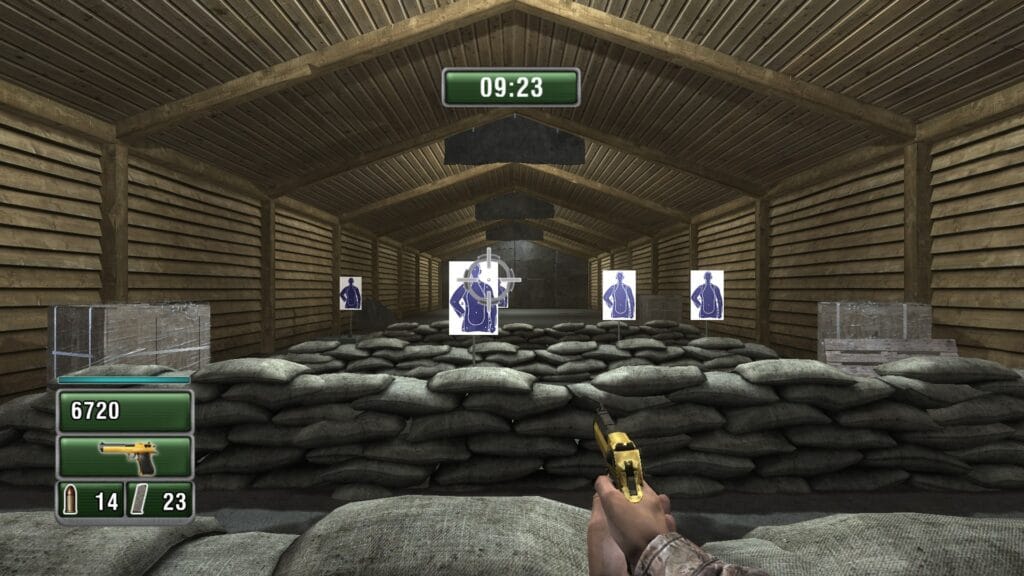
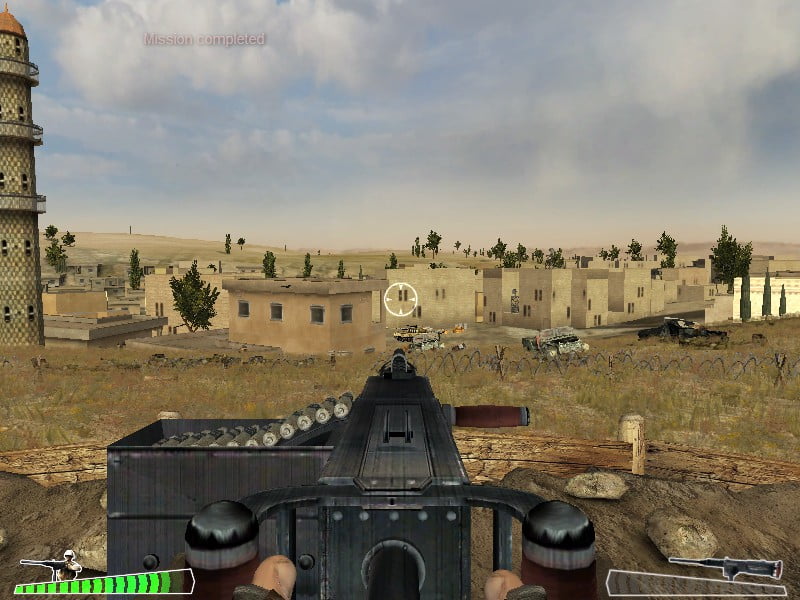
    Well, it’s doing what it says on the tin, that’s for sure.
    (more…)
  • Terrorist Takedown: More like Stereotype Shooter.

    Terrorist Takedown: More like Stereotype Shooter.

    (content warning: Depictions of violence and war within.)

    In 2021, it was announced that the previously canceled game Six Days in Fallujah was being brought back. With some of the original development team handling development, it naturally got a lot of backlash now just as it did back in 2009: by glorifying a specific military conflict as a good thing, and feeding into middle eastern stereotypes of them being nothing but terrorists. So much so that the Council of American-Islamic Relations (CAIR) asked for major publishers to drop support for the game. It will likely come out to poor reception, if it actually comes out this time.

    A promotional screenshot from the original 2009 version of Six Days in Fallujah. Sure looks generic until you find out the game’s backstory.

    Seeing this made me think a lot about the glut of military games made in a post-9/11 world. While war games existed before that tragedy – Novalogic’s Delta Force franchise was modestly popular around the late 1990s – they ballooned to being rather ubiquitous once the War on Terror started. We got games like SOCOM, Conflict, lots of Tom Clancy stuff, even Battlefield dipped its toes into modern warfare. There were so many that actual US military organizations started getting involved, with games like as America’s Army and PRISM: Guard Shield. Nowadays, the only franchise from that period still around making similar war games is Call of Duty, but that might be considered a stretch by some.

    Why all this preamble? It’s so I can talk about one of those games made by a budget label that cashed in on the War on Terror, and is a bad game, not just on a technical level, but a moral one as well. One game I’ve had for several years, going back to 2013, and this has lately been a year of looking back, so let’s travel to 2003 and look at one of the more bad games.

    This article was originally up on Patreon one week early. If you wish to see this article before everyone else, you can pledge to my Patreon here. Just a buck will get you a chance to see this stuff early.

    Yeah, this cover looks incredibly generic alright.

    Terrorist Takedown is the first installment in a franchise made to capitalize on the war on terror. Developed by Polish developer City Interactive, this would be one of their early breakout hits. Nowadays they’re known as simply CI Games, but their overall message has been consistent: Make games based on war conflicts old and new, and sell them in bargain bins everywhere. For Terrorist Takedown however, City Interactive didn’t have much of a presence outside of Europe, so another budget publisher, Merscom, handled the release here in the United States. Merscom even touted that some of the profits of the game would be donated to the Special Operations Warrior Foundation, which I think is a conflict considering this game’s premise.

    Probably the blandest menu screen I’ve ever seen.

    There is no story to Terrorist Takedown. You play a bunch of no-name, faceless soldiers as you’re sent from one conflict zone to the next, taking down terrorists left and right by any means necessary. The “Terrorists” in this case are generic middle-eastern soldiers presumably meant to stand in for Al-Qaeda insurgents, but it’s kinda hard to tell in this game.

    Charlie Don’t Surf this ain’t.

    The missions themselves are rather varied: The first mission has you in a helicopter gunship mowing down anti-air emplacements and random soldiers. The second mission has you protect a convoy from enemy soldiers and RPGs. Each mission is similar in structure: Survive a conflict of terrorists while protecting objectives and not dying. At least it spices things up a bit, from using machine gun turrets to flying a helicopter, to controlling a targeting reticle on a surface-to-air-missile.

    (more…)
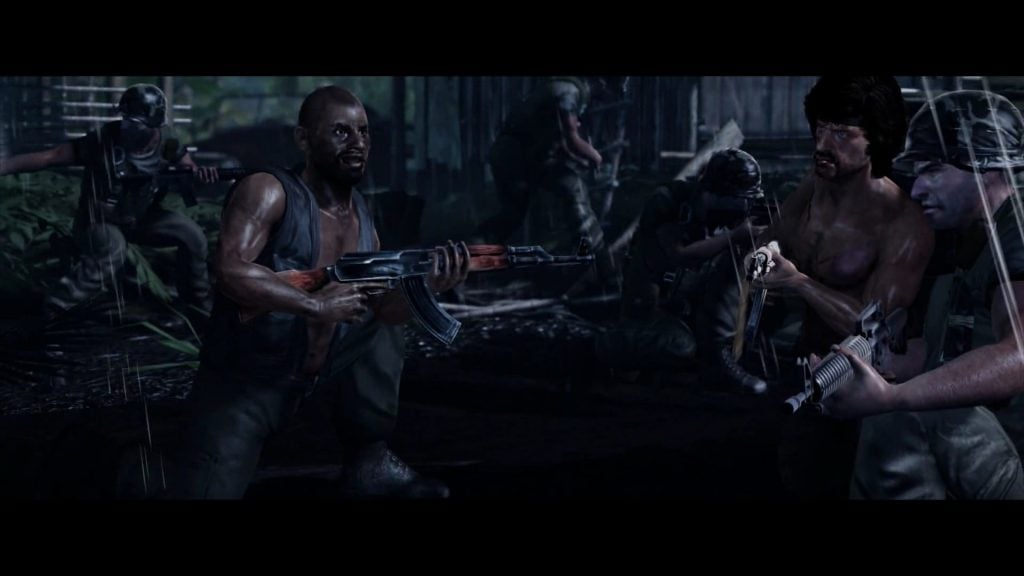
  • Rambo: The Video Game: Torque bow sold separately.

    Rambo: The Video Game: Torque bow sold separately.

    The Rambo series of films are an interesting timepiece. The first film, aptly titled First Blood, features Sylvester Stallone as Vietnam war veteran John Rambo being chased from some irate cops in a small Washington town, and is more of an action-driven thriller. However, Rambo: First Blood Part II and Rambo III are definitely action movies in the simplest sense, something that could really only be made in the Reagan-dominated 1980s.

    They’re cheesy as all hell, and a little bit unsettling these days – especially the more recent entries, John Rambo and Rambo: Last Blood – but I can appreciate their relevance in pop culture all the same.

    Over the years there’s been a handful of Rambo video games, mostly of average quality. One of the more well-known ones was Pack-in-Video’s Rambo game on the NES that was a knockoff of Zelda II: The Adventure of Link, and many of Sega’s games throughout the ’80s. After Rambo III, there weren’t any games featuring that M60-wielding muscle man, unlike similar action films like Robocop that got games years after the films were relevant. Cut to 2014, several years after the fourth film, and at a time when the franchise couldn’t be any less relevant, and somehow we got… this.

    “I’m sorry they sent you to such a hellhole, John.”
    “I’ve seen worse.”

    Rambo: The Video Game is the most recent attempt to make the action movie series into a video game. With so many years between the last major Rambo game, you’d think we get a really solid adaptation of the film series, right? Wrong. Developer Teyon and publisher Reef Entertainment brought this out to critically negative reviews, from gamers and fans of the films alike.

    So, what’s the genre they opted to go for? First-person shooter, right? Perhaps a third-person cover shooter? The answer to that is neither: It’s a light gun game. Considering Teyon’s pedigree – they made a majority of the Heavy Fire series of light gun games – it seems fitting, but also very limiting.

    “Let’s commemorate this man by being glad the bastard’s gone, that’ll show him.”

    So how does the game piece the story together? Well, our game begins with a cutscene of a military colonel talking about John Rambo at his funeral, retelling his stories of war, while satisfied the man’s dead.

    This is amazingly inaccurate it hurts. Not only does Rambo live after the events of these films, it just comes off as incredibly comical and not at all powerful or emotional. I honestly thought this was a reference to a small scene in one of the films, but nope, this was made specifically for the game. I don’t know why they opted to tell the story this way, but it’s really really dumb.

    For a game released in 2014, this looks… pretty bad.

    After that, we’re thrown into a cutscene that takes place before the events of First Blood, featuring Rambo (with digital Stallone sporting a mustache just as ugly as he did in that movie) escaping from a camp. Then the game begins, in all its light gun glory.

    Now’s not a time to reload, Rambo!
    (more…)